L.7Part. N. 8000 H1344 (10-2009)
BRAKES
Front braking system bleeding (SMR)
The braking system must be bleed when, due to air in the circuit, the lever stroke
is long and spongy.
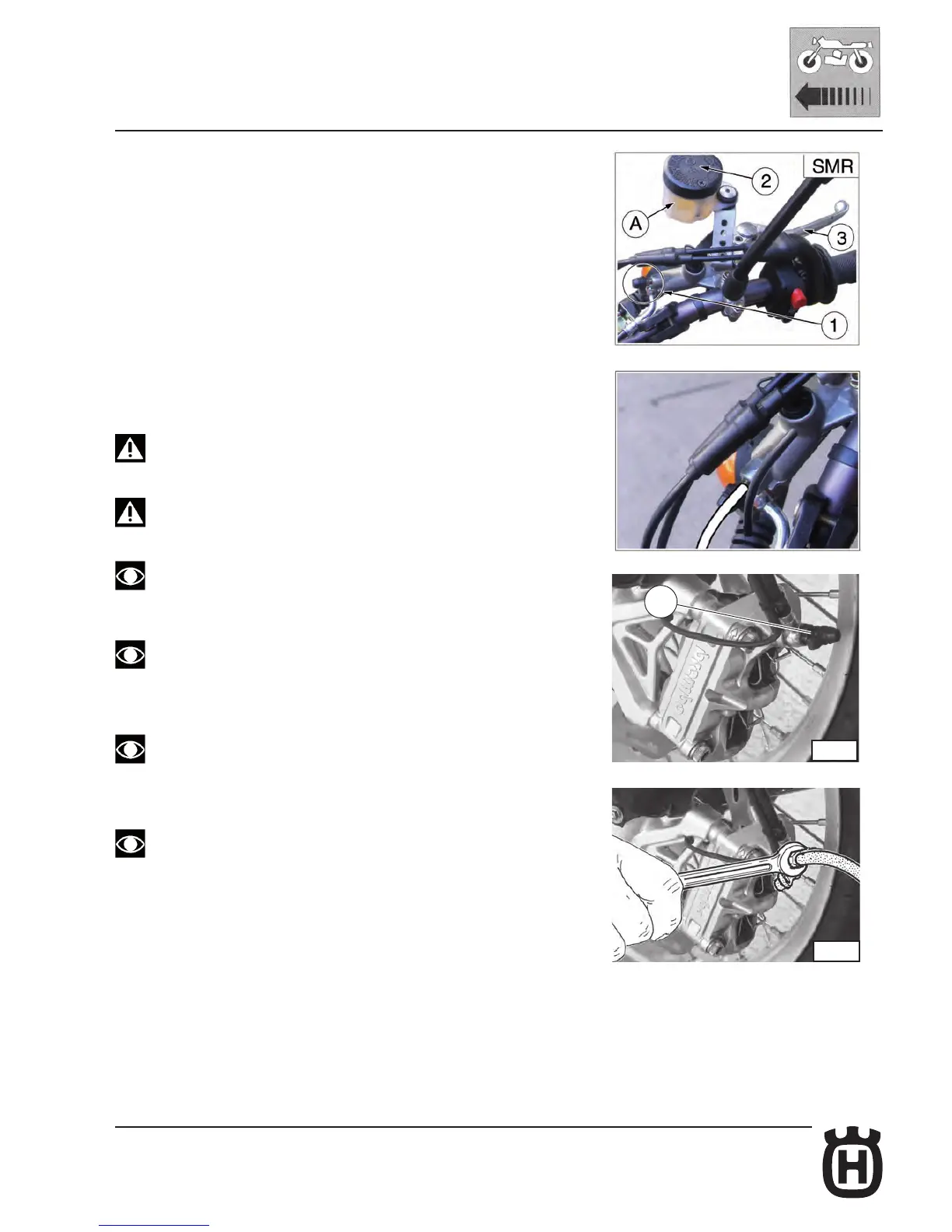
Regarding the front braking system, rst proceed to bleed the upper braking
system control (bleeding valve 1), then the brake caliper (bleeding valve 1A).
In both cases, proceed as follows:
- Remove the rubber cap on the bleeding valve (1) or (1A).
- Attach a clear plastic hose to the bleeding valve on the brake caliper and turn
the other end of the hose into a container (make sure that the end of the hose
is submerged in brake uid during the entire bleeding operation).
- Remove uid reservoir cap (2), the rubber and ll the reservoir with fresh brake
uid.
- Open the bleeding valve and pump with brake lever (3) several times until the
uid, clear and without bubbles, comes out of the hose: now close the bleeding
valve.
- Restore the brake uid level (A) then reassemble the rubber and the uid
reservoir cap (2).
During the bleed operation the uid level inside the reservoir must
never be lower than the minimum level.
As the braking uid is a very corrosive substance, in the case it comes
in contact with your eyes wash them abundantly with water.
During the bleeding of the braking circuit keep the handlebar turned
leftwards. This is the way to lift pump tank and to make easier the bleeding
of the braking system.
As the bleeding operation does not fully eliminate the air inside the
circuit, the small quantity of air remaining inside will be eliminated after a
short time of use of the brake. In this case however, the action of the lever
will be harder and the stroke shorter.
Should the motorcycle, due to a fall during a competition or shop
repairs, show some elasticity of the brake lever stroke, with a subsequent
braking efciency decrease, you’ll to repeat the circuit bleeding as above
described.
Bleeding valve tightening torque: 12÷16 Nm/ 1,2÷1,6 Kgm/ 8.7÷11.6
ft-lb
1A
SMR
SMR





 To Next Page