OPERATION MACHINE OPERATIONS AND CONTROLS
3-179
Adjustment 3
Seat Adjustment
When adjusting the position of the operator's seat, always set the lock lever to the LOCK position to pre-
vent any accidental contact with the control levers.
q Always adjust the operator's seat before starting each operation or when the operators change shift.
q Push your back against the backrest of the operator's seat and adjust so that you can depress the brake pedal
fully. In addition, adjust the seat so that you can operate the control levers and switches freely.
q An air compressor built into the seat is used for adjustments (C), (D), and (I), so turn the engine starting switch
to the ON position before adjusting.
There is danger of damage to the air compressor, so do not keep lever (3) operated continuously for more
than 1 minute.
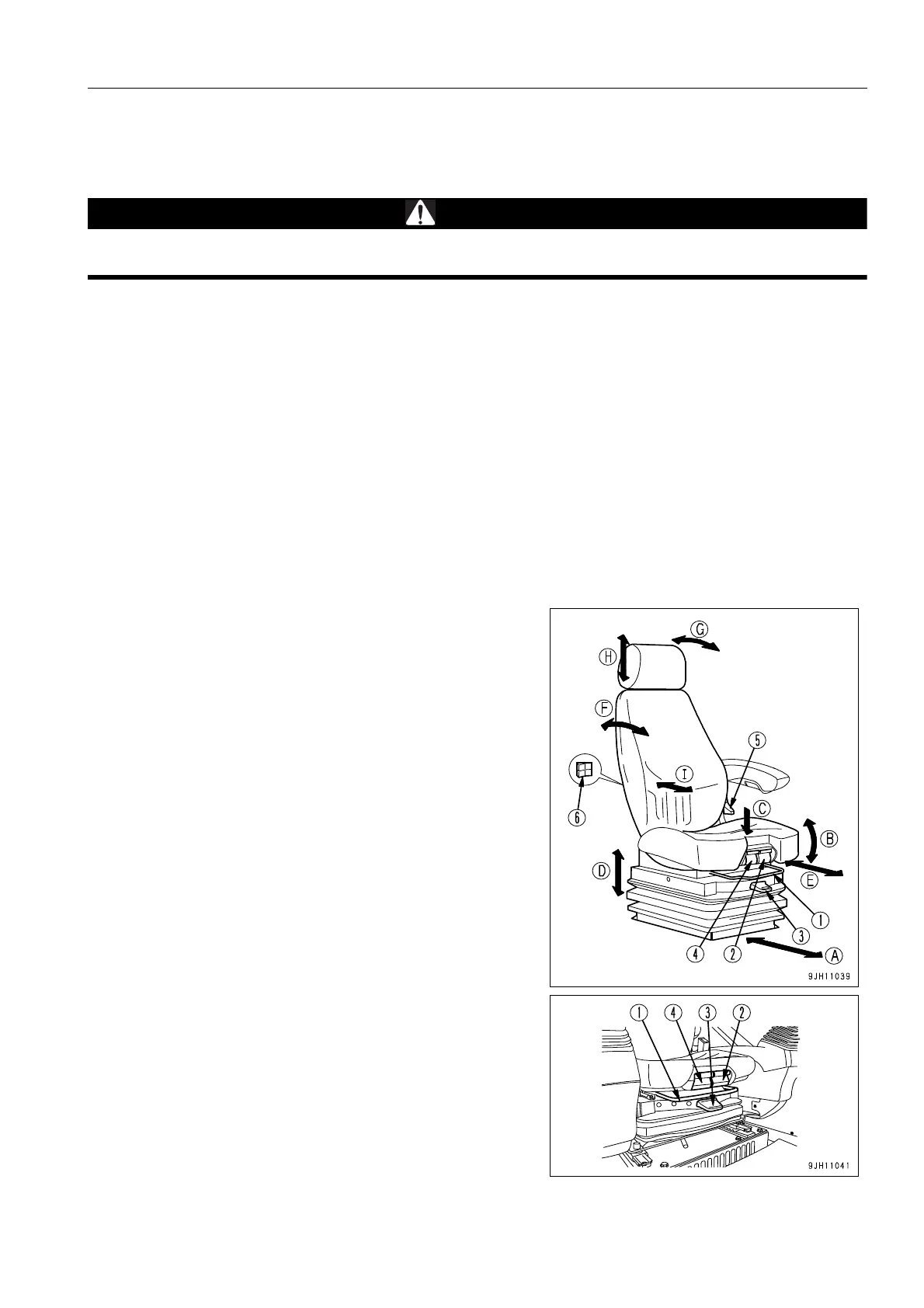
(A) Fore-and-aft adjustment
Pull lever (1) up, set the seat to the desired position, then
release the lever.
Fore-and-aft adjustment: 170 mm [10 mm x 17 stages]
(B) Adjusting seat angle
Operate lever (2) up, move the front of the seat cushion up or
down to set to the desired height, then release the lever.
Amount of adjustment : Forward tilt 3°
Rear tilt 11°
(C) Setting seat for operator's weight
Sit in the seat in the normal operating posture, pull lever (3) up
lightly until a click is felt, then release lever (3). Of the range
that can be adjusted, the lowest position is automatically
adjusted.
q If the operator raises his body from the seat or changes the
amount of weight applied to the seat during adjustment, the
air in the suspension may be discharged.
q When operators change shifts, the new operator should
push lever (3) down to release all the air in the suspension.
Then the new operator should carry out the weight adjust-
ment again.



 To Next Page