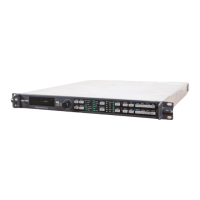
X75SD/X75HD Installation and Operation Manual 5
Chapter 1: Introduction
Audio Processing
Processing for audio includes level control, analog-to-digital and
digital-to-analog conversion, and SD-SDI and HD-SDI serial digital
signal embedding and de-embedding.
Other capabilities include the following:
• Sample rate conversions, synchronization, and timing-to-video for
correction of lip sync errors
• Embedding/de-embedding of signals such as Dolby-E™ and AC-3™
• Processing of multiple channel program signals for surround-sound
applications before or after compression
• Audio-follow-video routing
• Converting, adjusting, timing, demultiplexing, and multiplexing
Signal Control and Monitoring
You can control and monitor signals passing through the
X75HD/X75SD using a variety of methods:
• Local X75HD/X75SD control panels
• Remote X75-RCP control panels
• Web server software
• Local DPS-575 control panels
• Remote RC-575 control panels
• CCS™ software applications and QuickTime Player
Operating Modes
There are three main operational modes: Auto Detect (default mode)
M-Path (multiple path) processing, and Simulcast processing.
• The Auto Detect default mode detects any one input and processes
it to all outputs.
• M-Path selects or detects input signals to processed output signals.
The Default M-Path mode is All Output Select, for which a single
input is processed to all outputs. In Video Routing Mode, M-Path
allows for up to 4 processed paths; you choose the output first, and
then select which input is to be processed to that output.
• Simulcast operation makes it possible for you to switch any two
inputs to standard and high definition outputs.
See “Overview of Operating Modes” on page 25 for more information
on modes of operation.



 To Next Page