Procedures for Testing with the DX Host
megger.com 81
Partial Discharge Testing Overview and Preparation
Surge testing with the Baker DX includes the optional feature of partial discharge (PD) testing,
which involves detecting localized, partial bridging between conductors due to dielectric
breakdown caused by high-voltage stress that does not fully short the two conductors. These
discharges, when severe enough, can create a persistent visible glow known as corona. Less
severe breakdowns can cause smaller invisible partial discharges.
NOTE: For detailed information on partial discharge detection theory including common terminology used,
refer to the Megger Motor Testing Theory Reference Manual.
Preparing for PD Testing
Partial discharge testing relies on the accurate detection of four key metrics: partial discharge
inception voltage (PDIV), repetitive partial discharge inception voltage (RPDIV), repetitive partial
discharge extinction voltage (RPDEV), and partial discharge extinction voltage (PDEV).
The RPDIV and RPDEV voltages are determined by using data from several surge pulses and
comparing them to the current pulse. To ensure that these values are accurately detected,
voltage ramping should occur in controlled, and slowly-increasing and slowly-
decreasing steps.
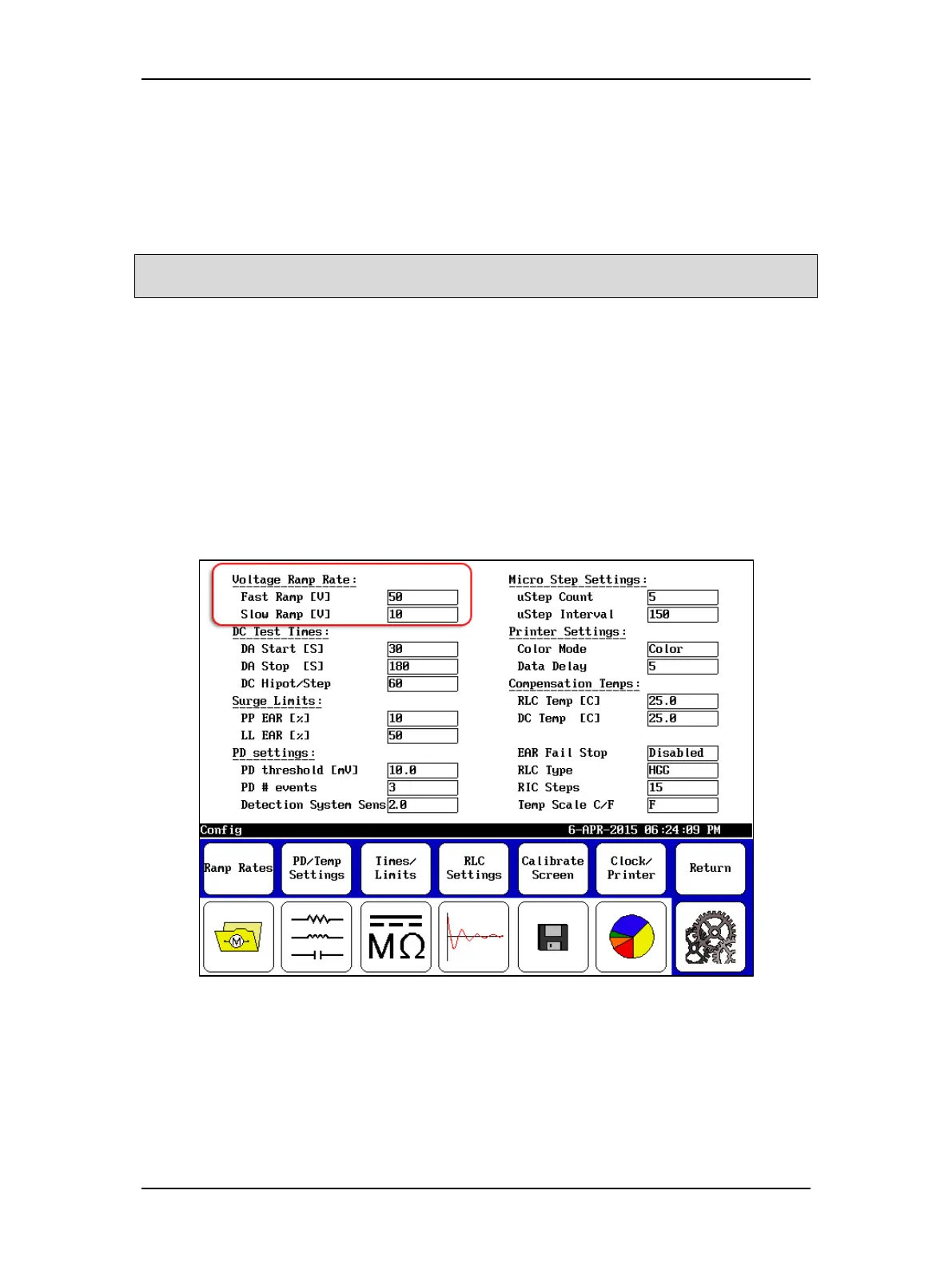
From the User Settings screen, we suggest using a fast ramp rate of no more than 50 volts and a
slow ramp rate of no more than 10 volts.
Figure 89. Setting ramp rates for PD testing.
As the voltage approaches the maximum test voltage, use the slow ramp to obtain greater
accuracy. When possible, run a test with a known good coil or stator of similar insulation and
ratings to determine a baseline noise level of the partial discharge signal. This helps you select a
threshold level that clearly indicates partial discharge activity and reduces the occurrence of false
positive readings during testing.


 To Next Page