Chapter 16 Reference
16.2 Measuring mV (oxidation-reduction potential [ORP])
220 HORIBA
16.2 Measuring mV (oxidation-reduction potential
[ORP])
● ORP principles
ORP (or Oxidation-Reduction Potentialî) is an abbreviation for oxidation-reduction potential.
ORP is the energy level (potential) determined according to the state of equilibrium between
the oxidants and reductants that coexist within a solution.
One type of equilibrium in a solution
•••••••••• ①
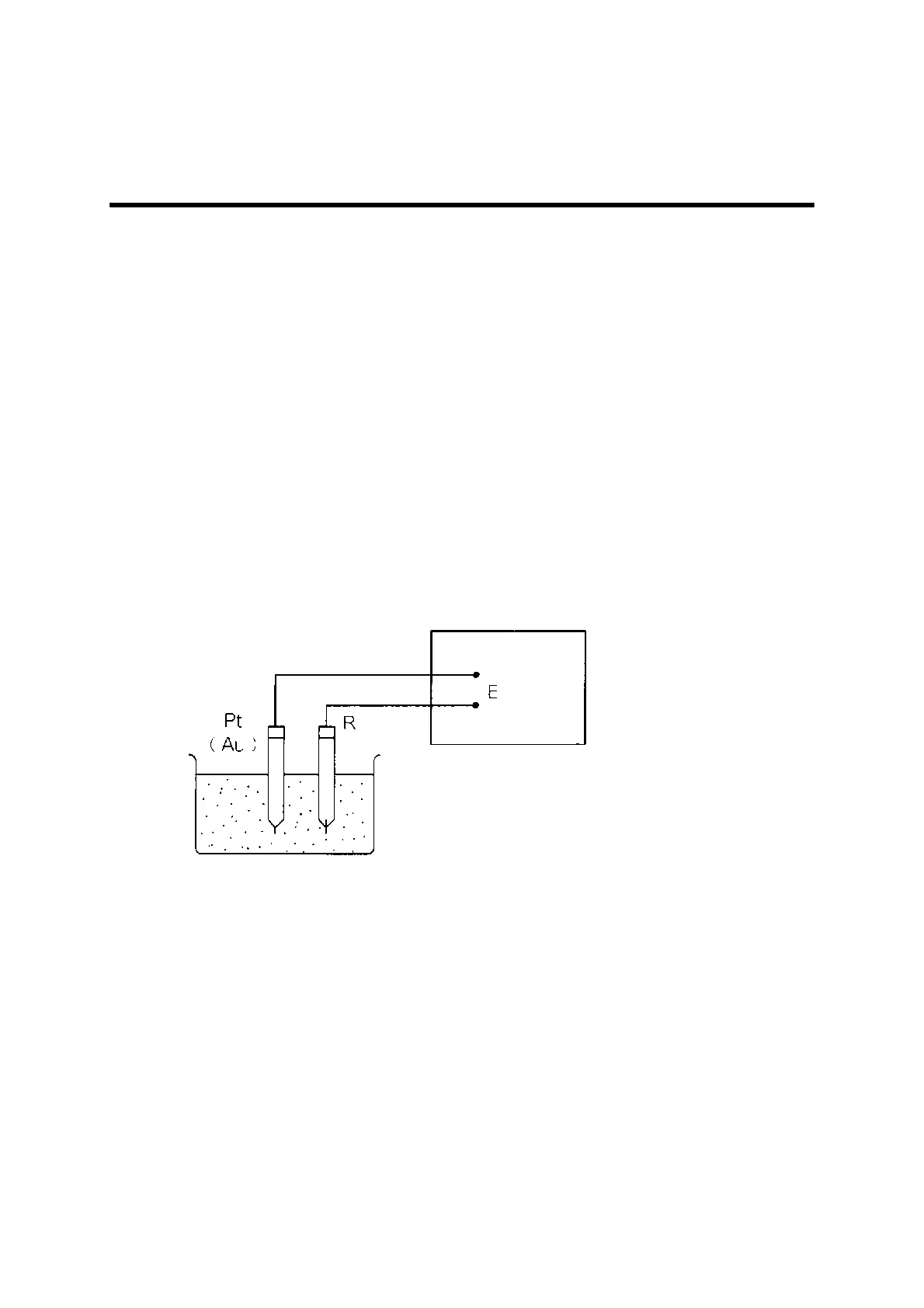
If only ① exists within a solution, a metal electrode (platinum, gold, etc.) and a reference
electrode are inserted into the solution, forming the ORP measuring system shown in
Fig.1.
Measuring the potential (ORP) that exists between the two electrodes enables the potential to
generally be expressed by the following equation.
•••••••••• ②
E: Electric potential E: Coefficient R: Gas coefficient
T: Absolute temperature n: Electron count
F: Faraday constant a: Activity
Fig.1 ORP measuring system
For example, for a solution in which trivalent iron ions coexist with bivalent iron ions, equa-
tions ① and ② would be as follows.
•••••••••••• ① '
•••••••••••• ② '
When only one type of state of equilibrium ① exists in the solution, the ORP of the solution
can only be determined by equation ② . What is important here is that ORP is determined by
the ratio of activity between the oxidant and the reductant ) (using the equation ). In actuality,
however many kinds of states of equilibrium exist simultaneously between various kinds of
ions, in most solutions. This means that under actual circumstances, ORP cannot be expressed
using the simple equation shown above and that the physical and chemical significance with
respect to the solution is not very clear.
EE
0
RT
nF
------
aM
Zn–()+
aM
Z +
--------------------------ln–=
Potentiometer
EE
0
RT
F
------
aFe
2 +
aFe
3 +
-------------------
ln–=



 To Next Page