Chapter 16 Reference
16.3 Ion measurement
F-52, 53, 54, 55 229
this measurement must be carried out free from the fluctuation in temperature by using a con-
stant temperature vessel or the like.
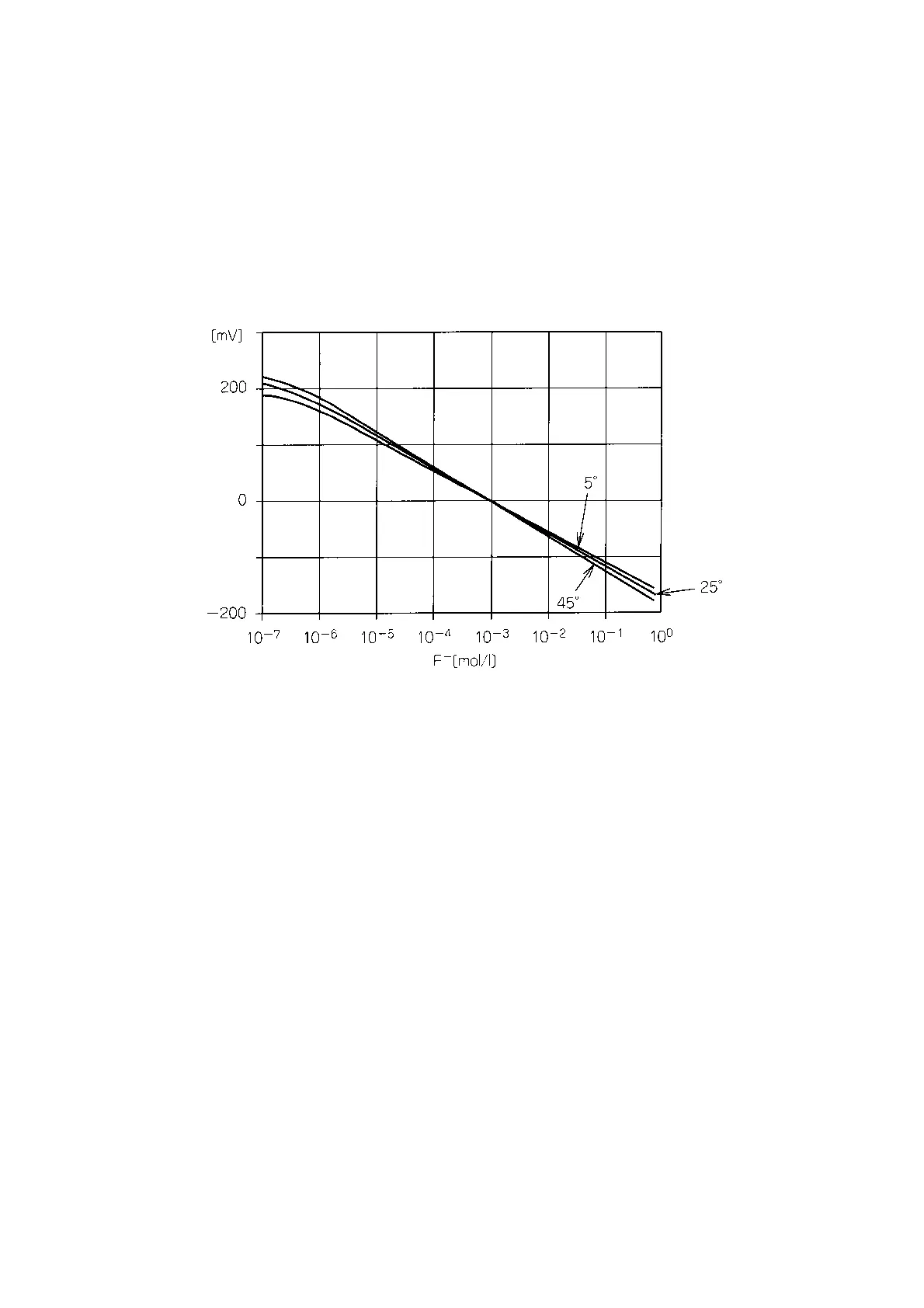
(Example)
As you will find in Fig.5, a clear isothermal cross point for the ion electrode is located at
10
-3
mol/L(19 mg/L)
Fig.5 Effect of temperature on fluoride ion electrode
Effect of stirring
The stirred state of the solution to be measured influences the measurement of the difference
in electric potential which is performed using the ion electrode, e.g., (a) the response becomes
slower, (b) low concentration cannot be measured, or (c) the electric potential on the electrode
changes. In order to avoid this influence, stir the solution as quickly as possible at a constant
speed to the extent that measurement never be interfered.
Effect of coexisting substance
The ion electrode is excellent in its selectivity for the target ions, but it may sometimes
respond to other ions. If those ions coexist with the target ions, they interfere with or influ
-
ence the measurement of the target ions. Such ions are called “interfering ions.“ In the ion
electrode method, it is critical to well understand the effect of the coexistent ions and then
avoid their effect
.
The effect of the coexistent ions on the electric potential differences at the ion electrode can
be predicted from the component of the responsive membrane and the responsiveness of the
coexistent ions. For example, those coexistent ions which may create any compound that is
difficult to dissolve or any complex base with the constituent substance of the responsive
membrane might exert a great effect on the solid membrane electrode. For the liquid mem
-
brane electrode, the effect of the coexistent ions which may form any ionic association with
the component in the responsive membrane might become greater.
Supporting electrolyte; 0.1 mol/L KNO3



 To Next Page