A2537-002/01 February 2020 8-1 SEMCO Proprietary Information
SECTION 8 - TM OVER I/P OPTION
8.1 Description
The RC100C-2 AL113 TM over IP interface supports multiple IRIG standard telemetry data formats,
DMQ/DQE interfaces and user specified custom interfaces (consult the factory). The main interfaces
required by users will be the IRIG formats. These can be broken down into two main interfaces: PCM data
Interfaces and IRIG Chapter 10 Interfaces. The TM over IP module accepts data and clock signals from
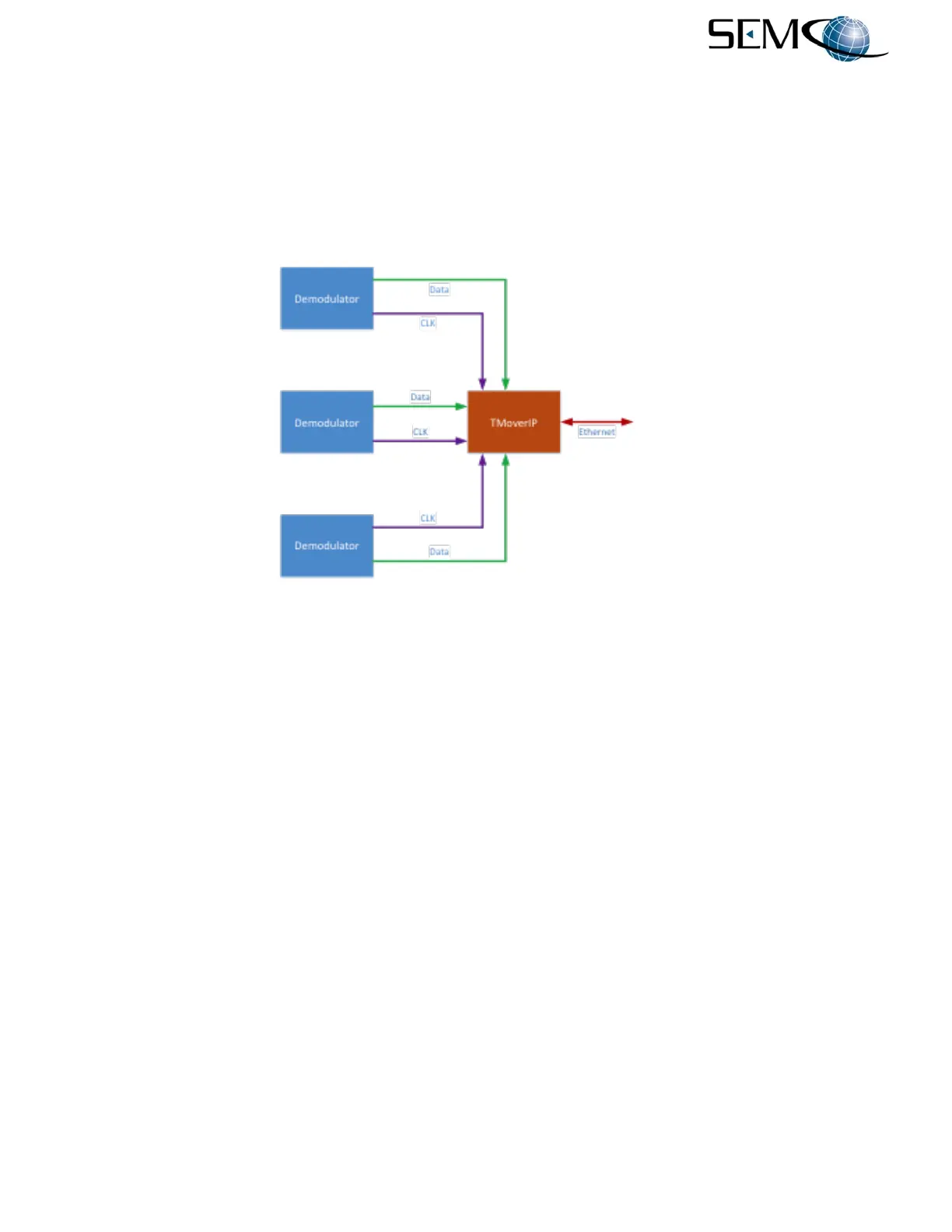
the three receiver demodulators and provides a single Ethernet output as shown in Figure 8-1.
Figure 8-1
TM over IP Block Diagram
The Ethernet output connection is dedicated to the TM over IP connection and auto detects at 10, 100 or
1000 Mbps. Operation can be over a User Datagram Protocol (UDP) or Transmission Control Protocol
(TCP) connection.
The SLTS remote GUI incorporates the controls and displays for the TMoIP option. Displays and controls
using the front panel LCD displays and Keypad will be incorporated in the next revision to this manual.
8.2 PCM TM over IP
Operating the TM over IP module in PCM mode supports IRIG chapter4/8 Format 1 data. This interface
transfers the demodulated data by routing the recovered clock and data signals to the TM over IP module.
In this mode, the data is transported in data packets to the reception device, which then reproduces the
data and clock signals. This can be done using UDP or TCP packets based on the user configuration.
The user can also transport time with the packets based on an IRIG timing signal or network timing if
desired.
8.3 Chapter 10 TM over IP
The RC100C-2 TM over IP feature also supports IRIG 106-17 Chapter 10 packets, which are further
specified in IRIG 106-17 Chapter 11. The receiver can support Time Data, Format 1 (IRIG/GPS/RTC) as
defined in RCC Document 106-17, Telemetry Standard, Chapter 11, July 2017, section 11.2.1.1, table 11-
4, which is reproduced in Table 8-1. The user should refer to IRIG 106-17 Chapter 11 for specific details
regarding data formatting and protocols when initially setting up a TM over IP network.


 To Next Page