Cirklon Sequencer User Manual
Getting Started with Cirklon
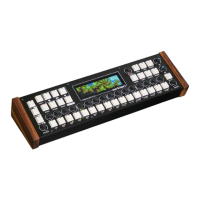
In order to follow these instructions for the Cirklon sequencer, it will help to familiarise
yourself with the layout of the front panel, and the names of the various controls.
Refer to the diagram on the previous page.
The horizontal row of keys along the lower part of the panel labelled with numbers 1 to 16 are
the STEP or TRACK KEYS.
The knobs located directly above the step keys, are the STEP or TRACK ENCODERS.
In modes where they are used to alter track settings, such as muting and muting tracks, they
will be referred to as TRACK keys/encoders.
In pattern edit modes, where they are used to alter the settings for the steps of a pattern, they
will be referred to as STEP keys/encoders.
The encoders rotate continuously, and have no marker positions.
They are used to make relative changes to numeric values, and to scroll and select in lists.
All encoders have a centre-push action, so they can be pressed as well as turned.
In some cases, the encoder may also be held in while it is turned, to enable coarse adjustment
of values in larger steps.
In contrast, the two KNOBs, labelled A & B, which are used for absolute control of values,
have a 300 degree range, and have no press-switch.
The encoder to the immediate right of the display is the VALUE encoder.
The centre push switch of the VALUE encoder is the ENTER key.
This encoder is often turned to alter a numeric value, then pressed to confirm the change.
It is also used to confirm operations where it was not used to edit any value.
All other keys and encoders are labelled with their respective names, except for the transport
keys, where the commonly used square, triangle and circle symbols denote the keys for
STOP, RUN and RECORD.


 To Next Page