USING TWO POWER SUPPLIES FOR REDUNDANCY
The positive (+) ground wire on both power supplies should be connected to the center pin of
the three pin pluggable terminal block. One negative wire from the first power supply should
be connected to the left pin while the other negative wire of the second power supply should
be connected to the right pin.
FUSING
The IDU contains two resettable fuses that will automatically open the if the current draw
becomes too high, as in a short-circuit condition. One fuse is for the ODU N-Connector, and
the other is for the IDU main chassis circuitry. Circuit heating triggers the opening, so the fuse
will reset itself after it cools down. If there is a real fault the fuse will open again and the
problem must be diagnosed. The fuse is rated for 1.1 amps maximum and will open with 1.6
or greater amps current flowing.
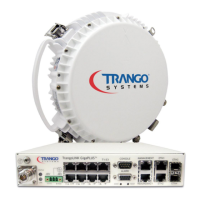
T1/E1 ports (1 – 8): Standard RJ45 connectors break out all the T1/E1 ports into 8 RJ45
120 Ohm connectors.
RSSI/PDH LEDs:
RSSI Operation: By default, the IDU displays the actual ODU Receive Signal
Strength by illuminating the LEDs that, when added together, give a the negative
dBm indication of the Received Signal Strength.
Example: LEDs “40” “10” and “1” only illuminated indicates an RSSI of -51 dBm
since the sum of the LED values is 51.
PDH Operation: Via software command, the LEDs can be multiplexed to display
the connection status of the T1/E1 circuit. The arrows indicate the upper (Arrow
pointing up) or lower (arrow pointing down) port above the indicator.
Management Ports (RJ45 – 10/100BaseT Autosensing/Auto-negotiating): For out of
band Web, SNMP, Telnet, and SSH management.
Redundancy Port: Connect this port to the hot standby IDU using the redundancy
cable. Note: This port is not a standard Ethernet Port and will not function using a
standard Ethernet cable. CBLDAT-RIU3 is required (optional)
Serial Console Port (DB9 male): 1 serial RS-232 port used to manage unit.
Alarms (DB9 female): There are 2 alarm inputs which are CMOS level and are user
configurable. There are 2 outputs which are dry contact rated for 50 Volt 1 Amps each.


 To Next Page