75
Model Code Page
21. Engine
1. 9. 1992
6000--8750 216 1
Inlet and exhaust system,
turbocharger (Op no 216)
An engine that is equipped with a turbocharger is a great deal
more sensitive to disturbances and impurities in the inlet and
exhaust systems than a conventionally aspirated engine.
Therefore special attention should be given to the whol e inlet
and exhaust system.
A. Checking air cleaner
The engine performance and length of service life depend to
a great extent on the state of the air cleaner. A defective air
cleaner allows impurities to pass through, which in time dam-
age the turbocharger and the engine. A blocked air cleaner
lowers the engine output and also causes oil leakage through
the sealing ring on the turbocharger shaft.
Note! The safety filter inside the main filter should not be re-
moved unnecessarily, for checking or cleaning. The safety
filter must not be cleaned, but should be changed once a year
or when necessary (see Operator’s Manual)
B. Checking inlet and exhaust system
Important! Leaks in the inlet or exhaust system markedly
lower the effect of the turbocharger. Because of the pressure,
even small leaks in the manifold or in the turbine inlet contact
flange quickly increase in size. For t his reason all l e aks must
be dealt with immediately.
1. Inspect the pipes and sealing surfaces between the air
cleaner and the turbocharger, as well as between the turbo-
charger and the induction manifold. If the inductio n manifold
is dusty on the inside, there is a leak in either the air cleaner
or the induction pipes. Remedy the leak.
2. Clean the induction manifold sealing surface. Check that
the sealing surface is flat using a straight ruler. If the surface
is not flat or it has s cratches, machine or renew the induction
manifold. On 620---engines ensure that the cylinder heads are
parallel.
3. Fita new gasket and fasten theinduction manifold. Tighten
the manifold fixing screws to a torque of 30 Nm. Fasten the air
pipes carefully..
4. Check that the exhaust manifold is air tight. Tighten the
bolts to 50 Nm and inspect for any damage (cracks, deforma-
tion, corro sio n etc.). Check also the connection between the
turboc harger and the exhaust manifold.
5. Remove the manifold if necessary. Clean the sealing sur-
faces and remove any carbon deposits. Check that the seal-
ing surfaces are flat. I f the fastening flanges are twisted or
there are scratches on the sealing surfaces, machine the
flanges or renew the exhaust manifold.
6. Ensure that no loose objects or impurities have entered the
exhaust pipe or the silencer. Any such loose objects or impu-
rities can increase the back pressure for the exhaust gases
from the turbine wheel.
C. Checking turbocharger
If a fault is suspected in the turbocharger it can be l o c ated in
the following way:
1. Visually inspect the turbine and compressor wheels. The
vanes must not show any signs of damage, deformation or
wear caused by foreign objects.
2. Investigate any oil leaks through the sealing rings on the
shaft in the turbine and compressor housing.
N.B! At low idling there is always a certain amount of oil leak-
age on the compressor side. However, this should not cause
too much concern unless the oil consumption is too great.
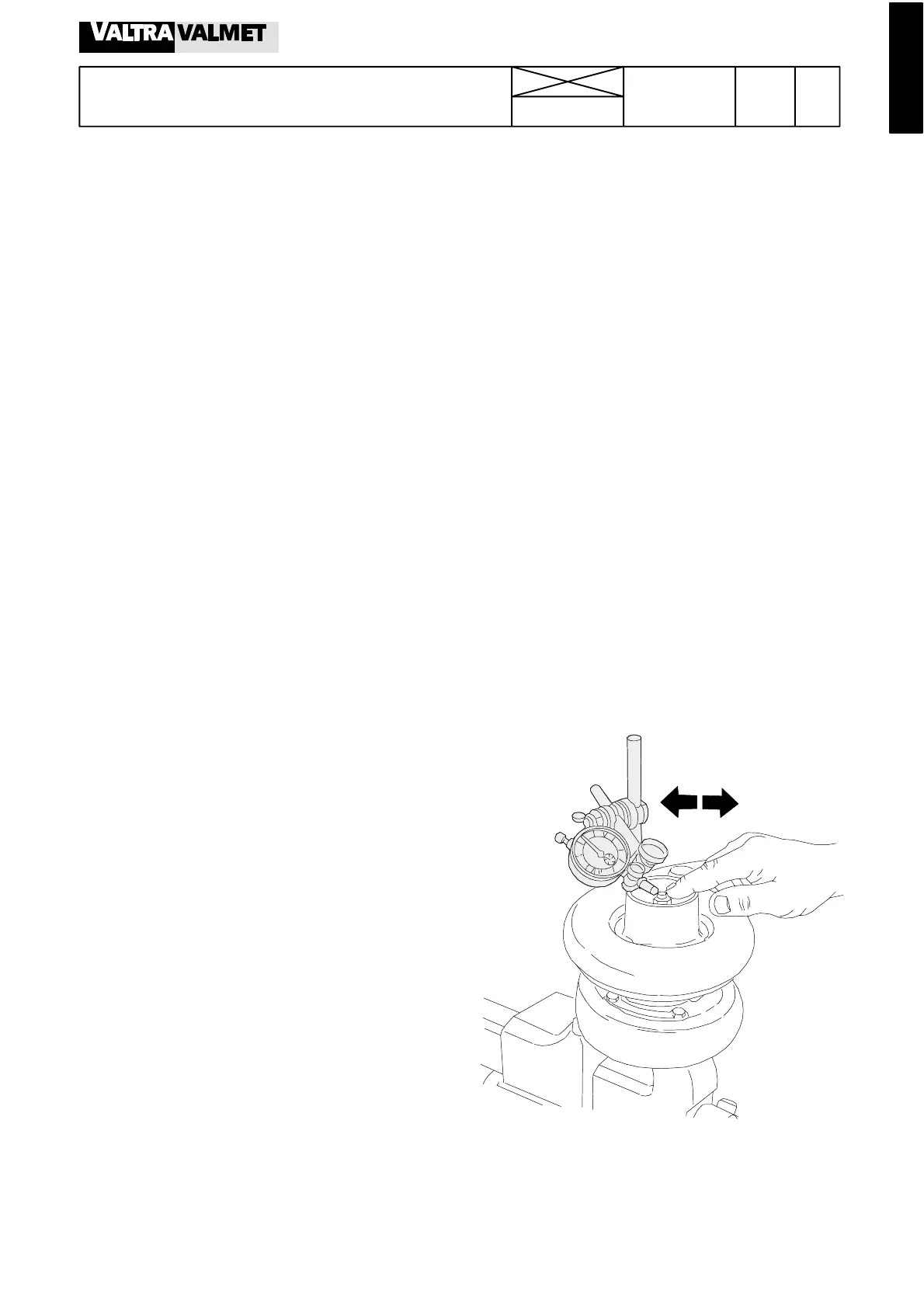
3. Check the turbine shaft running clearance. Place the stylus
of a dial gauge against the shaft and move the shaft sideways.
refer to the clearance given in the specifications on page
210/9.



 To Next Page