CABIN
M6060, M7060, WSM
9-S21
Charging an Empty or Partially Charged System (Vapor)
This procedure is to charge the system through the LO pressure
side with refrigerant in the vapor state. When the refrigerant
container is set right side up, refrigerant will enter the system as a
vapor.
• Never open the HI pressure side valve of manifold gauge
while the engine is running.
• Do not turn the refrigerant container upside-down when
charging the system by running the engine.
• Put refrigerant container into a pan of warm water
(maximum temperature 40 °C (104 °F)) to keep the vapor
pressure in the container slightly higher than vapor
pressure in the system.
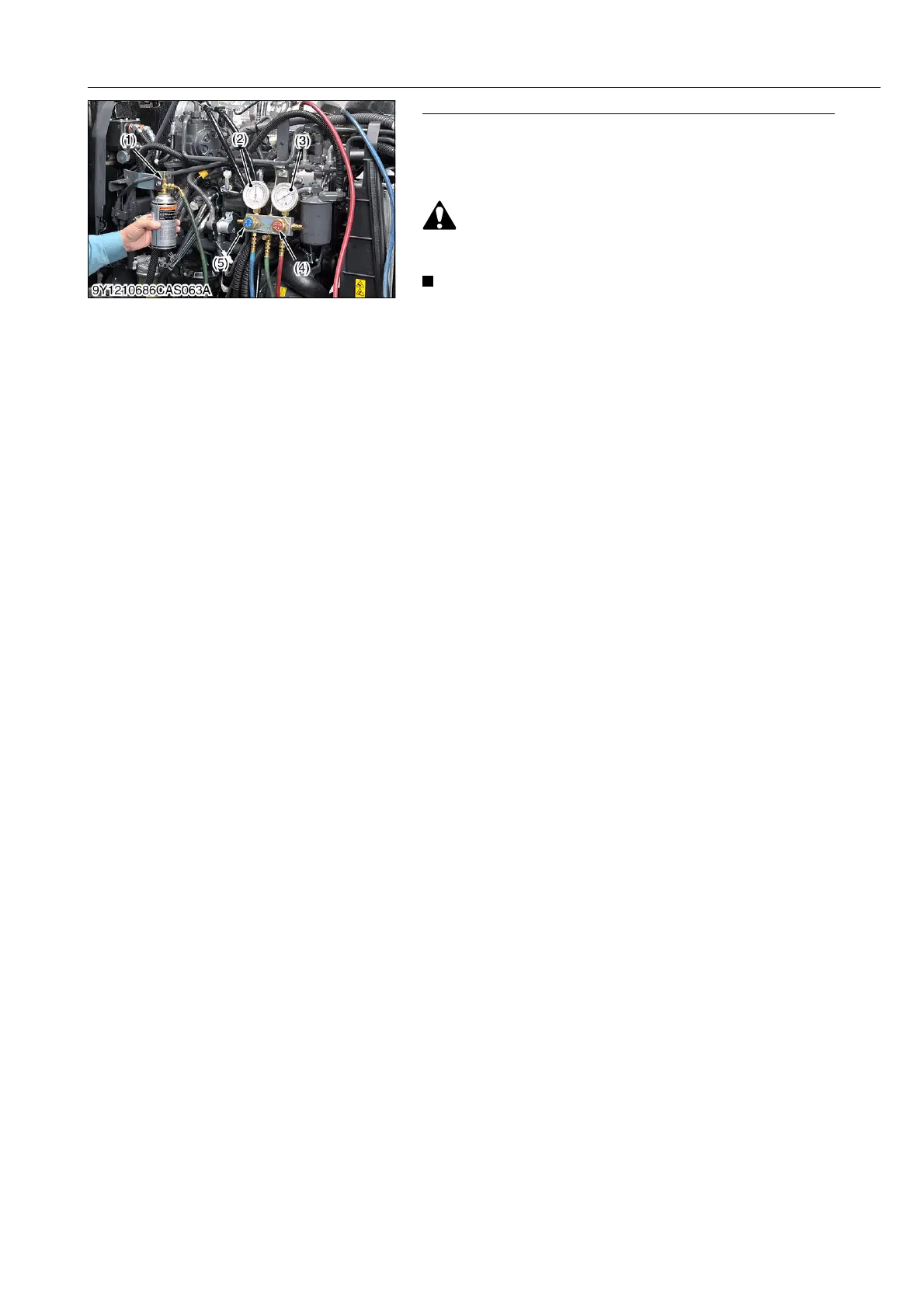
1. Check that the HI pressure side valve (4) is closed.
2. Start the engine and set an approx. 1500 min
-1
(rpm).
3. Turn on the A/C switch.
Set the temperature control lever to maximum cooling position
and the blower switch to HI position.
4. Open the LO pressure side valve (5) of manifold gauge and the
can tap valve (1) on refrigerant container and charge the
refrigerant until air bubbles in the sight glass of the receiver
vanish.
5. After charging the specified amount of refrigerant into the
system, close the LO pressure side valve (5) of manifold gauge
and can tap valve (1), then stop the engine.
6. Check for gas leak with an electric gas leak tester. (See page
9-S11.)
(Reference)
• Specified amount of refrigerant (total):
R134a
0.85 to 0.95 kg
1.9 to 2.0 lbs
• Manifold gauge indication at fully charged system (at ambient
temperature: 30 °C (86 °F))
– HI pressure side:
1.3 to 1.6 MPa
13 to 17 kgf/cm
2
190 to 240 psi
– LO pressure side:
0.15 to 0.19 MPa
1.5 to 2.0 kgf/cm
2
22 to 28 psi
9Y1210828CAS0030US0
(1) Can Tap Valve
(2) LO Pressure Gauge
(3) HI Pressure Gauge
(4) HI Pressure Side Valve
(5) LO Pressure Side Valve



 To Next Page