5-24
Chapter 5. Functions
AT (automatic tuning)
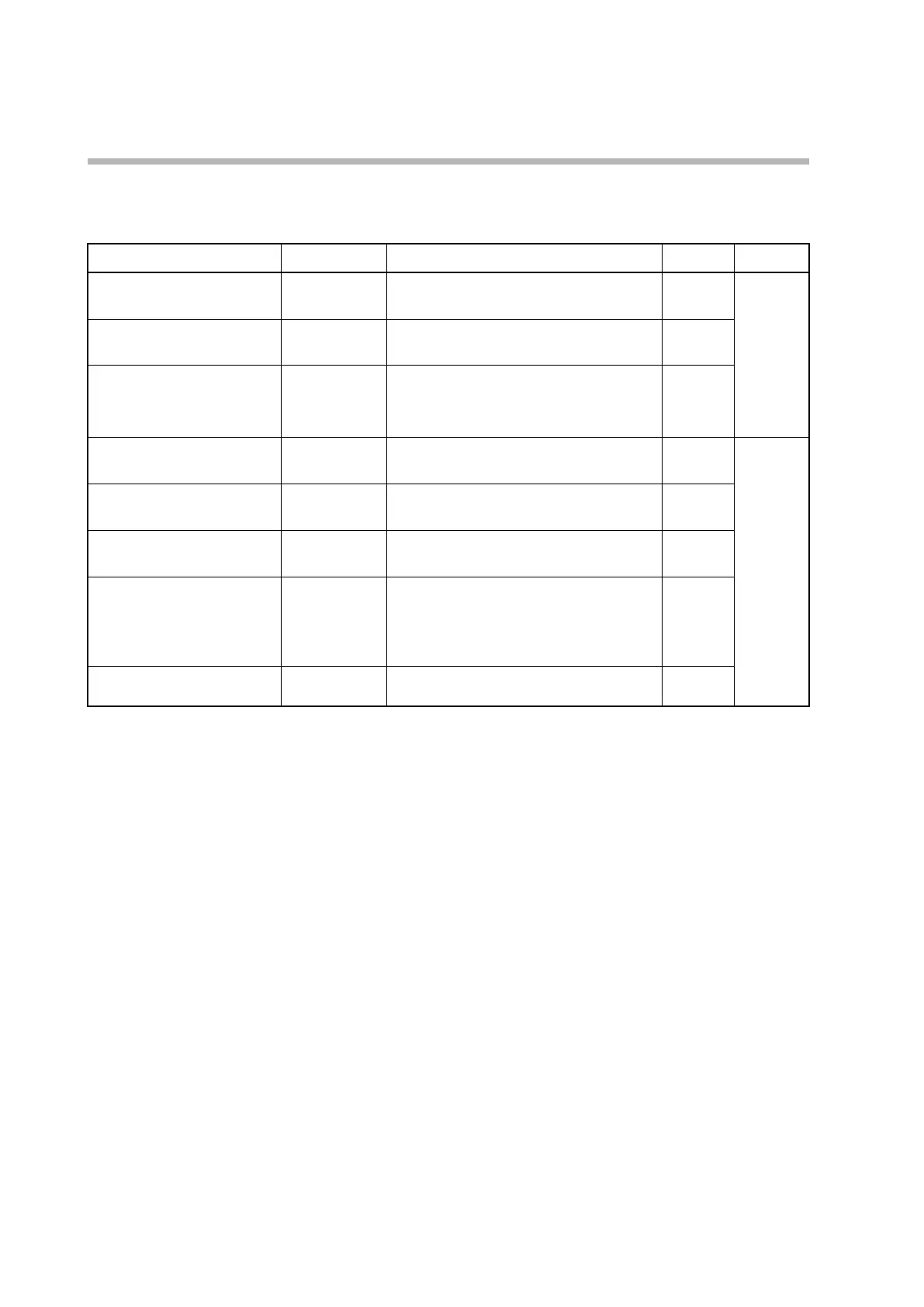
The following settings can be specified for AT.
Item (bank) Display Description Initial value User level
MV low limit at AT
(parameter bank)
AT.OL
−10.0 to +110.0 % 0.0 % Simple,
standard,
advanced
MV high limit at AT
(parameter bank)
AT.OH
−10.0 to +110.0 % 100.0 %
AT type
(extended tuning bank)
AT.TY
0: Normal (regular control characteristics)
1: Immediate response (to disturbance)
2: Stable (minimal PV fluctuation)
1
AT proportional band adjust
(extended tuning bank)
AT-P
0.00 to 99.99 1.00 Advanced
AT integral time adjust
(extended tuning bank)
AT-i
0.00 to 99.99 1.00
AT derivative time adjust
(extended tuning bank)
AT-d
0.00 to 99.99
1.00
Type of MV switching point at
AT
(extended tuning bank)
At.Pt
0: Default (2/3 of the deviation of the initial PV
from the initial SP)
1: SP
2: PV
0
MV switching point PV in AT
At.Pv
−1999 to +9999 U
0
• If CtrL (control method) is set to “1” (PID control), this item is displayed and the
setting can be changed.
• The MV when AT is executed can be limited by “MV low limit at AT” (At.OL) /
“MV high limit at AT” (At.OH).
• If C26 (heat/cool control ) is set to 0 (not used), the MV is limited by both “MV
low limit at AT” (At.OL) / “MV high limit at AT” (At.OH) and by “MV low limit”
(OL-1) / “MV high limit” (OH-1) for the PID constants.
• If C26 (heat/cool control) is set to 1 or 2 (use),
•
The MV is limited by “MV low limit at AT” (At.OL) / “MV high limit at AT”
(At.OH).
•
The heating MV is limited by “MV low limit” (OL-1 to 8) / “MV high limit”
(OH-1 to 8).
•
The cooling MV is limited by “cool-side MV low limit” (OL.1C to 8C) / “cool-
side MV high limit” (OH.1C to 8C).
• “AT type” (At.ty) is used to calculate the PID constants that are appropriate for
the control characteristics of the equipment by AT.
1 (immediate response): adjustment for speed-oriented applications, such as a
process where the PV directly reflects heating by a heater.
2 (stable): adjustment for stability-oriented applications, such as a process where
the PV indirectly reflects heating by a heater.


 To Next Page