3 Devices
which are set by users, and the DVP-20PM series motion controller sends pulses by a pulse
generator.
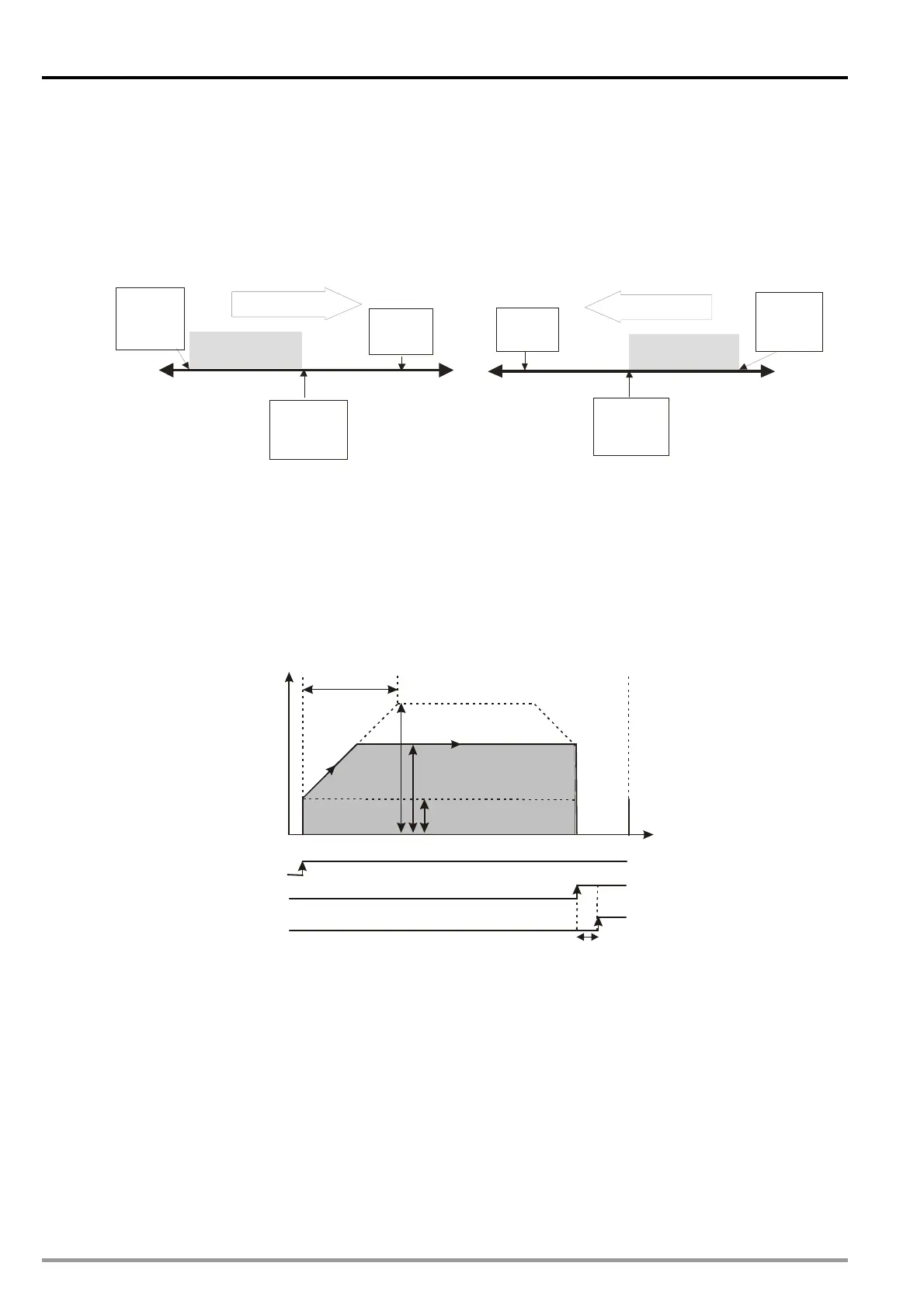
The range which is masked is shown below. It depends on the present command position of the
Y-axis and the target position of the Y-axis. If the present command position of the Y-axis is less
than its target position, t the motor used will rotate clockwise. If the present command position of
the Y-axis is greater than its target position, the motor used will rotate counterclockwise, and the
Y-axis leaves the range which is masked when the value in D1928 is 0.
Positive direction Negative direction
Present
command
position
(D1928)
Range which
is masked
Direction in which
the Y-axis moves
Present
command
position
(D1928)
Target
position
(D1918)
Present
command
position
(D1928)
Direction in which
the Y-axis moves
Present
command
position
(D1928)
Target
position
(D1918)
Range which
is masked
If relative single-speed motion is activated, the sign bit of the P (I) set by users will determine the
direction of the relative single-speed motion.
Absolute single-speed motion: If the target position of the axis specified is greater than its present
command position, the motor used will rotate clockwise. If the target position of the axis specified
is less than its present command position, the motor used will rotate counterclockwise.
The speed of the Y-axis increases from the V
BIAS
set to the V (I) set. After PG1 is turned ON, the
Y-axis will stop outputting pulses.
V
BIAS
: D1824 (D1904, D1984); V (I): D1840 (D1920, D2000); V
MAX
: D1822 (D1902, D1982); T
ACC
:
D1836 (D1916, D1996)
Speed
T
ACC
V
MAX
Time
V
BIAS
DOG1
V(I)
PG1
CLR1
20 s
µ
9. Bit 8 in D1846 (D1926, D2006): A mode of single-speed motion is activated.
After bit 8 in D1846 (D1926, D2006) is set to 1, a mode of single-speed motion will be activated.
The
target position of the single-speed motion and the speed of the single-speed motion depend
on the P (I) and the V (I) which are set by users, and the DVP-20PM series motion controller
sends pulses by a pulse generator.
If relative single-speed motion is activated, the sign bit of the P (I) set by users will determine the
direction of the relative single-speed motion.
Absolute single-speed motion: If the target position of the axis specified is greater than its present
command position, the motor used will rotate clockwise. If the target position of the axis specified
is less than its present command position, the motor used will rotate counterclockwise.
After single-speed motion is activated, the speed of the absolute single-speed motion will increase
from the V
BIAS
set to the V (I) set. The speed of the absolute single-speed motion will not decrease
from the V (I) set to the V
BIAS
set until the number of pulses output is near the P (I) set.
DVP-20PM Application Manual
3-58


 To Next Page