54200
Users Manual
5-48
BTSC Sound
General
The BTSC (Broadcast Television System Committee) Sound system is a Multichannel-
Television Sound (MTS) standard that uses only one sound carrier to transmit a stereo-
phonic as well as a second audio program. The BTSC standard was first introduced in
the USA and later on in Canada and Taiwan. The BTSC sound system is mostly trans-
mitted in combination with NTSC M but also can be found in combination with PAL M,
for example, Brazil.
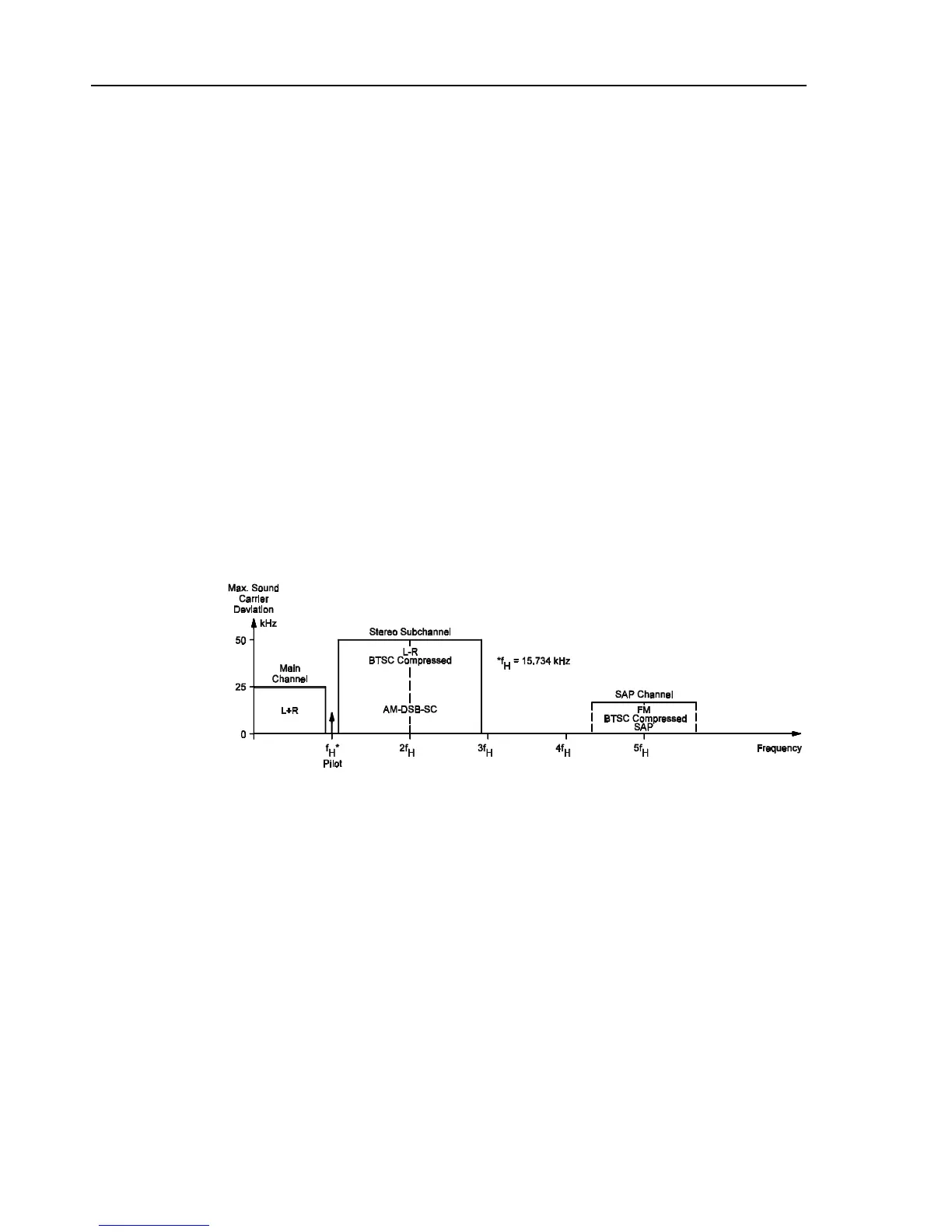
The four components of the BTSC composite signal are described below and shown in
Figure 5-33.
•
Main channel,
a monophonic L+R signal with a 75 µs
pre-emphasis.
•
Pilot carrier,
locked to the line frequency fH (15.734 kHz).
•
Stereo subchannel,
L-R signal, amplitude modulated on a suppressed 2xfH subcarrier, compressed by
the dynamic noise reduction system according to the BTSC specification.
•
SAP (Second Audio Program) channel,
frequency modulated on a 5xfH subcarrier (78.670 kHz), compressed by the
dynamic noise reduction system according to the BTSC specification.
Figure 5-33. BTSC Baseband Spectrum
The broadband baseband spectrum is transmitted using frequency modulation on the
sound carrier (4.5 MHz). Due to the parabolic noise characteristic, which is typical for
FM transmission systems, the noise level increases for higher frequencies. To improve
the Signal-to-Noise Ratio of the L - R signal and the SAP signal, both channels are en-
coded by the BTSC Compressor; see Figure 5-34.
The compressor on the transmitter side is level and frequency dependent and the
expander on the receiver side has to respond exactly in the opposite way to guarantee
proper signal processing, mainly determined by stereo channel separation and frequency
response. Therefore, it is important that the audio signal levels are well defined, which is
mostly done by giving the corresponding peak deviation of the sound carrier.


 To Next Page