How to Use the Instrument
Description and Applications of the Test Patterns
4
4-49
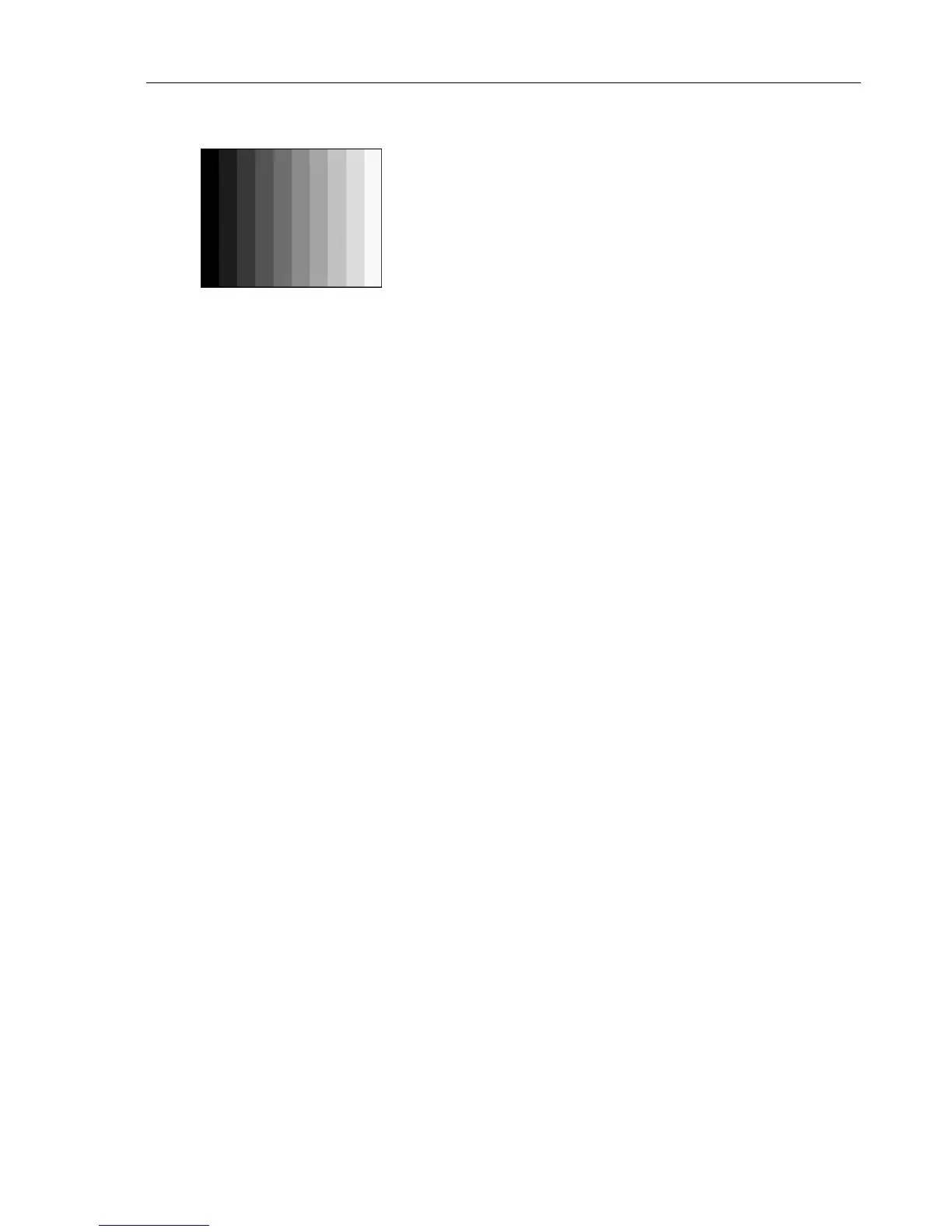
Greyscale
Figure 4-76. Greyscale
Description:
Greyscale with color burst is a full screen linear
staircase signal with ten vertical steps from black to
white, Y = 0% to 100% (7.5 IRE to 100 IRE).
Applications:
The Greyscale pattern is used to locate faulty linearity
of the video amplifier or greyscale setting.
Nonlinearities mainly result in a compression of the
white level.
A color receiver should show no color in any of the
ten bars. Color here means that the guns of the picture
tube are incorrectly adjusted. This pattern is also used
when checking the contrast and brightness control.
DEM Pattern
DEM offers two different test patterns: DEM 1 and DEM 2. The signal contents of the
DEM patterns depend on the TV system that is selected.
DEM 1 (PAL)
The DEM 1 pattern for PAL has different V and U levels for 625 or 525 line systems and
contains four horizontal bars. The luminance is set to 50% for 625 and to 53.8% for 525
line systems. For details, see Figures 4-77 and 4-78.
•
The first bar consists of two rectangles.The left part contains V and U color-
difference signals and G-Y is zero. The right part is a reference bar with no color
information, only 50% luminance (Y signal).
•
The second bar consists of four colored squares with color information that is PAL
coded. This bar indicates a proper functioning of the color demodulator part.
•
The third bar consists of four squares that are color coded (anti-PAL) but should not
show any color at a well aligned color television or monitor: The burst signal is PAL
coded and checks the operation of the PAL switch in a color receiver. The first and
second square contain only V- signals (U = 0) while the third and fourth square
contain only U- signals (V = 0). All four squares should be grey on the screen.
•
The fourth bar shows a grey reference bar: Y = 50% (53.8%) with no color
information.


 To Next Page