3-29
Chapter 3 Settings and Measurement
Contents General Description
Checks and Preparation
Settings and Measurement
Example of Use Specification
D
n
n-1
n-2
n-3
n-4
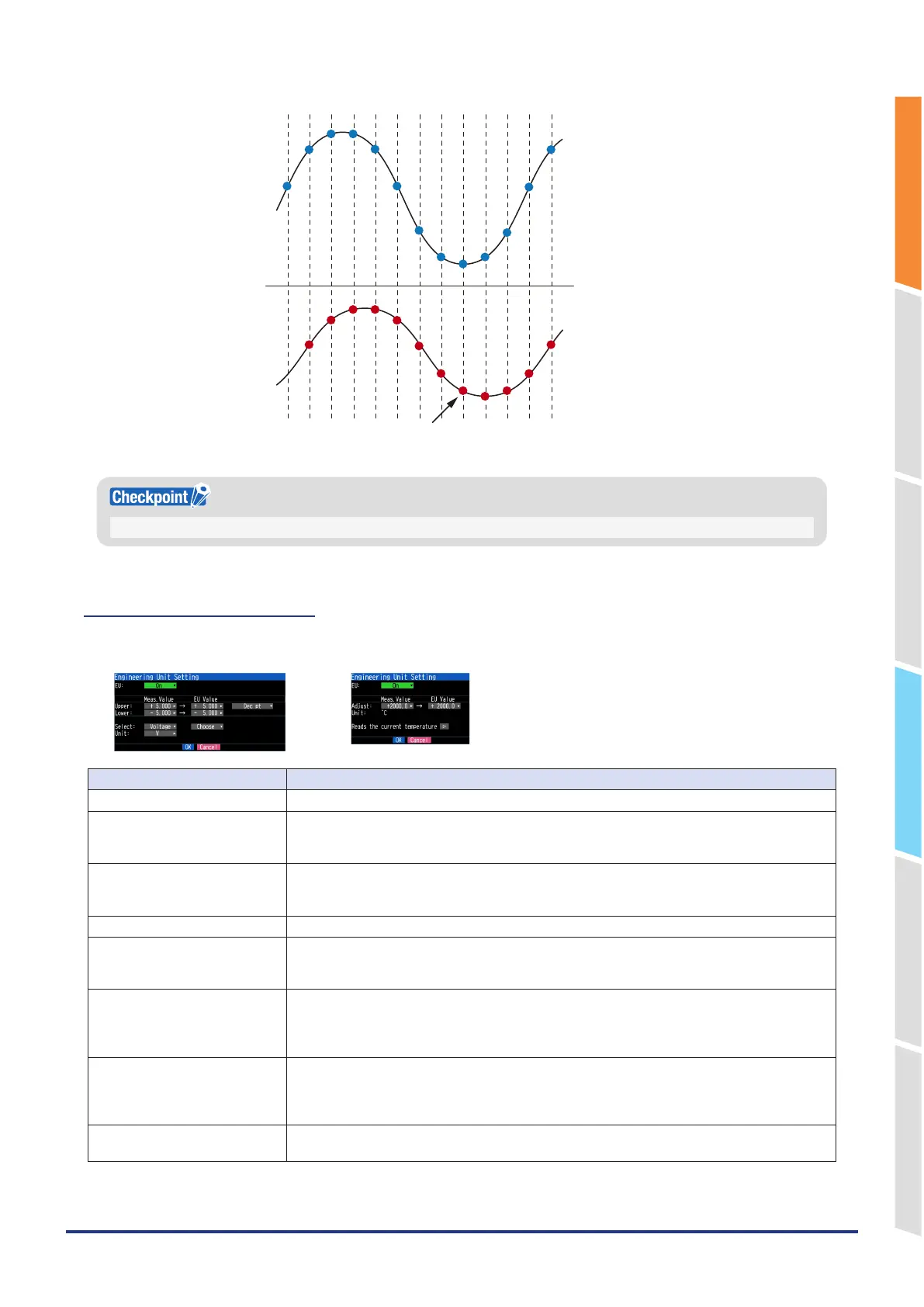
If the filter setting is 5,
The moving average is "D=((n-4)+(n-3)+(n-2)+(n-1)+ n)÷5".
If the sample interval exceeds 30 seconds, the average value of data obtained in a sub-sample (30 seconds) is used.
1-5. EU (Scaling settings)
This is used to convert the measured signals to other units.
<For voltage input> <For temperature input>
Setting Description
EU Function Sets the scaling function to ON or OFF.
Meas. Value (Upper/Lower) Sets the upper and lower limits of values to be converted.
* For temperature input, there is no distinction between upper and lower limits.
See the setting examples shown below for details.
EU Output Value (Upper/Lower) Sets the upper/lower limit output values after conversion.
* For temperature input, there is no distinction between upper and lower limits.
See the setting examples shown below for details.
Dec pt Sets the decimal point position for an EU output value.
Select Selects a specific engineering unit classification. (The following are available.)
Voltage, Current, Length, Area, Volume, Velocity, Accel, Freq, Mass, Energy, Pressure, Flow,
Temp, Strain, Brightness, Concentration
Unit Selects a unit to be used after conversion.
A unit displayed in this field belongs to the classification selected in "Select." To set a unit not
displayed in this field, set arbitrary text in "Arbitrary unit." The setting selected in this field is
displayed in "Arbitrary unit."
Arbitrary Unit Sets a unit to be used after conversion.
Arbitrary text consisting of alphabetical characters and numerical values can be set as a unit.
(For the character input, refer to "10. Text input" in "3.4 Setting Menus".)
When "Select Unit" or "Unit" is specified, it is reflected here.
Reads the current temperature
measurement value
Substitutes the current measurement value into Measurement value and EU output value.
* The value is not substituted when burnout occurs or the scale is exceeded.







 To Next Page