Skx
Owner’s Manual
28
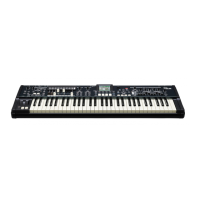
PULL OUT DRAWBARS
Pull out Upper Drawbars to your taste. You can monitor your
selections easily while playing the keyboard.
e Drawbars make the fundamental organ sound of SKX. e
tone changes depending on how far the Drawbars are pulled
out.
e volume of each sound becomes maximum when the Draw-
bar is fully pulled out, and null when fully pushed back. e
drawbars are arranged so that the pitch grows higher from left
to right.
For this example, pull the rst three Drawbars out all the way as
shown in the illustrated on the left 16´, 5 ⅓ ´ and 8´.
NOTE: You can change the sound character of the Drawbars. (P. 72)
NOTE: The present registration is displayed in the Play mode. (P. 63)
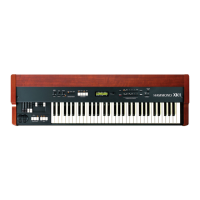
ADD THE TOUCH-RESPONSE PERCUSSION
Hammond’s Touch-Response Percussion adds a distinctive at-
tack to the Tone Wheel/Drawbar tones. is Percussion is not
like a drum or cymbal, but closer to an xylophone or marimba.
[PERCUSSION] is available only on the UPPER part.
To enable the Percussion, turn the [ON] button “ON”.
e [SOFT] button reduces the volume of the Percussion voice
and [FAST] button quickens the decay of the Percussion voice.
ere are two choices of pitch for Percussion. One sounds an
octave above the note played (“Second”), and another sounds
a “twelfth” above. (“ ird”) - When the [THIRD] light is o
“Second” is selected.
For this example turn all of the Percussion buttons “ON”
([ON], [SOFT], [FAST], [THIRD]).
NOTE: You can ne-tune the Percussion parameters to your taste. (P.
80)
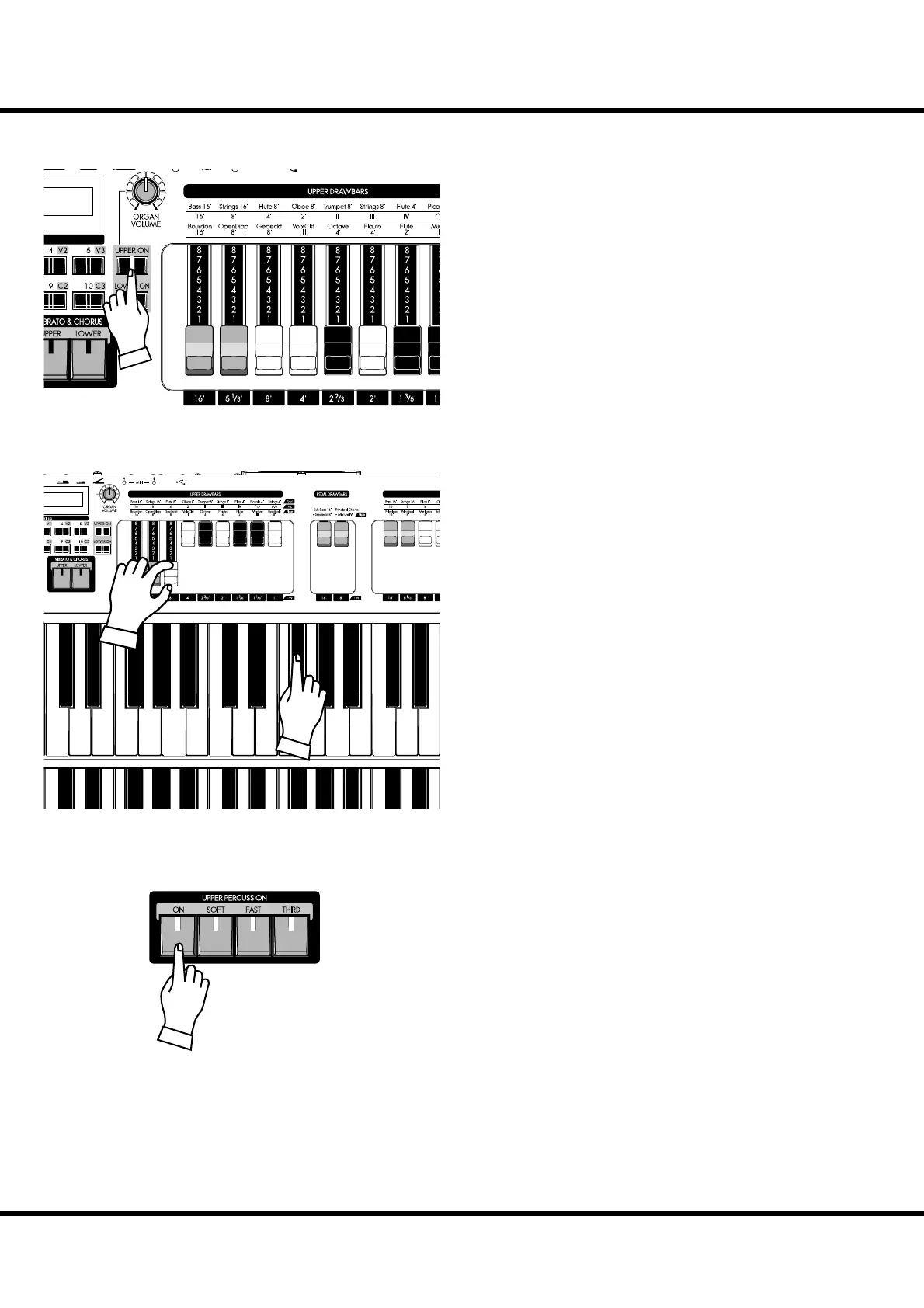
SWITCH THE ORGAN SECTION ON
In this example, make sounds to begin with the Organ Section.
e ON buttons switches sounds or does not at each part for
the Organ Section.
NOTE: What is a “PART”? (P. 32)
Switch the [UPPER ON] button “ON”. e UPPER part of
the Organ Section will sound.
NOTE: You can set that the Extra Voice Section turns o automati-
cally by the Organ Section is switched on. (P. 79)
Next, set the [ORGAN VOLUME] knob. It adjusts the overall
volume for the Organ Section. Set this knob in the center posi-
tion at this time.
TRY CREATING YOUR OWN SOUND - continued



 To Next Page