49
Setting Up
VIBRATO & CHORUS
e Hammond Vibrato & Chorus is another hallmark of the Classic Hammond
sound. Vibrato alters the pitch slightly, as a violinist, singer, or guitarist may do. And
Chorus combines a detuned signal with the original for a lush tone.
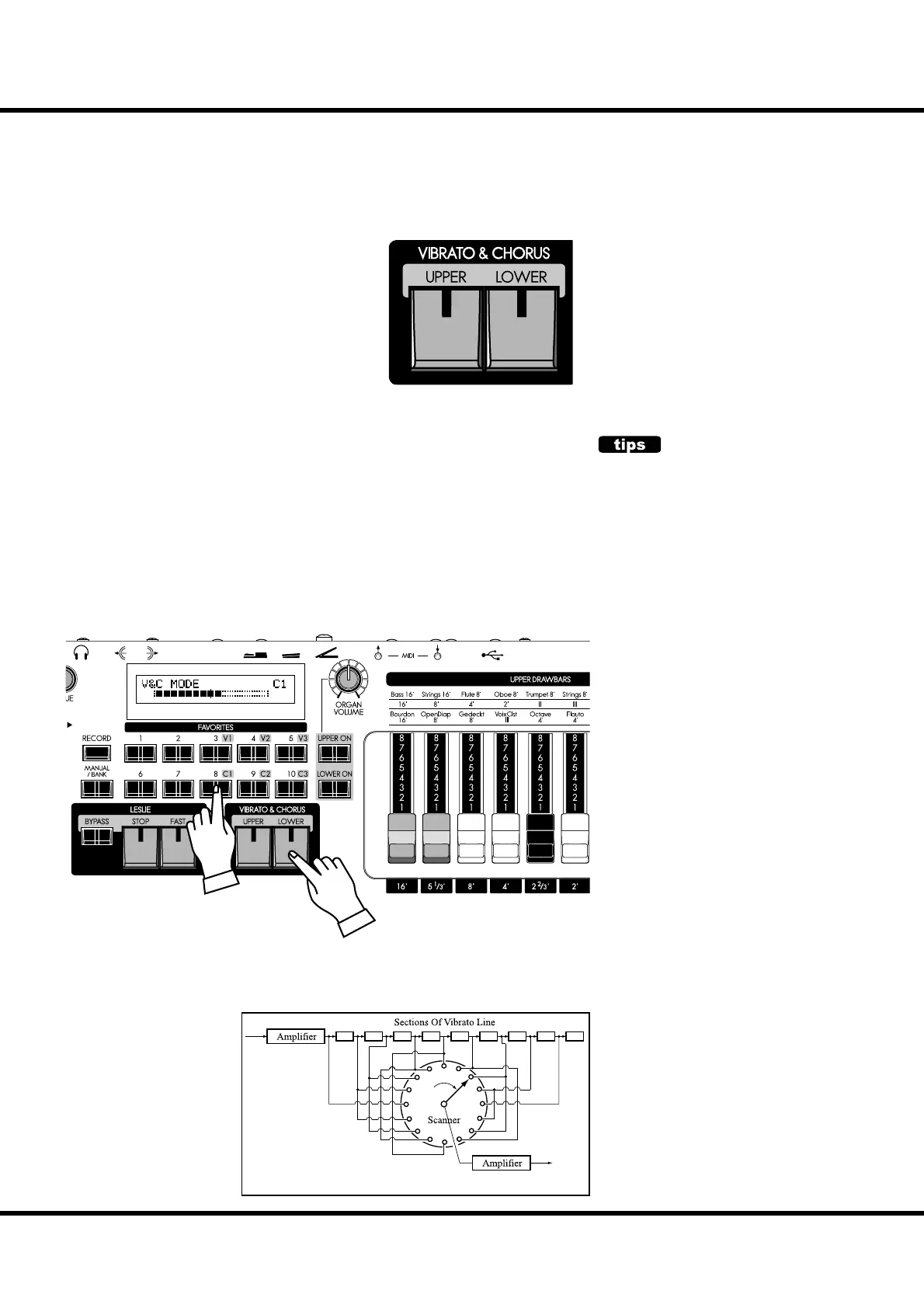
[UPPER] button
Pressing [UPPER] button “ON” (red LED lit) will turn the Vibrato & Chorus e ect
on for the UPPER Drawbars.
[LOWER] button
Pressing [UPPER] button “ON” (red LED lit) will turn the Vibrato & Chorus e ect
on for the LOWER and PEDAL Drawbars.
NOTE: Vibrato & Chorus is available on 5 Organ Types; BType1, BType2, Mellow, Vx and Farf.
NOTE: The mode, speed etc. of the Vibrato & Chorus e ects can be ne-tuned. (P. 81)
TO SELECT THE VIBRATO & CHORUS MODE
VIBRATO AND CHORUS OF HAM-
MOND ORGANS
On string instruments, the vibrato e ect is created
by changing the string tension by one’s fingers.
On wind instruments, by changing the strength
of breath. On electronic instruments with analog
circuitry, by modulating the oscillator. As the rota-
tion of the Tone Wheels of the original B-3/C-3 was
stabilized by the synchronous motor, it was not
possible to provide a vibrato e ect. On these mod-
els, the vibrato e ect was obtained by modulating
the signal post-generator.
The vibrato & chorus system of the original B-3/C-3
consisted of a 9 stage delay line using LC phase
shift circuits. This produced a very short delay
of about 1 ms. Tones were passed through coils,
delaying the phase. Several coils were connect-
ed in tandem and when the output of each tap
was passed from the top to the last by turns, the
pitches gradually lowered. By taking the output
of each tap from the last to the top by turns on
the contrary, the pitch would gradually rise. These
operations were automatically made by turning
the scanner with a motor.
The scanner was used to select one of multiple
input terminals by the static connection. As each
terminal was selected by the “blades” which ap-
proached each other, a popping noise like that of
a switch did not occur and the signals of neigh-
boring terminals cross-faded and switched them-
selves.
The mode-selection of vibrato e ects was made by
changing the range of the connecting tap.
As this system modulated the produced tonal sig-
nals and not the oscillator, the original sound could
be heard without the vibrato e ect. By mixing the
sound with the vibrato effect and the original
sound, the chorus e ect was obtained.
On this model, the chorus and vibrato e ects are
simulated and modelled in the original fashion
digitally, by the DSP, without using moving parts.
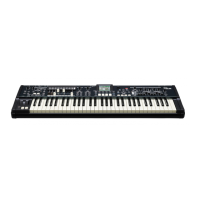
To select the Vibrato & Chorus Mode instantly, press and hold either the VIBRATO
& CHORUS [UPPER] or [LOWER] button, and press any of the six buttons shown
above ([V1] to [C3]) to select the Vibrato or Chorus Mode you want.
Vibrato & Chorus diagram of



 To Next Page