116
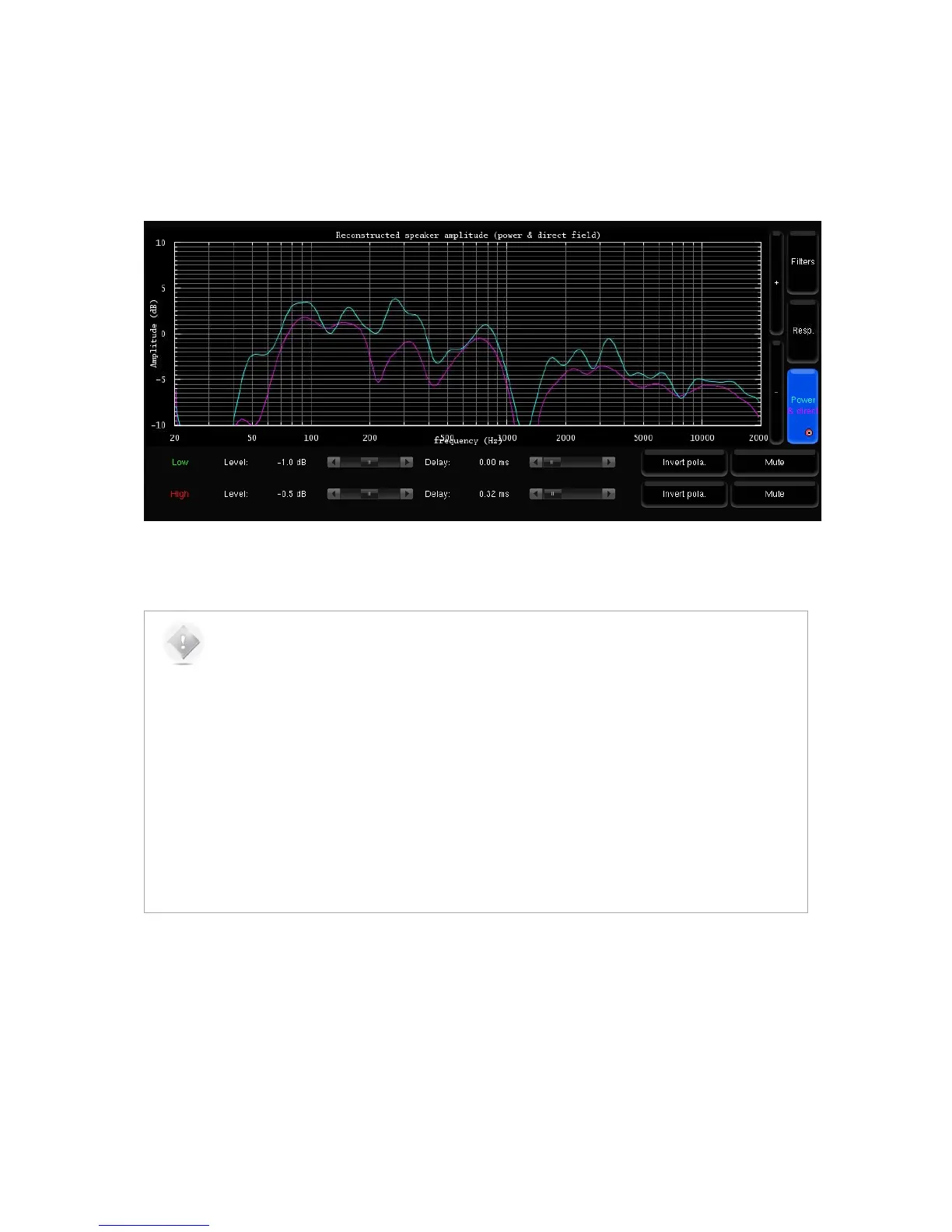
• The recombined amplitude response of the speaker: You can see whether the combination of the drivers is
constructive, and you can observe the effects of level/delay/polarity modification on the combined amplitude
of the speaker. Two curves are displayed, one showing the total acoustic output of the speaker (including the
room), and one showing the amplitude of the direct front and early reflections. Comparing both curves will
indicate whether the crossover preserves the directivity of the speaker: The two curves will look more alike
when the acoustic summation is optimized for the primary listening position.
Figure'83:'Recombined'amplitude'response'of'the'speaker'
NOTE:
• The levels, delays and polarities set previously are ignored during the calibration. In other words,
adjusting these parameters before launching the calibration will have no effect on the result.
• Under some circumstances, the automatic crossover algorithm may suggest inverted polarities
for a driver from one speaker to another. This can be explained by various factors:
• The physical polarity of one speaker is, indeed, inverted (from a cabling issue, as an
example). In this case, the correction suggested by the System should be applied to
improve audio quality
• Two adjacent drivers (for instance Mid and High) are phase-shifted by an amount of about
90°. In this case, the System provides more uncertain results, as it gets harder to see
whether the drivers are in or out of phase. If you are not comfortable with the results
provided by the System, you can correct them manually afterwards (via the button “Invert
polarity”).


 To Next Page