Section 4 – TRANSPORTATION Mini-Crawler Crane M A E D A
4-174 1/2019 MC405C-3
• To hoist, use the crane, wire ropes (2) and
hoisting bracket (1) (for instance shackles)
having enough strength against the machine
mass (weight).
Following is the load force that applies to each
of the wire ropes when the machine main body
is hoisted by four wire ropes.
Standard specification: 1400kg
• Always set the machine in the "travelling
posture" and securely insert the position pins (4
pieces) to the outrigger rotary parts before
hoisting the machine.
The centre of gravity position of the machine
has been decided under the condition where
the machine posture was "travelling posture".
For more information, see "TRAVELLING
POSITION" on page 4-23.
• Use the carrying instruments shown the right
figure and work safely when carrying the
machine using a crane.
Recommended hoisting equipment
• Wire ropes (front two): Length 2400 mm,
Breaking force 8.7t or better, with single eye
lock and single thimble
• Wire ropes (rear two): Length 2000 mm,
Breaking force 8.7t or better, with single eye
lock and single thimble
• Shackle: Breaking force 8.7t or better
Loading/Unloading
WARNING!
• For more information on the dimensions
and mass of the machine, see "PRINCIPLE
SPECIFICATIONS LIST" on page 3-4.
• Select and use the ramp boards that satisfy
the following conditions.
• Has the length that when placed, the angle
from the track is 15 degrees or less.
• Has the width no narrower than the rubber
tracks.
• Has the thickness and strength that can
fully withstand the mass of the machine.
• Be sure to place the ramp boards
perpendicular to the truck box.
Also, match the centre of the each of the
rubber tracks with the centre of
corresponding ramp board.
Misguided ramp boards and unmatched
rubber crawlers may cause the machine to
slip out of the ramp boards and cause
serious accidents.
• Use ramp boards with slope of 15 degrees
or less. The space between boards shall be
set to be appropriate to the centre of the
rubber tracks.
• Always put the machine in the "travelling
posture" when loading/unloading the
machine. For more information on travelling
posture, see "TRAVELLING POSITION" on
page 4-23.
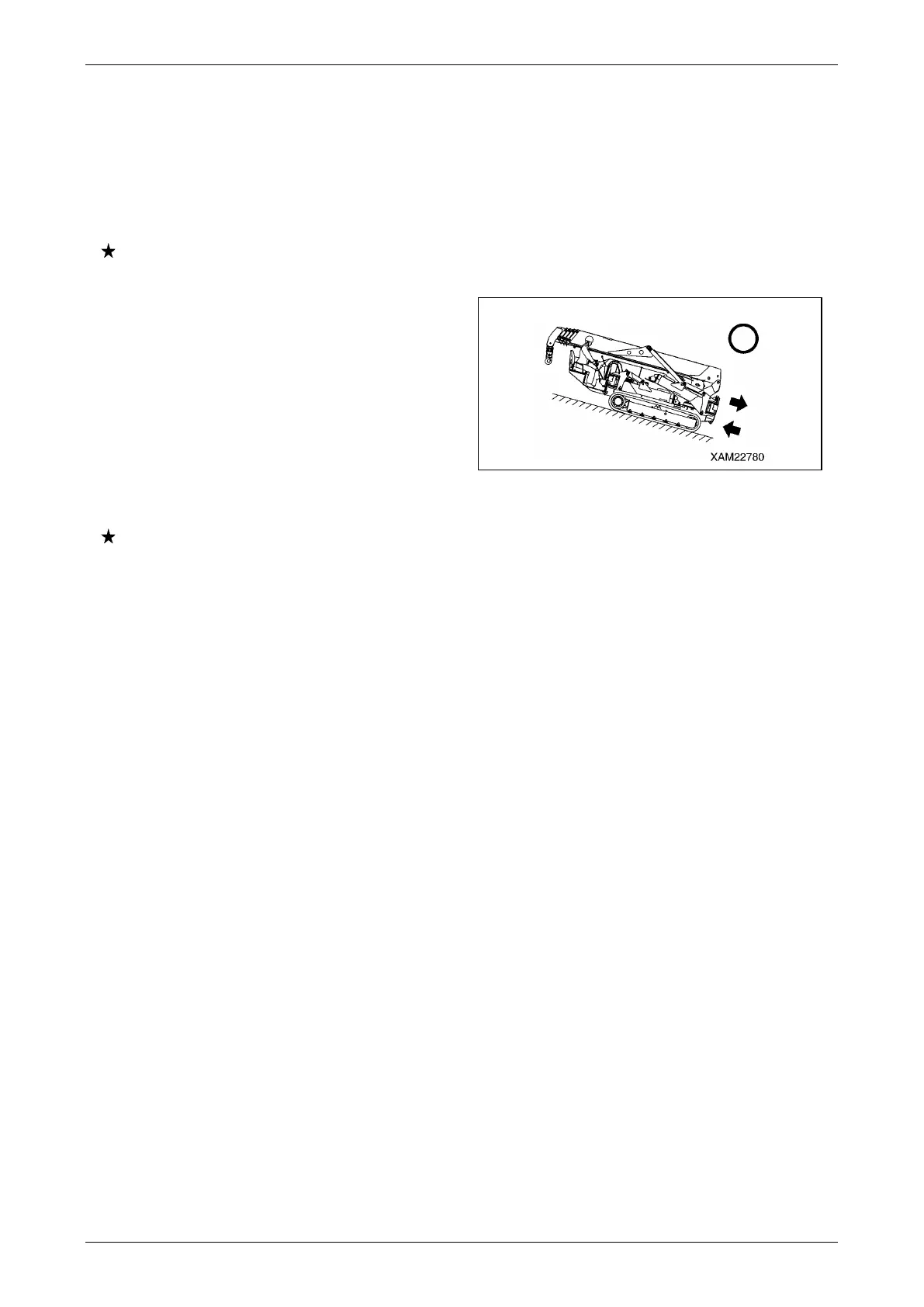
Fig. 4-521
• Always load the machine by travelling
backward. Travelling forward involves
overturning hazard. The operator must be
on the back side of the truck.
• Always unload the machine by travelling
forward. Travelling backward involves
overturning hazard. The operator must be
on the back side of the truck.
• Loading/Unloading the machine involves
danger. Be extremely careful.
• Select flat and solid ground for
loading/unloading the machine. Keep
sufficient distance from the shoulders.
• Remove dirt around the crawlers to prevent
side slip of the machine on the ramp
boards. Remove any materials on the
loading ramps such as ice, grease, and oil.
• Never change direction on the ramp boards.
Go down from the ramp board, and then
change the direction.


 To Next Page