G-2 Theory and Principles of Operation
GCT Premier functionality
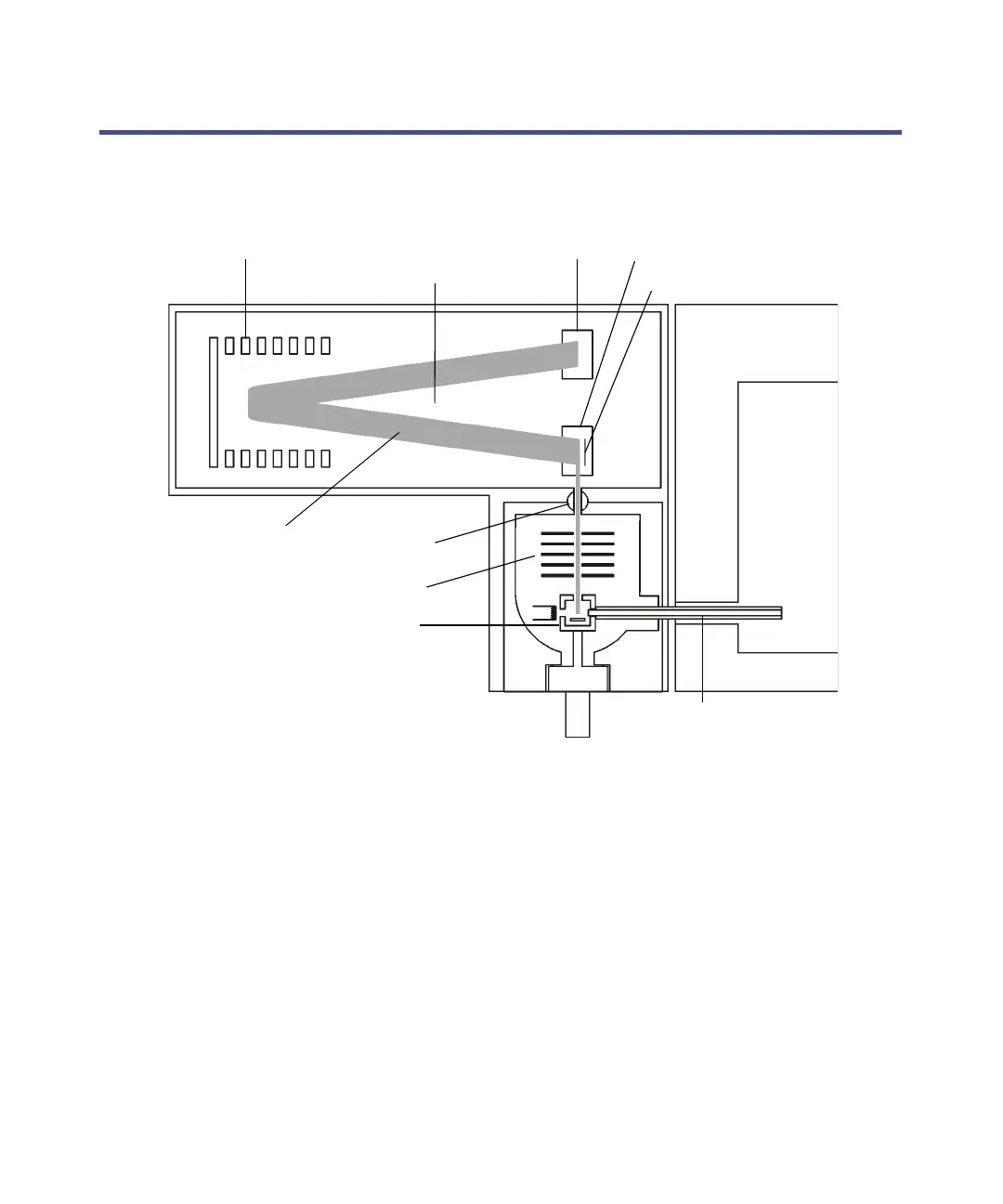
GCT Premier mass spectrometer schematic diagram (fitted with GC
interface):
Sample is introduced into the inner source, where ions are generated. the ions
are accelerated to 40 eV and focused into the pusher region. Voltage pulses
applied to the pusher electrode, at repetition frequencies up to 30 kHz, eject
sections of the ion beam orthogonally. Each discrete ion packet then passes
through a two-stage acceleration region before entering the time-of-flight
(TOF) mass analyzer. In the mass analyzer, the reflectron reflects the ions
back to the dual microchannel plate (MCP) detector. As the ions travel
through the mass analyzer, they are separated in mass according to their
flight times: ions with the highest mass-to-charge ratio (m/z) take the longest
to arrive at the detector. Ion arrivals are recorded using a time-to-digital
converter (TDC) with a sampling rate of 4 GHz, giving high mass resolution
and accuracy.
Reflectron
GC oven
Detector Pusher regionTime-of-flight
mass analyzer
Inner source
GC interface
Isolation valve
Ion path
Pusher electrode
Outer source



 To Next Page