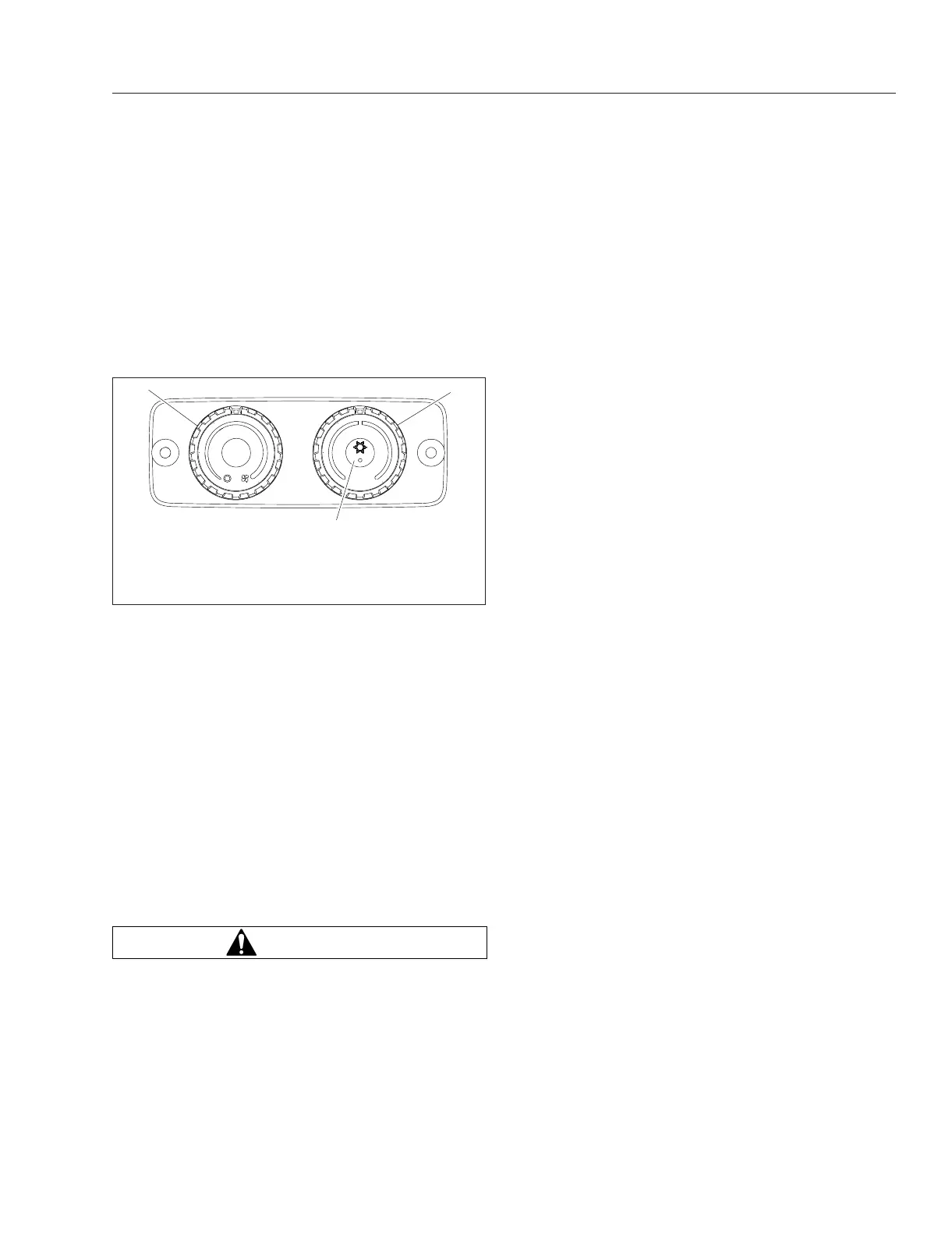
Sleeper Climate Control
The sleeper temperature can be controlled from the
sleeper climate control panel or from the cab climate
control panel if the bunk-override button is activated.
The fan knob controls the sleeper temperature fan
speed. To increase airflow, turn the knob clockwise to
a higher number. To decrease the airflow, turn the
knob counterclockwise to a lower number. See
Fig. 4.35.
The temperature control knob is used to select the
desired temperature in the sleeper. Turn the knob
clockwise to the red area for warm air. Turn the knob
counterclockwise to the blue area for cool air.
Press the button in the center of the temperature
control knob to activate the A/C.
Cancel the bunk-override mode, if activated, by
changing the sleeper fan speed or temperature set-
ting. The system will then operate from the sleeper
controls.
Seat Controls
NOTE: See Chapter 9 for detailed information
about seat controls and adjustments.
WARNING
Keep hands, tools, and other objects away from
the scissor points under the seats. Failure to do
so could cause personal injury.
The following is a description of adjustments that can
be made to various Freightliner seats. Not all seats
have all of the adjustments listed below. See
Fig. 4.36.
1.
Backrest Tilt: This adjustment enables the back-
rest to pivot forward or backward.
2.
Lumbar Support: Lumbar support changes the
shape of the seat back to give more or less sup-
port to the occupant’s lumbar (lower back) area.
This adjustment is either mechanical or air con-
trolled, depending on make and model of the
seat.
3.
Isolator: This feature reduces the amount of road
shock by isolating the occupant from the motion
of the vehicle, and allowing the upper seat to
move in a simple pendulum motion. A lockout
feature is used whenever the isolator is not de-
sired.
4.
Height Adjustment: This adjustment moves the
entire seat up or down. The adjustment is either
manually- or air-controlled, depending on the
make of the seat.
5.
Bottom Cushion Angle, or Fore-and-Aft Bottom
Cushion Height: This adjustment enables the oc-
cupant to raise or lower the front or back of the
bottom cushion. This adjustment is easier to per-
form when all weight is removed from the seat.
6.
Fore-and-Aft Seat Slide, or Seat Track Adjust-
ment: This adjustment moves the entire seat for-
ward or backward on its track.
7.
Seat Tilt: This adjustment allows the seat assem-
bly (back and bottom cushions) to tilt forward or
backward.
8.
Headrest Adjustment: This adjustment changes
the angle of the upper part of the backrest to
provide head and upper back support.
09/09/2016 f611328
3
1
2
1. Fan Knob
2. Temperature Control Knob
3. Air Conditioning Button
Fig. 4.35, Sleeper Climate Control Panel
Driver Controls
4.18



 To Next Page