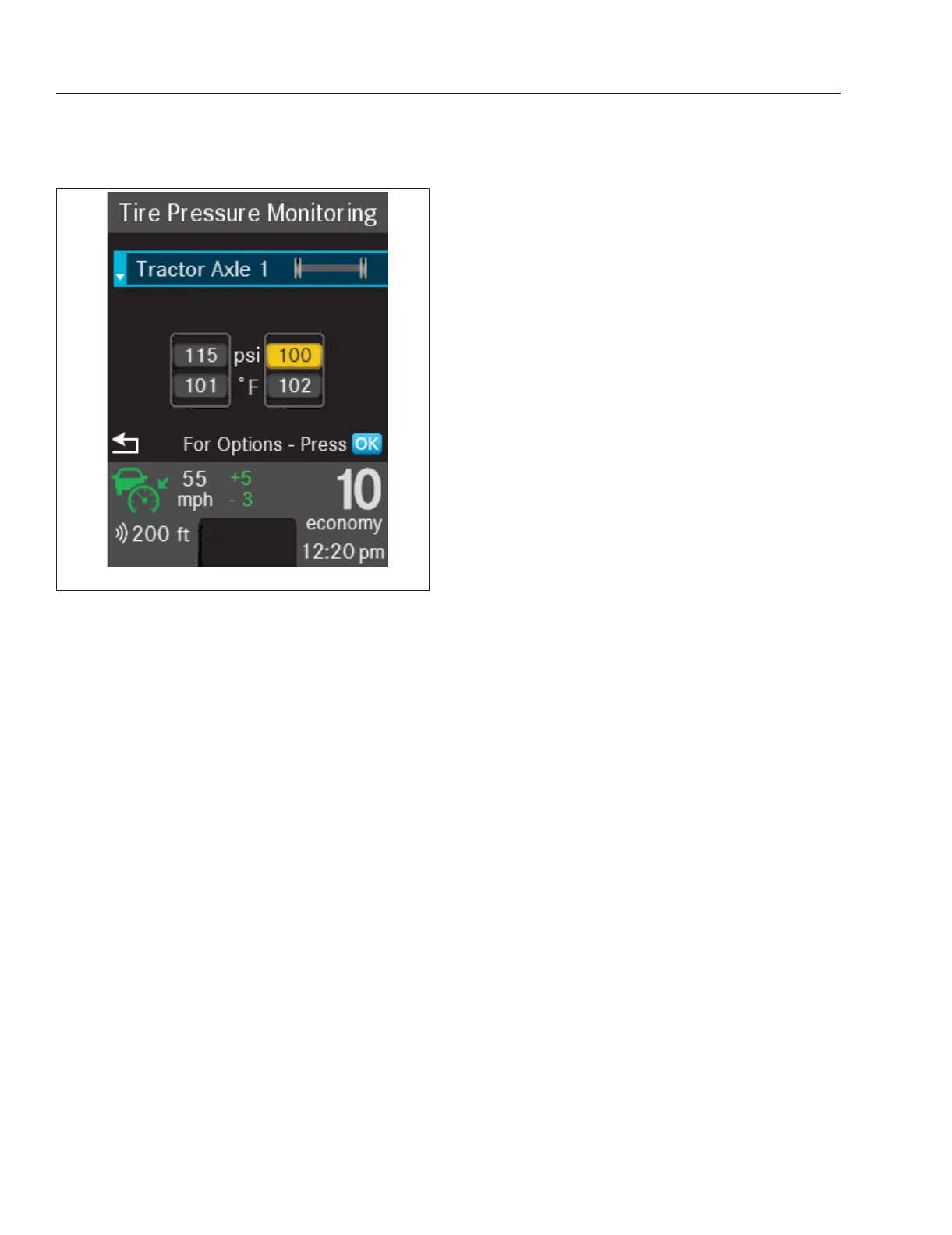
Tire pressure monitoring settings are part of the
TPMS. Threshold temperatures and what triggers
alerts can be set on this screen.
Other ICUC Gauges and
Measurements
In addition to the two screens of gauges displayed
under the Vehicle Operations menu described above,
the ICUC driver display communicates a number of
values related to vehicle operations. They are listed
in alphabetical order below.
Alerts
The Alerts screen stores the current active alerts.
Alerts are color-coded to indicate severity. Red indi-
cates a condition that may pose a threat to control of
the vehicle. Amber indicates a condition that may
result in damage to vehicle components or derating
of engine power. Grey is used for notices.
Battery Voltage
The Home screen in the ICU displays the vehicle
charging system voltage in the bottom left. By moni-
toring this number, the driver can stay aware of po-
tential battery charging problems and have them
fixed before the batteries discharge enough to create
starting difficulties.
The Home screen will normally show approximately
13.7 to 14.1 volts when the engine is running. The
voltage of a fully charged battery is 12.7 to 12.8 volts
when the engine is off. Battery voltage under 12.0
volts is considered a low battery, and a completely
discharged battery will produce only about 11.0 volts.
If the Home screen shows an undercharged or over-
charged condition for an extended period, have the
charging system and batteries checked at an autho-
rized Freightliner service facility.
Diagnostics
The Diagnostics screen communicates fault codes
and other diagnostic information about the vehicle.
Fault codes are color-coded to indicate the severity
of the fault. Red indicates a condition that may pose
a threat to control of the vehicle. Amber indicates a
condition that may result in damage to vehicle com-
ponents or derating of engine power. Grey indicates
a condition that may affect fuel efficiency or vehicle
handling.
Engine Maintenance
Shows the number of hours the engine has been op-
erating.
Maintenance System
NOTE: the wrench icon is indicative of service,
not of something that needs to be fixed.
Standard messaging is based on the number of
miles (km) driven or time passed since the last ser-
vice.
Predictive maintenance information is calculated
based on these factors as well as engine and trans-
mission load and oil temperature.
Currently, predictive maintenance information is given
for engine oil, transmission oil, and axle oil changes.
By taking driving conditions into account, predictive
maintenance provides more accurate intervals for
fluid changes.
Just before the service interval ends, a message that
maintenance is due will appear. See
Fig. 3.27.
When the service interval is reached, a pop-up notice
that maintenance is due will appear with every key
cycle.
f611460a05/30/2019
Fig. 3.26, Vehicle Operations: TPMS Axle Tire Pressure,
Temperature, and Sensor Status
Instruments
3.15



 To Next Page