NOTICE
Do not operate the vehicle continuously with the
interaxle locked during extended good road con-
ditions. To do so could result in damage to the
axle gearing and excessive driveline and tire
wear.
3.
Proceed over poor road conditions with caution.
4.
Press the lower half of the interaxle lock switch
to disengage the interaxle lock after leaving poor
road conditions.
5.
If the vehicle is moving, briefly let up on the ac-
celerator to allow the interaxle lock to disengage,
then resume driving at normal speed. Once the
interaxle lock disengages, the indicator light will
go off.
Driver-Controlled Differential
Lock (DCDL)
The driver-controlled differential lock (DCDL) feature
(side-to-side wheel lock, traction control, or traction
equalizer) is available on vehicles with single- or
tandem-drive axles.
The DCDL provides maximum traction for slippery
conditions by forcing the wheels on each drive axle
governed by the switch to rotate together. When the
DCDL is engaged, the clutch collar completely locks
the differential case, gearing, and axle shafts to-
gether, maximizing the traction of both wheels. Use
the DCDL if the interaxle lock does not provide suffi-
cient traction.
A status screen showing engaged locks is found in
the vehicle operations menus on the driver display.
See
Fig. 19.1.
Differential Lock Switch
Each differential lock is controlled by a switch on the
dash. See
Fig. 19.2.
DCDL Operation
NOTICE
Engage the DCDL only when the vehicle is
stopped or moving at less than 5 mph (8 km/h).
Engaging the DCDL at speeds above 5 mph (8
km/h) can cause internal axle damage.
NOTE: On some vehicles, the differential lock
system is connected through the low speed
range of the transmission. If this system is used,
the transmission must be in the low speed
range for the wheels to fully lock. In addition,
shifting out of low speed range will also disen-
gage the differential lock.
NOTE: If the DCDL is engaged when the engine
is shut down, the DCDL will disengage.
1.
With the engine running, press the upper half of
the differential lock switch to engage the DCDL.
2.
If the vehicle is moving, briefly let up on the ac-
celerator to relieve torque on the gearing, allow-
ing the differential to fully lock. An indicator light
on the differential lock switch illuminates when
the lock is engaged. Depending on the vehicle
configuration, a buzzer may also sound.
WARNING
Be especially careful when driving under slippery
conditions with the differential locked. Though
forward traction is improved, the vehicle can still
slip sideways, causing possible loss of vehicle
control, personal injury, and property damage.
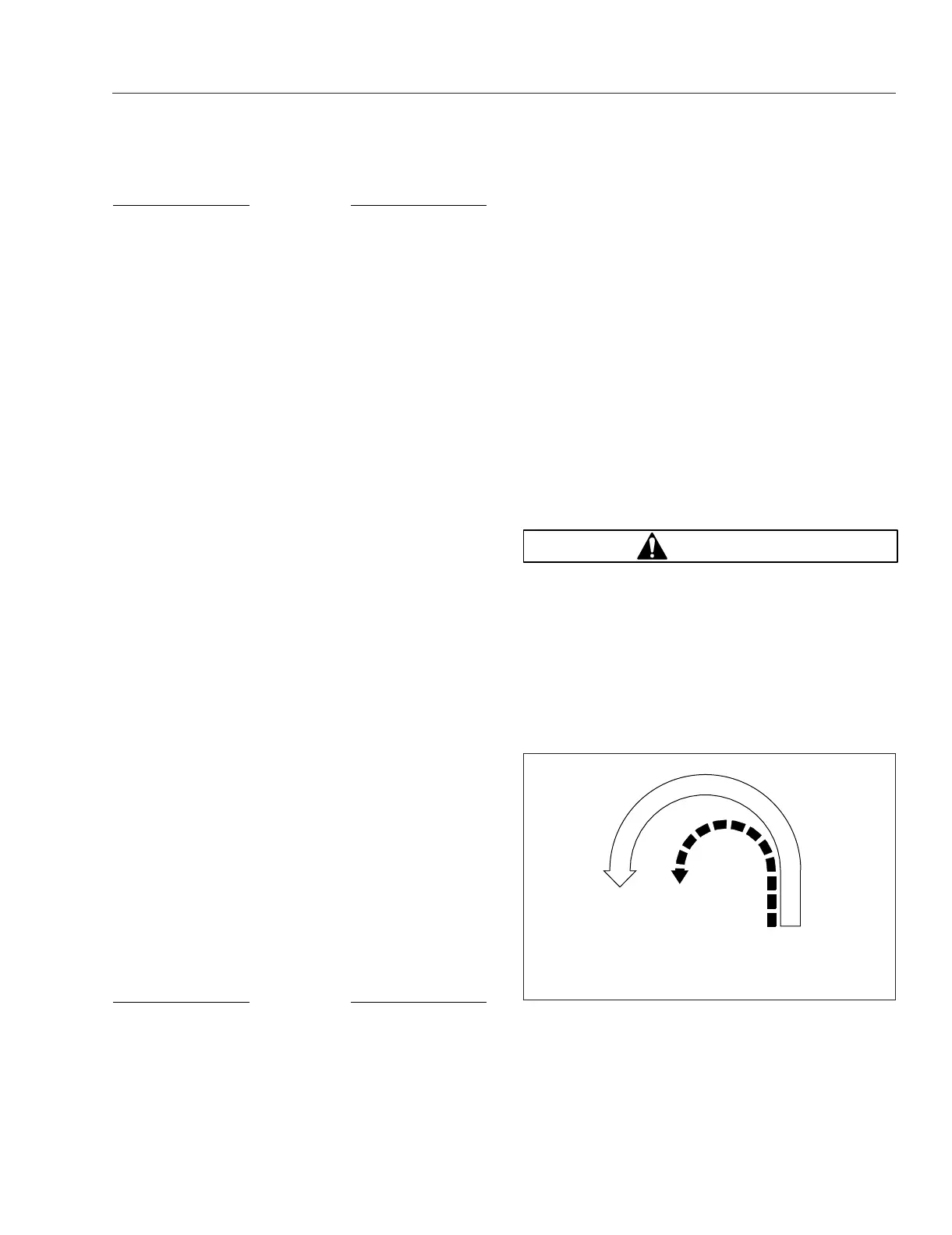
3.
Drive cautiously and do not exceed 25 mph (40
km/h). When the differential is fully locked, the
turning radius will increase because the vehicle
understeers. See
Fig. 19.3.
4.
Press the lower half of the differential lock switch
to disengage the DCDL after leaving poor road
conditions.
f350079a02/03/2017
A
B
A. Turning Radius When the DCDL is Engaged
(understeer condition)
B. Turning Radius When the DCDL is Disengaged
Fig. 19.3, Turning Radii
Drive Axles
19.2



 To Next Page