load has been greatly reduced) receive reduced
(proportional) air pressure, while the front axle
brake chambers receive full (normal) air pres-
sure. This results in a different brake pedal
"feel," as the pedal seems to require more travel
and/or effort to slow or stop the vehicle. How-
ever, the air brake proportioning system actually
improves vehicle control when the tractor is in
bobtail mode. When the tractor is towing a
trailer, the rear brake chambers will receive full
(normal) application air pressure.
When parking a vehicle attached to a trailer that
does not have spring parking brakes, apply the trac-
tor parking brakes. Chock the trailer tires before dis-
connecting the vehicle from the trailer.
WARNING
If a trailer or combination vehicle is not equipped
with spring parking brakes, do not park it by pull-
ing out only the trailer air supply valve knob.
This would apply only the trailer service brakes.
If air were to bleed from the trailer brake system,
the trailer brakes would release, possibly causing
an unattended runaway vehicle.
NOTICE
Never apply the service and spring parking
brakes simultaneously. To do so transmits exces-
sive input force to the brake components, which
could damage or cause eventual failure of brake
actuating components.
Brake Controls
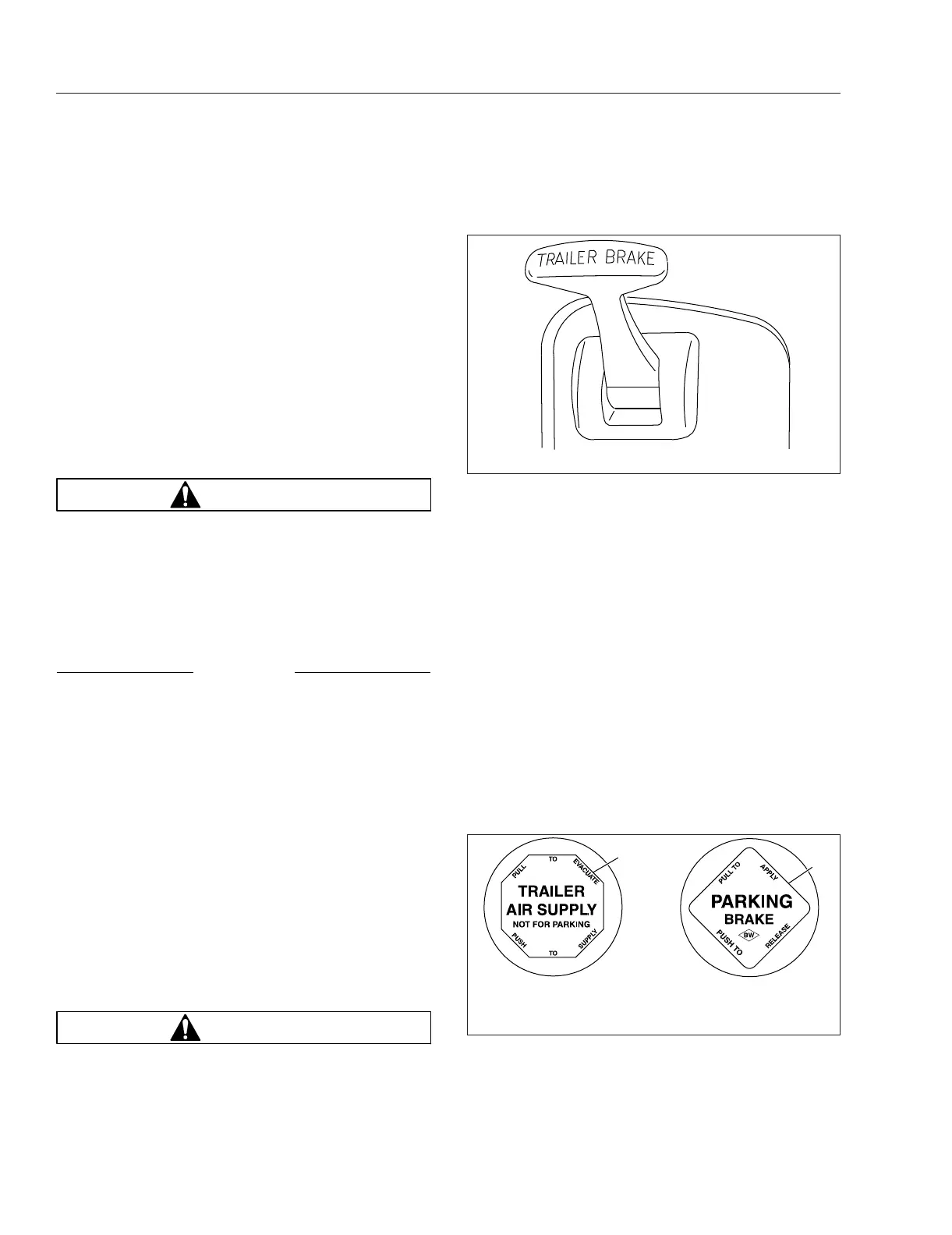
The trailer brake lever (hand control valve) is used
for applying the trailer brakes without applying the
truck or tractor service brakes. It is usually mounted
on the right-hand control panel. See
Fig. 15.1. The
valve can be partially or fully applied, but in any par-
tially on position it will be overridden by a full applica-
tion of the service brake pedal. Moving the lever
down applies the trailer brakes, while moving it up
releases the trailer brakes. The lever will automati-
cally return to the up position when it is released.
WARNING
Do not use the trailer service brakes for parking;
they are not designed for this purpose. If air
bleeds out of the trailer air tank during parking,
the vehicle could roll, causing serious personal
injury or property damage.
The red octagonal-shaped knob in the control panel
actuates the trailer air supply valve. See
Fig. 15.2.
After the vehicle’s air hoses are connected to a
trailer and the pressure in both air systems is at least
65 psi (448 kPa), the trailer air supply valve must be
pushed in. It should stay in to charge the trailer air
supply system and to release the trailer spring park-
ing brakes.
Pull the trailer air supply valve out before disconnect-
ing a trailer or when operating a vehicle without a
trailer.
If pressure in both air systems drops to 20 to 45 psi
(138 to 310 kPa), the red trailer air supply valve and
yellow parking brake valve automatically pop out,
applying both the tractor and trailer spring parking
brakes. If the trailer is not equipped with spring park-
ing brakes, the trailer service brakes are applied.
The yellow diamond-shaped knob in the control
panel actuates the parking brake valve. See
Fig. 15.2. Pulling out the parking brake valve applies
f61059102/03/2017
Fig. 15.1, Trailer Brake Lever
f61029102/02/2017
1
2
1. Trailer Air-Supply-Valve Knob
2. Parking-Brake-Valve Knob
Fig. 15.2, Brake Valve Knobs
Brake Systems
15.3



 To Next Page