wheel switches. Refer to Chapter 3 for more infor-
mation on instruments and driver display controls.
Adaptive Cruise Control (ACC)
Overview
Adaptive cruise control controls speed and the dis-
tance from a detected vehicle in front to maintain a
safe following distance.
When the vehicle is traveling above 10 mph (15
km/h) and there is no vehicle in front, ACC operates
in the same way as standard cruise control by accel-
erating to the set speed.
The default following speed of adaptive cruise control
is 3.6 seconds but can be adjusted in the range of
2.4 and 3.6 seconds.
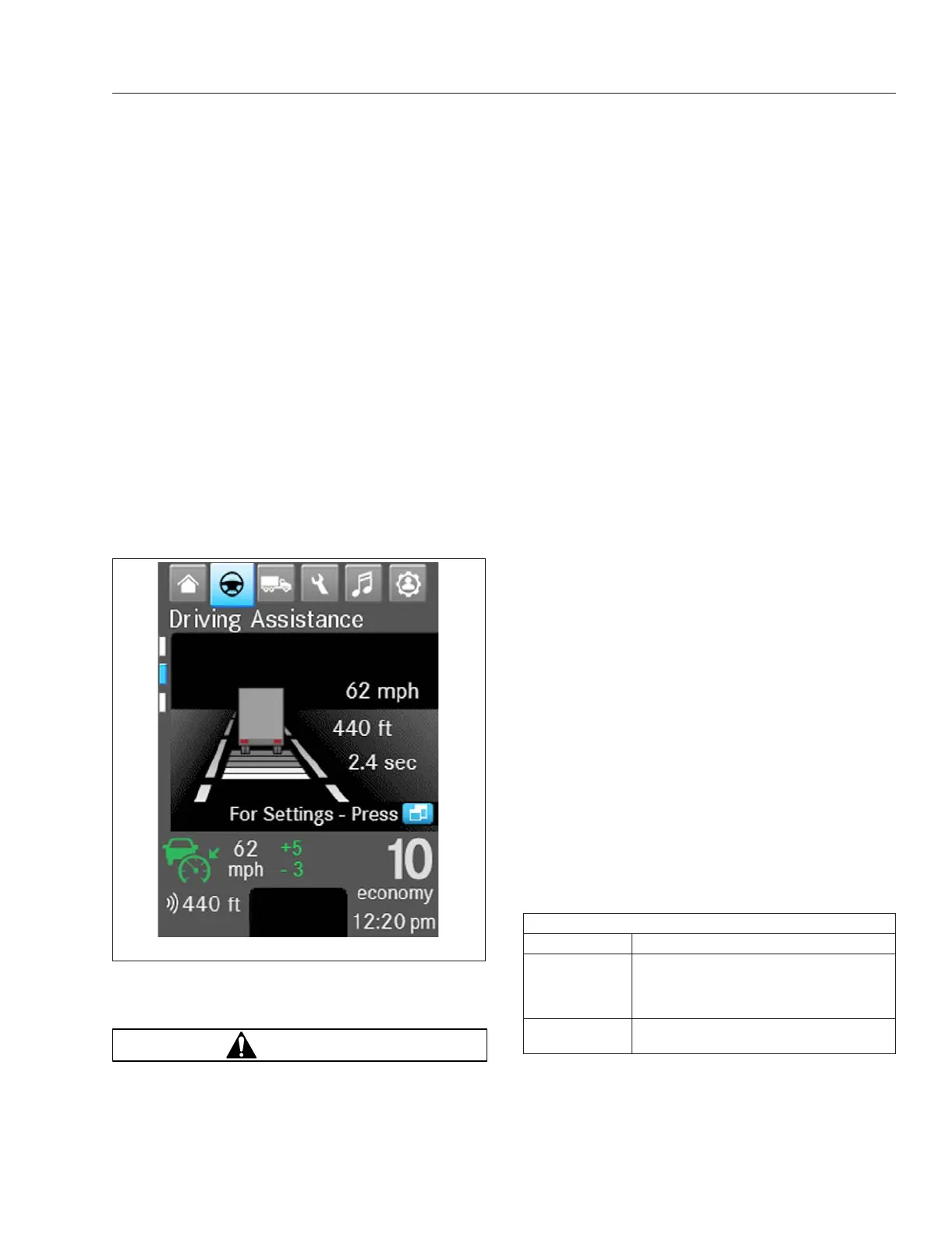
When a vehicle in front is detected, the driver display
shows the speed of the detected vehicle and the dis-
tance to the detected vehicle. See
Fig. 5.3.
Safety Information
WARNING
The Detroit Assurance system is intended solely
as an aid for an alert and conscientious profes-
sional driver. It is not intended to be relied upon
to operate a vehicle. Use the system in conjunc-
tion with rearview mirrors and other instruments
to safely operate the vehicle.
The Detroit Assurance system is not a substitute
for safe, normal driving procedures, nor will it
compensate for any driver impairment such as
drugs, alcohol, or fatigue.
Failure to drive safely and use the system prop-
erly could result in personal injury and/or death
and severe property damage.
Operate a vehicle equipped with the Detroit As-
surance system as if the vehicle were not
equipped with a collision warning system.
Adaptive cruise control (ACC) may not detect narrow
vehicles, like motorcycles, driving in front of the ve-
hicle, or vehicles driving in a different lane.
In particular, be aware of the following situations:
•
cornering, entering, and exiting bends;
•
vehicles driving in a different lane;
•
vehicles changing lanes;
•
vehicles exiting the road;
•
overtaking;
•
winding stretches of road; and
•
obstacles and stationary vehicles.
Adaptive cruise control does not compensate for inat-
tentive driving, weather, or traffic conditions. Adaptive
cruise control is only an aid. The driver is responsible
for maintaining a safe distance from the vehicle in
front, maintaining a safe vehicle speed, braking, and
remaining in a lane.
ACC Controls
See Fig. 5.4 and Table 5.1 for a description of
cruise control steering wheel switches.
Steering Wheel Controls
Description Function
–/SET
Sets the cruise speed while the vehicle
is traveling at the desired speed.
Pressing and and holding decreases the
set cruise speed.
+/RES
Resumes the set speed. Pressing and
holding increases the set cruise speed.
f61139209/14/2016
Fig. 5.3, Adaptive Cruise Control Screen
Detroit Assurance 4.0
5.2



 To Next Page