and cooling. When the engine is turned off, the ve-
hicle batteries power the separate electric air condi-
tioner loop or support a fuel-operated heater.
Operation of the Dual HVAC system is regulated by
the cab Progressive Low Voltage Disconnect (PLVD).
The PLVD must be enabled for the Dual HVAC sys-
tem to be started. The PLVD will stop operation of
the Dual HVAC system when the voltage gets below
a pre-determined threshold. Before operating the
Dual HVAC system, bring the sleeper interior tem-
perature to the desired temperature with the engine
running and the bunk curtain open. The Dual HVAC
system is designed to maintain an established com-
fortable bunk temperature in parked mode for up to
12 hours with the bunk curtain closed.
NOTE: The condition and charge of the vehicle
batteries will directly affect the run time of the
Dual HVAC system. If the vehicle run time be-
tween discharges is less than eight hours, or if
additional loads are added to the vehicle batter-
ies, the Dual HVAC system run time will be less
than expected.
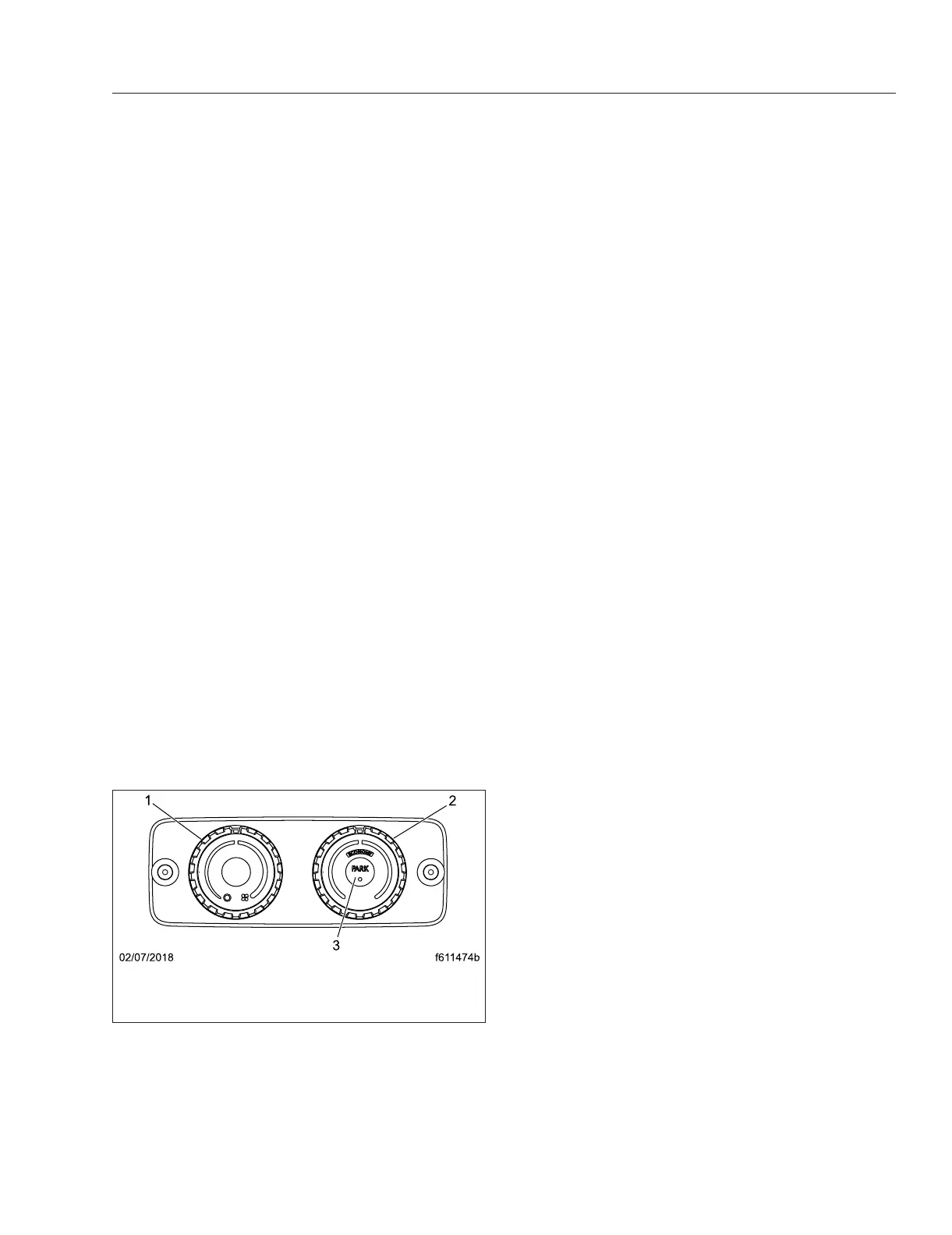
Dual HVAC Control Panel
The Dual HVAC system control panel replaces the
standard sleeper control panel in Dual HVAC-
equipped sleeper cabs. See
Fig. 8.11. The Dual
HVAC system is designed to maintain a comfortable
temperature inside the sleeper, and can operate in
combination with the cab climate control system
when the vehicle is running, or independently when
the vehicle is parked.
To operate Dual HVAC system, select a fan speed
(other than off) and push the PARK button. Adjust
the temperature control knob to the desired tempera-
ture.
The fan switch has ten fan speeds. Zero (0) is the
OFF position. Turn the switch clockwise to increase
airflow, and counterclockwise to decrease airflow.
The temperature control knob controls the tempera-
ture from 65°F to 85°F (18°C to 29°C). At the mini-
mum setting of 65°F the unit will attempt to cool the
bunk to 65°F and will not allow the coolant heater to
operate. At the maximum setting of 85°F the unit will
attempt to heat the bunk to 85°F and will not allow
the A/C cooling to operate. In between the two ex-
tremes the unit will operate in either the heating or
cooling mode to achieve the set point.
On vehicles with Optimized Idle, interior comfort
mode with Dual HVAC system operates with the fol-
lowing parameters regarding the set point and com-
fort zone:
•
If the bunk area reaches more than 10°F (5.5
°C) above the set point the Dual HVAC system
immediately requests the engine to start for
bunk cooling.
•
Bunk area temperature 5 to 10°F (2.8 to 5.5°C)
above the set point for over twenty minutes will
cause the Dual HVAC system to request the
engine to start for bunk cooling.
•
When the sleeper area drops to more than
10°F (5.5 °C) below the set point, the comfort
zone is exceeded and the Dual HVAC system
immediately requests the engine to start for
bunk heating.
•
Bunk area temperatures 5 to 10°F (2.8 to 5.5
°C) below the set point for over twenty minutes
will cause the Dual HVAC system to request
the engine to start for bunk heating.
The mid-point position on the Dual HVAC system
temperature control knob is a set point of 73°F
(23°C). In most conditions the mid-set point for tem-
perature and mid-set point for fan speed will assure
a stable environment. Mid-point for both controls is
suggested as the initial position, with subsequent ad-
justment for personal preference.
IMPORTANT: Wait three minutes after shutting
down the Dual HVAC system before turning the
cab load disconnect switch (CLDS) to OFF.
1. Fan Knob
2. Temperature Control
Knob
3. PARK Button
Fig. 8.11, Dual HVAC System Control Panel
Climate Controls
8.6



 To Next Page