vehicle to suddenly roll. This could cause prop-
erty damage or personal injury.
9.
Chock the tires on the disabled vehicle and con-
nect the towing vehicle’s air brake system to the
vehicle being towed. Then, release the spring
parking brakes on the disabled vehicle and re-
move the chocks.
Front Towing Hookup With
Removable Tow Hooks
DANGER
When working on the vehicle, shut down the en-
gine, set the parking brake, and chock the tires.
Before working under the vehicle, always place
jack stands under the frame rails to ensure the
vehicle can not drop. Failure to follow these
steps could result in serious personal injury or
death.
1.
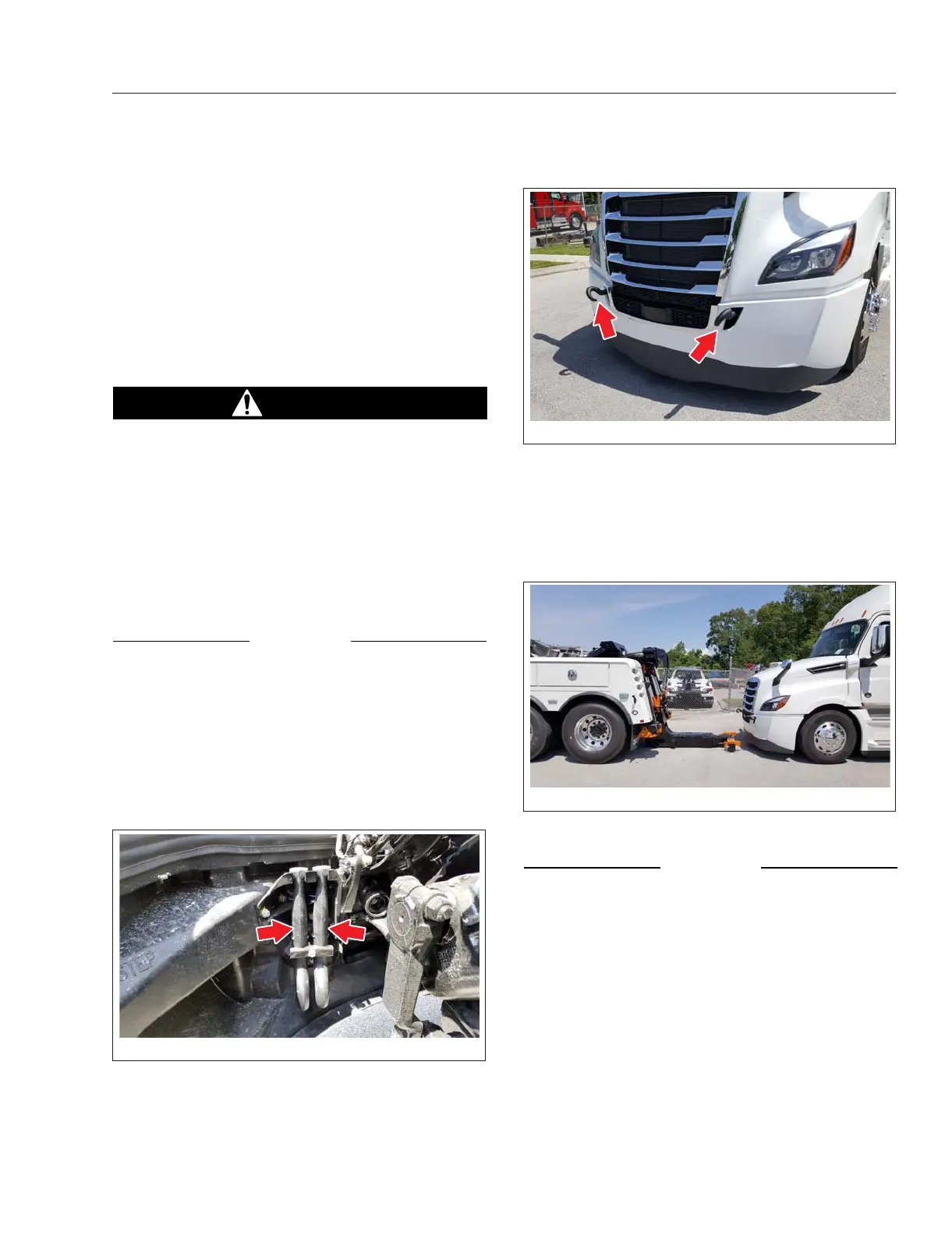
Open the hood. Remove the tow hooks, located
behind the driver’s-side bumper. See Fig. 26.4.
Close and latch the hood.
NOTICE
New or ungreased tow hooks may be hard to in-
stall. Tow hooks that are not properly installed
may be damaged or break.
2.
Install the tow hooks onto the tow hook receivers
through the tow hook holes in the bumper, rotat-
ing the hooks so the hook opening faces down.
See
Fig. 26.5. Pull the tow hooks to ensure they
are securely engaged in the tow hook receivers.
3.
Lower the stinger assembly so that it is level and
approximately 1 inch (0.3 cm) off the ground.
Back the tow truck so that the crossbar with lift
adaptors is within 6 inches (15 cm) of the Aero
bumper. See
Fig. 26.6.
NOTICE
When using tow hooks to move the vehicle, do
not pass a sling (for example, a rope or chain)
from one hook to another. Known as reeving, this
practice is not permissible in most industrial ap-
plications of towing and hoisting. Reeving can
overload the hooks and result in damage to the
vehicle. See
Fig. 26.3.
4.
Pull the tow cables out of the tow truck and con-
nect the tow cable lifting hooks onto the tow
hooks, then extend the recovery boom within 4
to 6 inches (10 to 15 cm) of being vertical of the
tow hooks. See
Fig. 26.7.
f13014606/14/2017
Fig. 26.4, Tow Hooks
f13014706/14/2017
Fig. 26.5, Tow Hooks Installed, Facing Down
f13014906/14/2017
Fig. 26.6, Positioning the Stinger Assembly
In An Emergency
26.4



 To Next Page