WARNING
Do the next step exactly as instructed and do not
allow the clamps of one cable to touch the
clamps of the other cable. Otherwise, a spark
could occur near a battery, possibly resulting in
severe personal injury from explosion or acid
burns.
5.
Connect one end of the negative jumper cable to
the negative battery or jump start post of the ve-
hicle providing the jump start.
6.
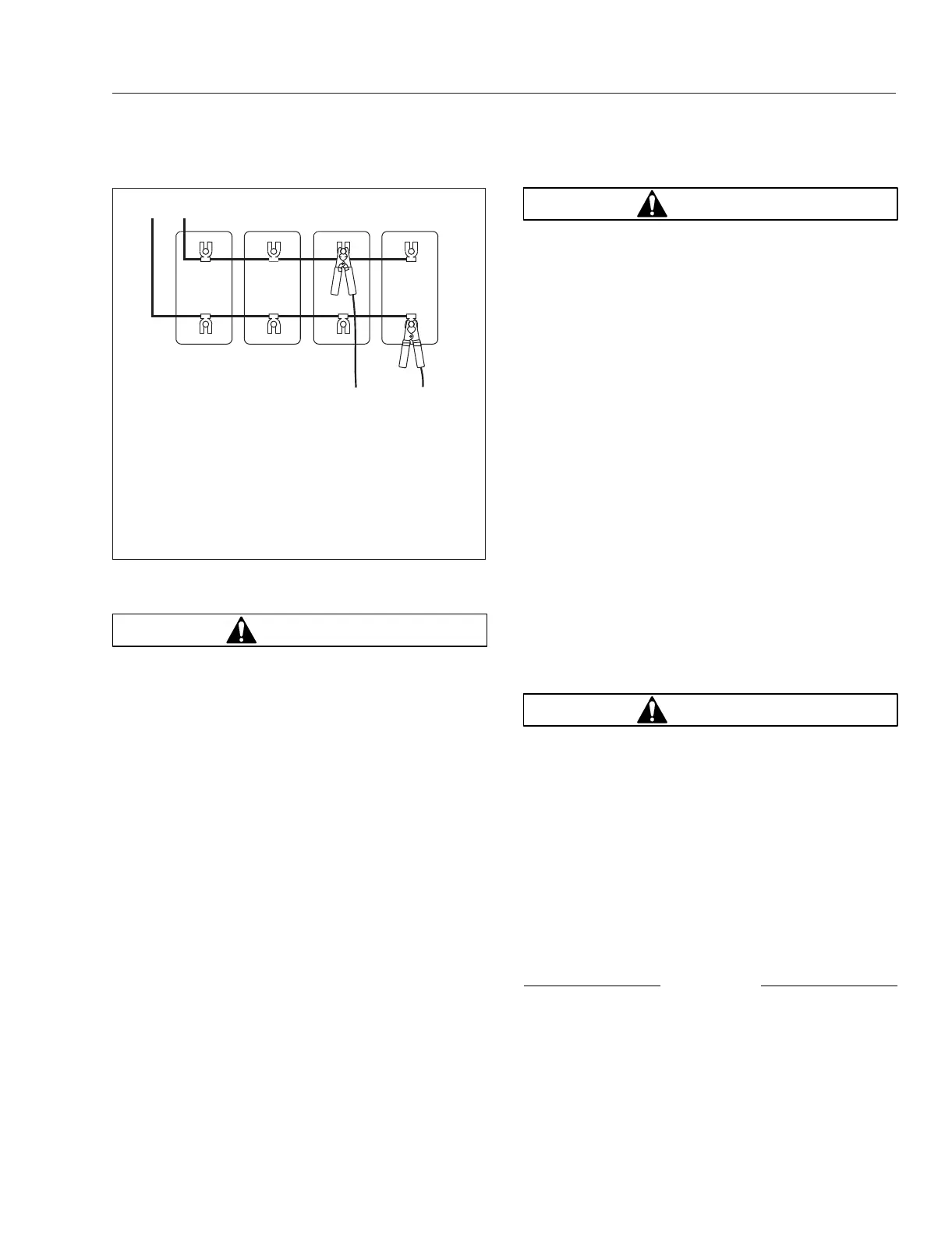
Then connect (ground) the other end of the cable
to a negative battery or jump start post on the
vehicle needing a jump start. See callout B in
Fig. 26.2.
7.
Start the engine of the vehicle providing the jump
start and let the engine run a few minutes to
charge the batteries of the other vehicle.
8.
Attempt to start the engine of the vehicle with the
batteries receiving the charge. Do not operate
the starter longer than 30 seconds, and wait at
least two minutes between starting attempts to
allow the starter to cool.
9.
When the engine starts, let it idle a few minutes.
WARNING
Do the next step exactly as instructed and do not
allow the clamps of one cable to touch the
clamps of the other cable. Otherwise, a spark
could occur near a battery, possibly resulting in
severe personal injury from explosion or acid
burns.
10.
Disconnect the negative (grounded) jumper cable
from the vehicle that needed the jump start. See
callout B in
Fig. 26.2.
11.
Then disconnect the other end of the jumper
cable from the vehicle that provided the jump
start.
12.
Disconnect the positive jumper cable from the
positive battery or jump start post of the vehicle
that provided the jump start.
13.
Then disconnect the other end of the positive
jumper cable from the positive battery or jump
start post of the vehicle that received the jump
start. See callout A in
Fig. 26.2.
14.
Install the battery box cover; be sure it is posi-
tioned properly before fastening the latches.
Towing
WARNING
Do not tow an unbraked vehicle if the combined
weight of both vehicles is more than the sum of
the gross axle weight ratings (GAWR) of the tow-
ing vehicle. Otherwise brake capacity will be in-
adequate, which could result in personal injury or
death.
Use of Tow Hooks
Tow hooks are not designed for on-road towing of
the vehicle, but to recover and move the vehicle to a
position where it can be hooked up properly for front
or rear towing.
NOTICE
When using tow hooks to move the vehicle, do
not pass a sling (for example, a rope or chain)
from one hook to another. Known as reeving, this
practice is not permissible in most industrial ap-
plications of towing and hoisting. Reeving can
f545111a04/22/2020
1
A
+
−
+
−
+
−
+
−
B
2
1. – Hardline Battery Cable of Vehicle Needing the
Jump
2. + Hardline Battery Cable of Vehicle Needing the
Jump
A. + Jumper Cable to Connect First and Disconnect
Last
B. – Jumper Cable to Connect Last and Disconnect
First
Fig. 26.2, Jumper Connections on Vehicle Needing
Jump Start
In An Emergency
26.2



 To Next Page