Default data:
Each reader is pre-programmed with the default data shown for a stand-alone reader above.
Database programming:
As described the database consists of two parts, a global part and a local part. During programming the global
database is automatically updated. On the contrary the local database must be programmed in each reader or at
least copied from one reader to the others if they are all the same.
The following data are in the global database:
- All card programming
- Week programs 0 - 30
If a reader has no communication with the bus, it will refuse to make the global database programming.
The following data are in each local database:
- All personnel group data
- Week programs 31 - 34
- Card reader data
- S-ART I/O data.
G:
If the reader has more input/output connections than pre-programmed in the default data each used input or
output address must be programmed with a softtype using the menus 84 or 85. This must be programmed
or copied in each reader.
H:
The pre-programmed door timing can be changed using menu 83. This must be programmed or copied in
each reader.
I:
After initialization the master card can be used to create normal cards and also more programming cards if
needed, and to make the system programming. Please refer to the following description of the personnel
group principle, week time program principle and the Operating instructions.
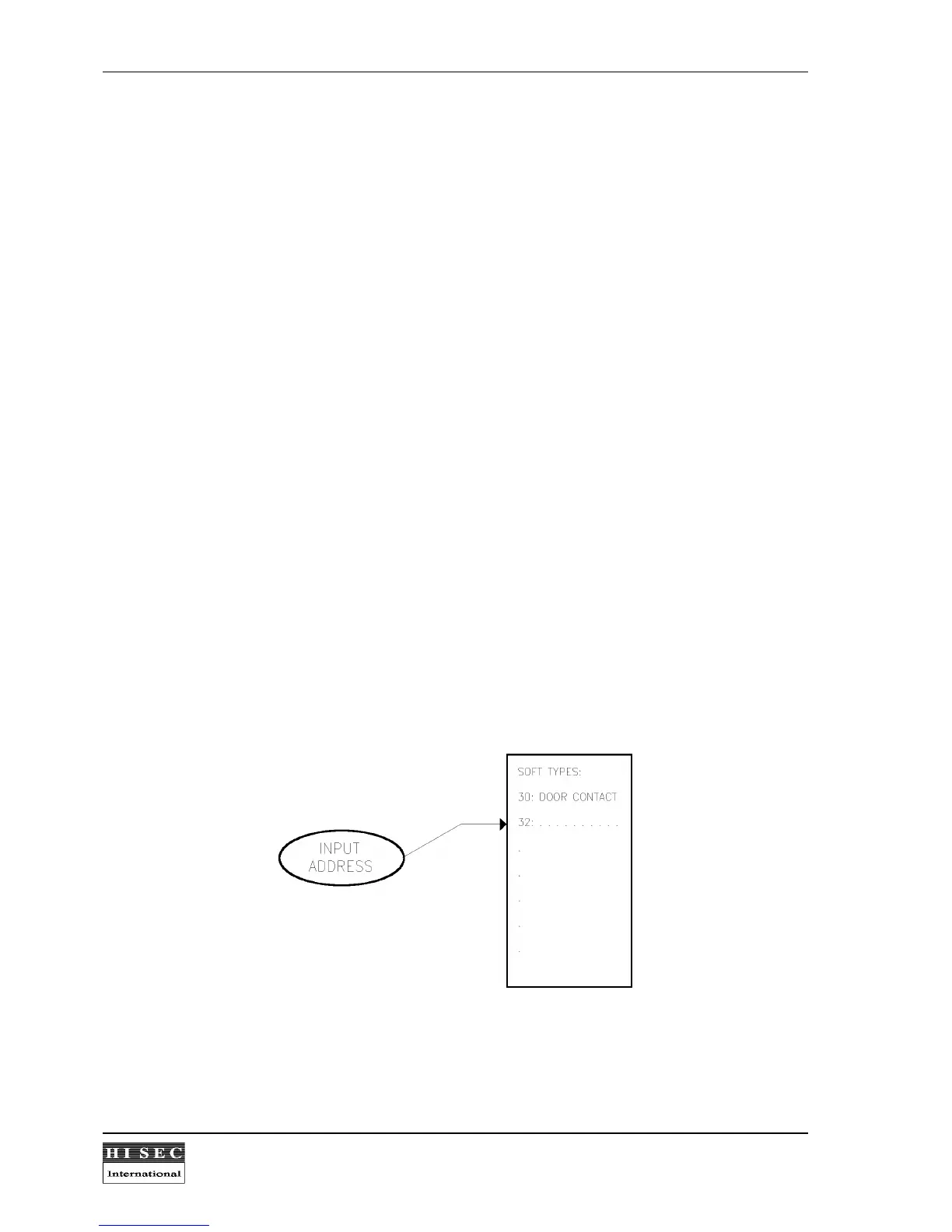
3.3 Programming of inputs.
All input/output to the reader is done by S-ART's. Each used S-ART input must be programmed with an input
softtype. Non-programmed inputs have no function. To give an input a function, a softtype is "connected" to the
address as illustrated below.
A list of predefined input softtypes is available (see the Function Description section 1.4). Included in this list are
also 10 types without a predefined function which can be used for other purposes. These types must be in-
cooperated in a IF/THEN equation. Also input soft types 30 to 36 can be used in IF/THEN equations. Please
refer to input soft type description section 1.4.2.



 To Next Page