Page: 1
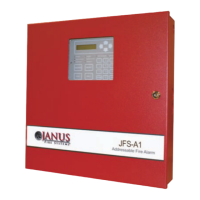
JFS-A1 INSTALLATION, OPERATION, AND INSTRUCTION MANUAL
Document # : DOC230
Issued: August 27, 2012
Revised: N/A
SECTION 1: INTRODUCTION
e Model JFS-A1 is a listed and approved, microprocessor based addressable re control panel and complies with
UL-864, NFPA-12, NFPA-12A, NFPA-13, NFPA-15, NFPA-16, NFPA-17, NFPA-17A, NFPA-72, NFPA-750,
NFPA-2001 and CSFM.
e JFS-A1 system software is compatible with Windows XP, Windows Vista and Windows 7 Operating Systems;
additionally, the latest version of Microsoft .NET Framework is required. e system software incorporates
conventional shortcuts, and provides great exibility in eectively programming individual or groups of devices.
Operational Mode behavior can be customized, including the four (4) on-board circuits (NACs 1 and 2, and
Input/Outputs 1 and 2). is exibility enables conguration of system points to maximize protection throughout
controlled site(s).
Purpose of This Manual
is manual is intended to assist in the installation and programming the JFS-A1 Fire Alarm Control Panel. Refer
to this manual to properly install and program the JFS-A1. It is recommended that the user follows the procedures
as outlined in this manual to assist in proper installation and prevent damage to the control panel and associated
equipment.
System Overview
e JFS-A1 system is designed for use as a re control panel for life safety applications, as a releasing panel for pre-
action and deluge, water-based extinguishing systems or for agent extinguishing systems. It may also be used as a
stand-alone re control panel.
System Features
e JFS-A1 features a built in signaling line circuit (SLC), and is capable of supporting 75 Potter/Nohmi
protocol devices.
5.0 Amp 24vdc Power Supply
Two (2) Notication Appliance Circuits (NACs) each rated at 3.0 Amps maximum.
Power Limited
Built in Sync
Cadence Patterns
Auxiliary Power
Releasing Solenoid Output
Two (2) Input/Output Circuits each rated at 1.0 Amps maximum.
Power Limited
Built in Sync
Cadence Patterns
Auxiliary Power
Contact Input
Reverse Polarity Driver
Releasing Solenoid Output


 To Next Page