Alteon Application Switch Operating System Application Guide
Persistence
588 Document ID: RDWR-ALOS-V2900_AG1302
Cookie Modes of Operation
Alteon supports the following modes of operation for cookie-based session persistence: insert,
passive, and rewrite mode. Table 49 - Comparison Among the Three Cookie Modes, page 588 shows
the differences between these modes:
Insert Cookie Mode
In the insert cookie mode, Alteon generates the cookie value on behalf of the server. Because no
cookies are configured at the server, the need to install cookie server software on each real server is
eliminated.
An inserted cookie has a value of 28 bytes, containing an 8-byte virtual server IP (VIP) value, an 8-
byte client IP (CIP) value, a 4-byte real server port (RPORT) value, and an 8-byte random client ID
value.
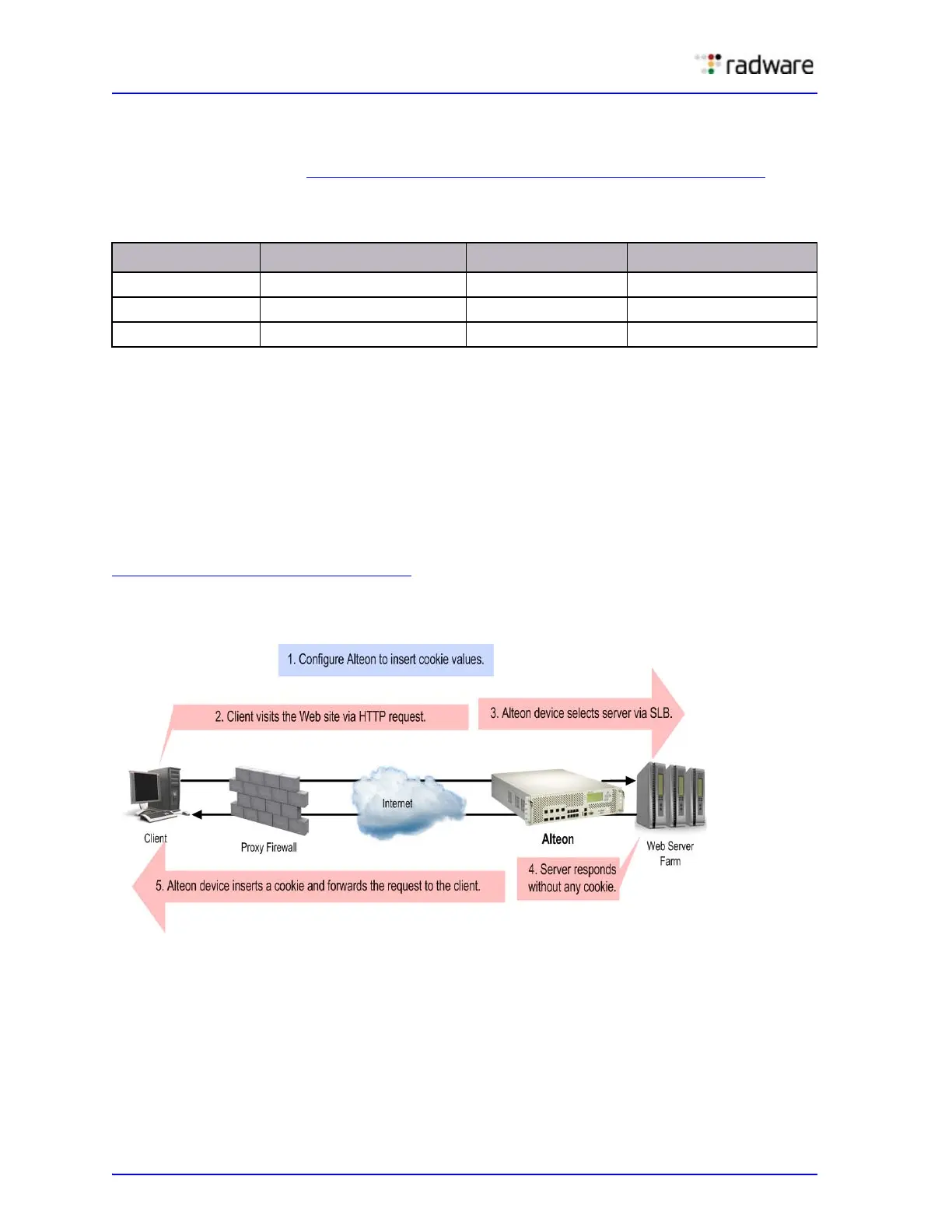
In this mode, the client sends a request to visit the Web site. Alteon performs load balancing and
selects a real server. The real server responds without a cookie. Alteon inserts a cookie and forwards
the new request with the cookie to the client.
Figure 93 - Insert Cookie Mode, page 588
illustrates insert cookie mode:
Figure 93: Insert Cookie Mode
Insert Cookie Mode Enhancement
This mode allows you to configure new cookie values, a path, and a secure flag. The configuration
options are:
• Cookie name—This defaults to "AlteonP".
• Expiry date and time—If configured, the client sends cookie only until the expiration time.
Otherwise, the cookie expires after the current session.
Table 49: Comparison Among the Three Cookie Modes
Cookie Mode Configuration Required Cookie Location Uses Session Entry
Insert Cookie Alteon only HTTP Header No
Passive Cookie Server and Alteon HTTP Header or URL Yes
Rewrite Cookie Server and Alteon HTTP Header No



 To Next Page