Need help?
Do you have a question about the R&S FSPN and is the answer not in the manual?
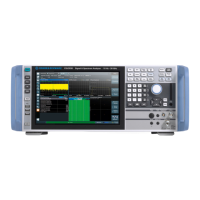
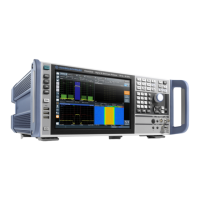
The R&S®FSPN is a dedicated Phase Noise Analyzer and VCO Tester, designed for the development, production, and verification of electronic components and devices in industrial, administrative, and laboratory environments. It is available in models such as R&S®FSPN8 (1322.8003K06) and R&S®FSPN26 (1322.8003K24).
The R&S FSPN's primary function is phase noise measurement, but it also offers capabilities for VCO characterization, spot noise vs. tune measurements, and PN transient analysis. It can handle several measurement tasks (channels) simultaneously, though asynchronously, with each channel displayed in a separate tab on the screen. A "MultiView" tab provides an overview of all active channels.
Phase Noise Measurements: The instrument measures the noise characteristics of a Device Under Test (DUT) over a defined frequency offset range. It can display single sideband phase noise, spectral density of phase fluctuations, and spectral density of fractional frequency fluctuations. It also calculates residual noise effects like residual PM, residual FM, and jitter, based on the integration of phase noise over specific offset frequency ranges.
VCO Characterization: This measurement determines the characteristics of DUTs like voltage-controlled oscillators (VCOs) or YIG oscillators, where characteristics change based on applied voltage or current. It provides results for oscillation frequency, output power, and sensitivity as a function of tuning voltage or current.
Spot Noise vs. Tune Measurements: This feature measures the spot noise characteristic of DUTs whose spot noise changes with applied voltage or current, similar to VCO characterization, providing results for phase noise and AM noise.
PN Transient Analysis: This measurement analyzes the transient response of a DUT over time, monitoring frequency and phase variations to determine how long it takes for the signal to reach a stable state.
Input Sources: The R&S FSPN supports RF input (50 Ohm) and baseband input (50 Ohm). The RF input can be AC or DC coupled, with AC coupling being the default to prevent damage from DC voltage. The baseband input is DC coupled and extends the lower frequency range to 1 mHz, suitable for testing DC sources' voltage supply or amplifiers' noise characteristics.
DC Power Supply: The instrument provides three DC power outputs (Vsupply, Vtune, Vaux) to supply external devices like DUTs or reference oscillators. Vsupply offers 0 V to +16 V (max 2000 mA), Vtune provides -10 V to +28 V (max 20 mA), and Vaux provides -10 V to +10 V (max 100 mA).
The R&S FSPN is equipped with a touchscreen display with a resolution of 1280x800 pixels, calibrated for a 16:10 format. It supports external monitors via DVI or DisplayPort. The instrument includes a 1 GBit Ethernet IEEE 802.3u network interface with Auto-MDI(X) functionality for LAN connections. It also has a GPIB interface (IEEE488 and SCPI compliant) for remote control. Three USB 2.0 ports are on the front panel, with additional ports (including one type B) on the rear. An OCXO (Oven Controlled Crystal Oscillator) generates a highly precise 10 MHz reference signal, which can be used internally or synchronized with other devices via the REF OUTPUT 10 MHz connector. External reference signals (1-20 MHz, 100 MHz, 640 MHz) can also be provided via REF INPUT connectors. The instrument's internal hard disk is removable, storing the operating system, firmware, and measurement data.
User Interface: The R&S FSPN features a touchscreen for intuitive interaction, allowing users to change settings, displays, move markers, zoom diagrams, and select evaluation methods. A keypad with alphanumeric keys and unit selection, along with a rotary knob and cursor keys, provides alternative control. An on-screen keyboard is also available.
Display Configuration: Users can customize the display layout using the "SmartGrid" function, arranging up to 16 individual windows (graphs or tables) in columns or rows. Windows can be moved, resized, added, or closed. Zoom functions (single and multiple) allow detailed analysis of measurement results. Various display elements like the status bar, channel bar, and toolbar can be hidden or shown to maximize the display area.
Measurement Control: Measurements can be started in single or continuous sweep modes. The "Sequencer" function allows configuring and running a sequence of measurements across multiple channels. Traces can be smoothed by averaging measurement data or by adjusting cross-correlation operations. Spurs (unwanted peak levels) can be displayed, removed, or filtered.
Data Management: Instrument settings and measurement data can be stored and recalled. The "Quick Save/Quick Recall" function allows fast storage and retrieval of up to ten settings sets. More configurable storage options enable users to select specific data types (current settings, transducers, traces, limit lines, weighting filters, spectrograms) and locations (internal flash disk, memory stick, network drive).
Remote Control: The R&S FSPN can be operated remotely via LAN (VXI-11, HiSLIP, raw socket protocols) or GPIB interface. A web browser interface provides remote access to instrument controls and file transfer. The Windows Remote Desktop application can also be used for central monitoring and control.
System Setup: The instrument allows configuration of various system settings, including LAN parameters, GPIB address, display themes and colors, date and time, and reference frequency.
Self-Alignment: The instrument can perform a self-alignment to align data to a reference source, especially after significant temperature changes or firmware updates. This ensures accurate measurement results.
Self-Test: A self-test function allows users to check for defective modules in case of instrument malfunction.
Firmware Updates: The firmware can be updated to enable new features or improve performance. Rohde & Schwarz provides update packages and release notes.
System Configuration Information: The instrument provides detailed information on installed hardware, firmware versions, options, and system messages, which is useful for troubleshooting and support. It can generate a "Device Footprint" (XML file) and a *.zip file with support information, including event logs and screenshots, to assist customer support.
Cleaning: The product should be cleaned with a dry, lint-free cloth. Liquid cleaning agents, solvents, acids, or bases should not be used to avoid damage to the casing, labeling, plastic parts, and display.
Safety: Safety instructions emphasize using the product for its intended purpose within specified performance limits, ensuring proper setup (stable surface, adequate ventilation), and safe power connection (correct voltage, frequency, fuse rating, intact cables, grounded outlets). Electrostatic discharge (ESD) precautions are recommended when connecting devices.
 General
| Brand | R&S |
|---|---|
| Model | FSPN |
| Category | Measuring Instruments |
| Language | English |

 To Next Page