Network and Remote Operation
R&S
®
FSPN
265User Manual 1179.4363.02 ─ 01
●
Output buffer
The output buffer contains the messages the instrument returns to the controller. It
is not part of the status reporting system but determines the value of the MAV bit in
the STB and thus is represented in the overview.
All status registers have the same internal structure.
SRE, ESE
The service request enable register SRE can be used as ENABle part of the STB if the
STB is structured according to SCPI. By analogy, the ESE can be used as the ENABle
part of the ESR.
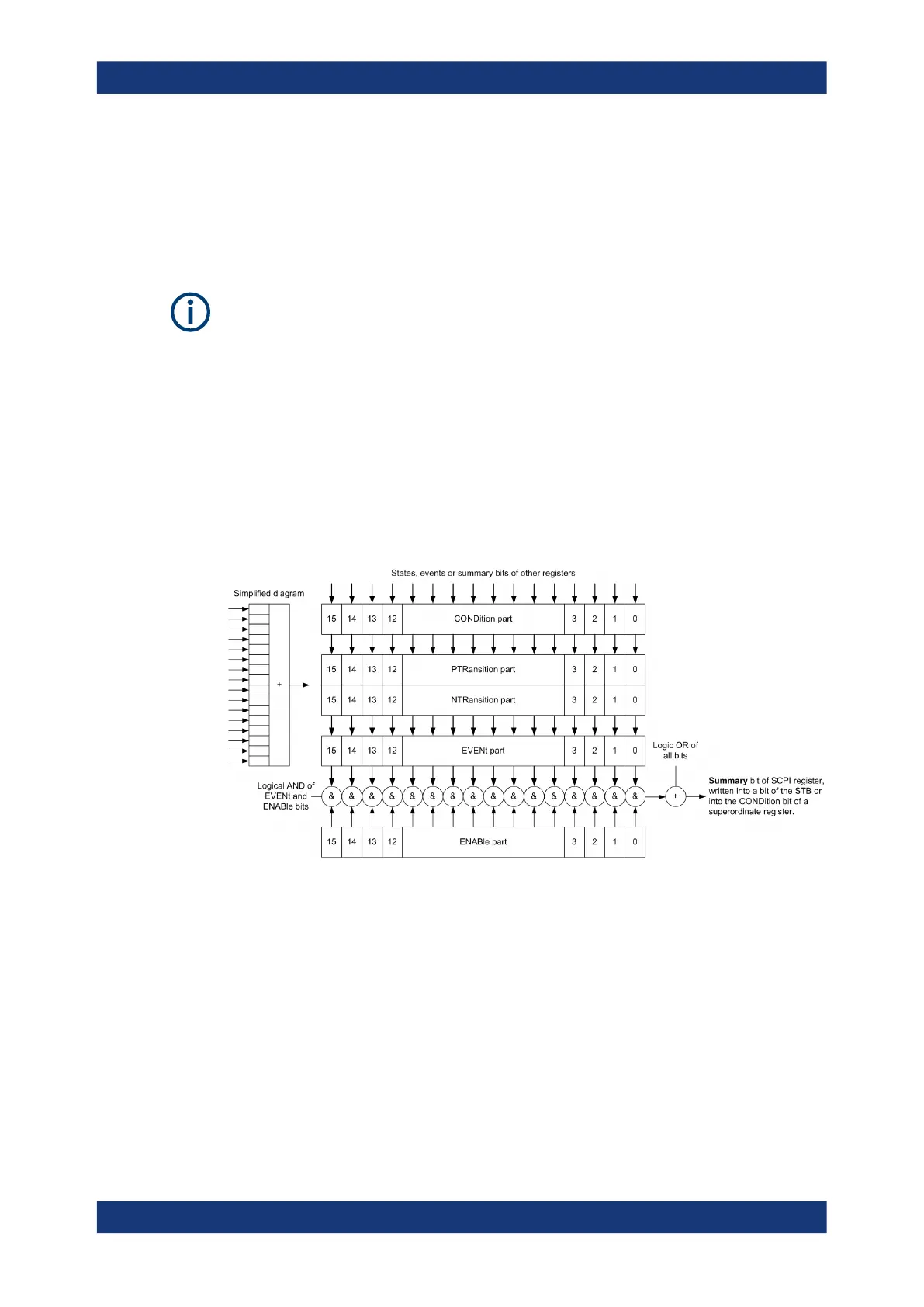
10.1.7.2 Structure of a SCPI Status Register
Each SCPI status register consists of five parts. Each part has a width of 16 bits and
has different functions. The individual bits are independent of each other, i.e. each
hardware status is assigned a bit number, which is valid for all five parts. Bit 15 (the
most significant bit) is set to zero for all parts. Thus, the contents of the register parts
can be processed by the controller as positive integers.
Figure 10-3: The status-register model
Description of the five status register parts
The five parts of a SCPI status register have different properties and functions:
●
CONDition
The CONDition part is written directly by the hardware or it mirrors the sum bit of
the next lower register. Its contents reflect the current instrument status. This regis-
ter part can only be read, but not written into or cleared. Its contents are not affec-
ted by reading.
●
PTRansition / NTRansition
The two transition register parts define which state transition of the CONDition
part (none, 0 to 1, 1 to 0 or both) is stored in the EVENt part.
Remote Control Basics



 To Next Page