Example:
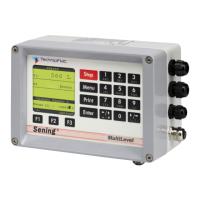
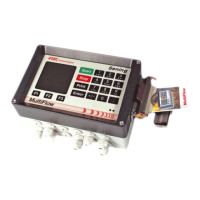
The MultiFlow display shows exactly 1000.0 l, and a volume of 1000.0
l was measured by the calibration vessel. Due to measurements
already taken, the figure displayed by the MultiFlow is to be moved
slightly to the positive. To do this, you do not enter the "Actual"
volume to define the target volume (measurement from the calibration
vessel), but a slightly higher value instead.
If, for example, 1010.0 l (see table) is entered, then a meter factor of
about 1.01 (positive offset) is produced, i.e. with this meter factor a
volume larger by a factor 1.01 is displayed at the next discharge of the
same volume.
In the reverse case, i.e. the counter is to be offset slightly to the
negative; a target value of 990.0 l must be entered, respectively. At
the next discharge, the actual measured volume is displayed reduced
by the factor 0.99.
Examples for positive and negative offsets:
Normally, only the target figure can be changed when making entries.
The actual value is always found by the MultiFlow. The same applies to
the other values, e.g. the mean flow.
The meter factor is computed in the MultiFlow according to the following
formula:
Meter Factor
=
V
tar get
V
actuak
You can now insert the correction value into the correction table using the
displayed mean flow rate.
Where compensation is dependent on the flow, you enter the different
flow rates at which the meter factor has been found, into the correction
table together with the respective meter factor.
If only one meter factor is to be used over the complete flow range (which
is the normal case), then the maximum flow rate of the meter must be




 To Next Page