Chapter 8 Operation 40058725 BTA Alpha HSM
Version: 12.19.17 Page 82 of 112 GB
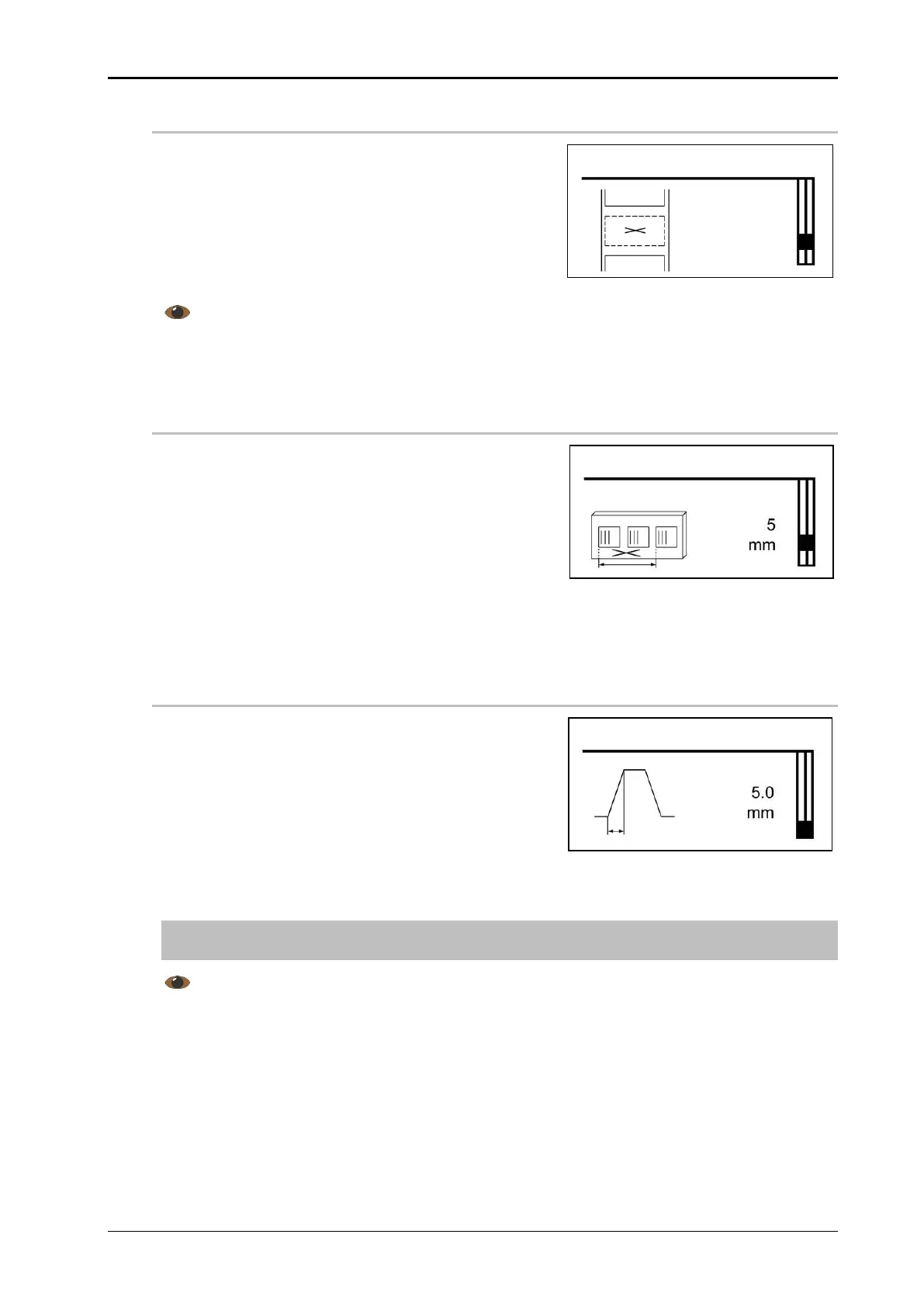
Label skip
The labeler can automatically recognise the posi-
tion of missing labels on the carrier material and
compensate for it. In the case of a gap, the label
liner is advanced to the next available label.
This parameter stipulates how many consecutive
labels may be missing before an error is generat-
ed. The adjustment range is 0-20.
The display of the "Label skip" parameter 009 in the configuration menu can be acti-
vated or deactivated by using the "Label skip configuration" machine parameter in the
system menu.
Trigger Blank
This parameter is used to set the route length on
which incoming start signals following from the first
trigger are ignored. i.e. no additional application
processes can be triggered after the first trigger
(debouncing).
This setting is particularly useful for products with
irregular shapes or reflective surfaces that may
trigger multiple releases per product. The setting
range is 5-1800 mm.
Ramp
A change of this parameter is in principle not re-
quired and should only be performed in agreement
with the manufacturer.
The labeler offers here the option of adapting the
acceleration ramp for extremely time-critical appli-
cations. The distance covered [mm] by the accel-
eration ramp with the standard setting corresponds
to approx. 1/10 of the speed (i.e. 50 m/min. >> 5
mm). The adjustment range is 10.0 – 50.0 mm.
IMPORTANT! Short ramp distances may cause strong thermal and mechanical
strain and lead to excessive wear.
The parameter "Ramp" can be displayed in the configuration menu via machine pa-
rameter 011 "Ramp. configuration" machine parameter in the system menu.
3


 To Next Page