0-1
GEN
INFO
General information
Safety while working
To prevent an accident or injury and to
ensure quality service, follow the safety pro-
cedures provided below.
Rotating part
• Hands, feet, hair, jewelry, clothing, Personal
flotation device straps, and so on can
become entangled with internal rotating
parts of the engine, resulting in serious
injury or death.
• Keep the top cowling in place whenever
possible. Do not remove or replace the
cowling with the engine running.
• Only operate the engine with the cowling
removed according to the specific instruc-
tions in the manual. Keep hands, feet, hair,
jewelry, clothing, Personal flotation device
straps, and so on away from any exposed
moving parts.
Hot part
During and after operation, engine parts are
hot enough to cause burns. Avoid touching
any parts under the top cowling until the
engine has cooled.
Electric shock
Do not touch any electrical parts while start-
ing or operating the engine. They can cause
shock or electrocution.
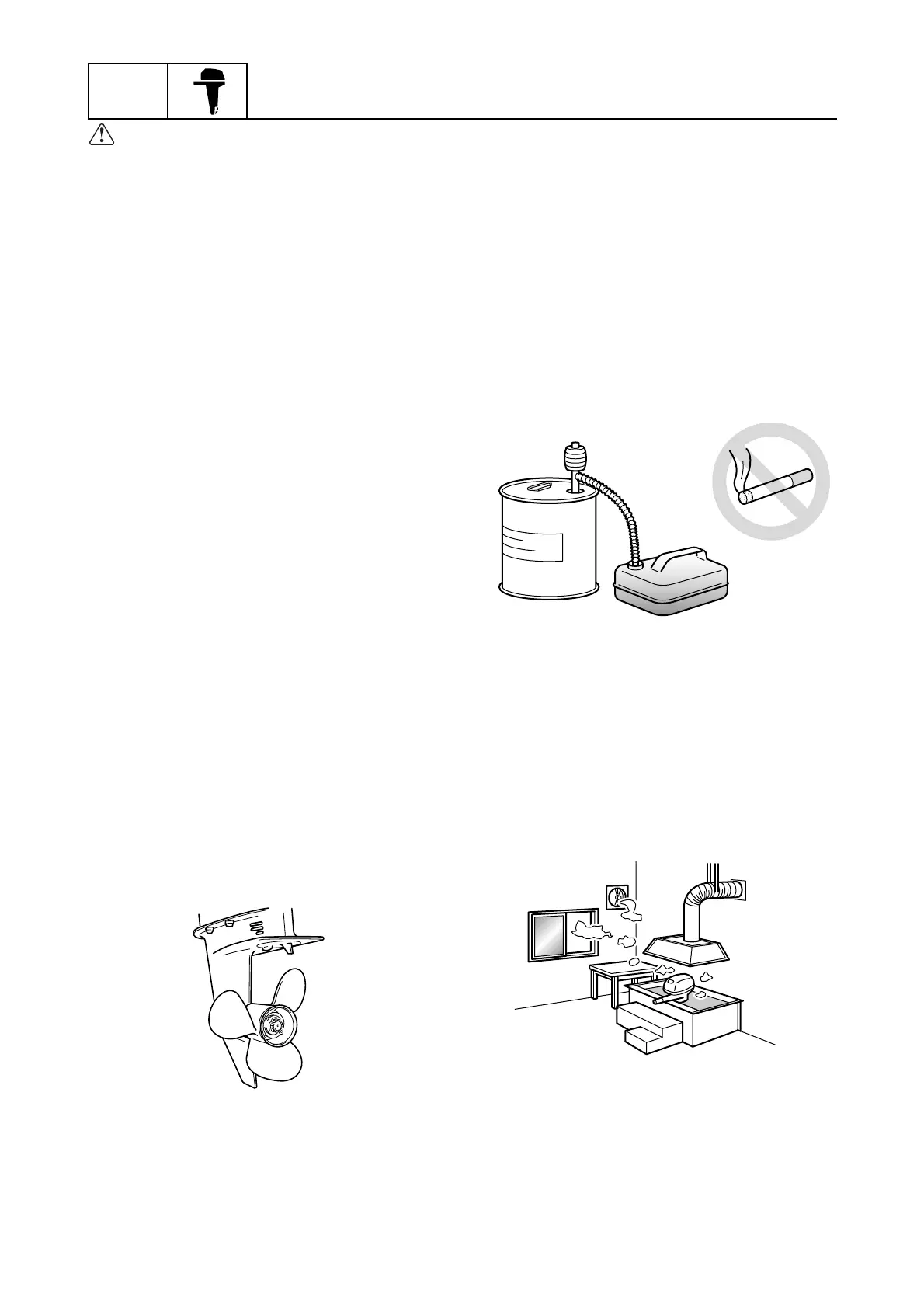
Propeller
Do not hold the propeller with your hands
when loosening or tightening it.
Handling of gasoline
• Gasoline is highly flammable. Keep gaso-
line and all flammable products away from
heat, sparks, and open flames.
• Gasoline is poisonous and can cause injury
or death. Handle gasoline with care. Never
siphon gasoline by mouth. If you should
swallow some gasoline or inhale a lot of
gasoline vapor, or get some gasoline in
your eyes, see your doctor immediately. If
gasoline spills on your skin, wash with soap
and water. If gasoline spills on your cloth-
ing, change your clothes.
Ventilation
• Gasoline vapor and exhaust gas are
heavier than air and extremely poisonous. If
inhaled in large quantities they may cause
loss of consciousness and death within a
short time.
• When test running an engine indoors
(example: in a water tank), be sure to do so
where adequate ventilation can be main-
tained.



 To Next Page