Asynchronous Transfer Mode – ATM
Acterna ANT-5 Page 107
• OAM is the number or percentage of cells that are used for network management
purposes.
The Specific ATM Path/Channel under test
• VPI and VCI shows the path and channel of the cell under test
• Filtered shows the number or percentage of cells which match the selected
VCI/VPI. This value is with reference to the total value.
• CLP =1. Count of cells where CLP=1. If congestion causes a problem, the network
will discard these cells first which match the VCI/VPI
• OAM is the number or percentage of cells that have been used for network
management purposes that match the VCI/VPI. This value is with reference to the
number of filtered cells.
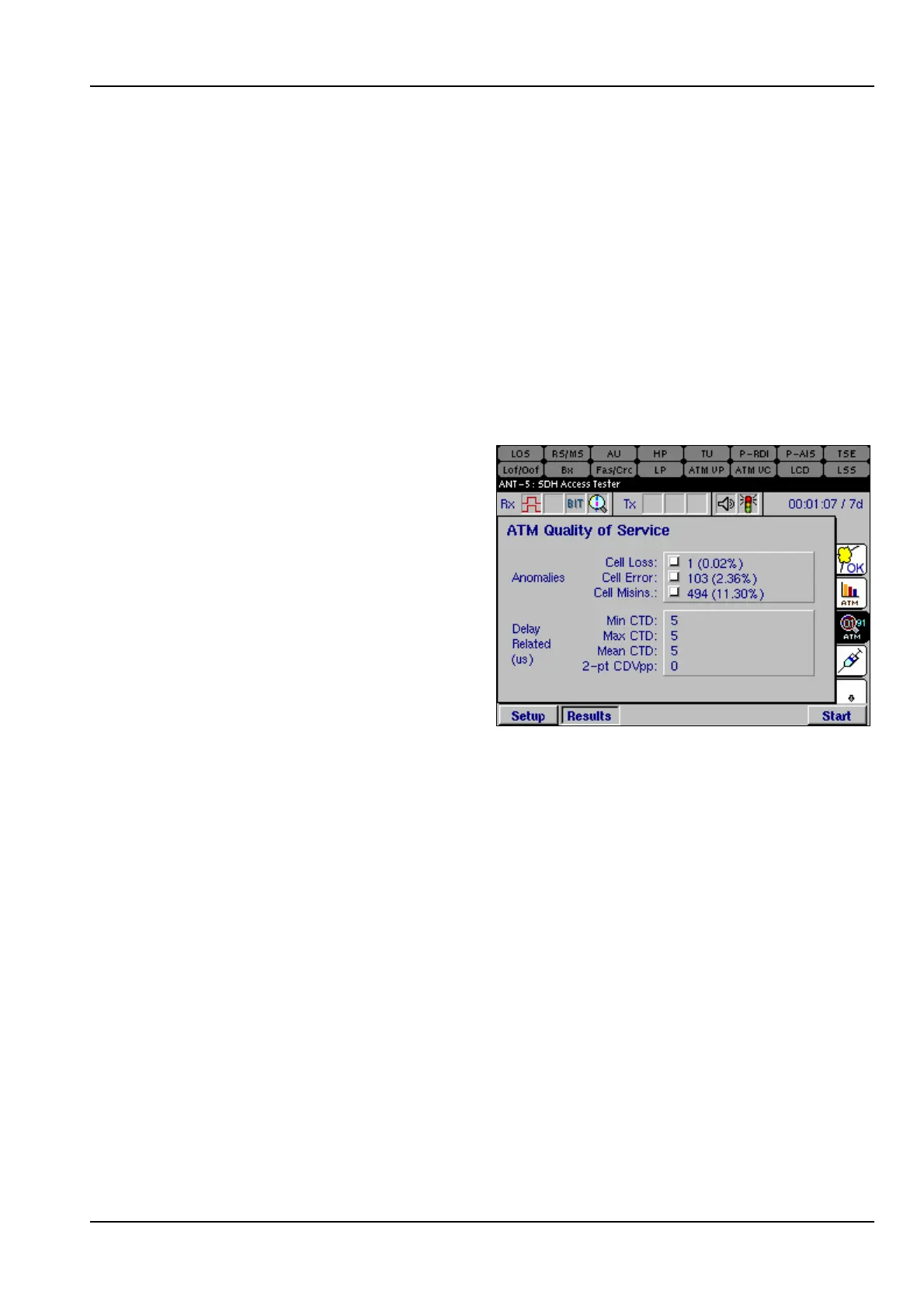
6.8.4 ATM Quality of Service
The ATM Quality of Service page
shows the results of the QoS test as
defined in ITU-T Recommendation
I.356.
Delay measurements include:
1. Cell transfer delay CTD, is the
time between t2 and t1 of the
test cell where:
t1 = the time the cell enters the
device under test
t2 = the time the cell leaves the
device under test
2. Cell delay variation CDV, is the degree of variation in the CTD of the virtual
connection. By defining the QoS it is possible to offer different levels of service,
for example, by offering different guaranteed maximum cell loss rates. This
gives service providers a means for structuring the changes made for the
service, but also, the service provider must be able to demonstrate the QoS to
ITU-T O.191.
Cells exceeding the specified maximum delay are assumed to be of significantly
reduced value to the application.


 To Next Page