The SDH Access Tester application
Page 76 Acterna ANT-5
4.17 Repetitive BERT
Note: The Repetitive BERT tab will become available if selected from the
Measurement Selection page. See Section 4.3 for further details.
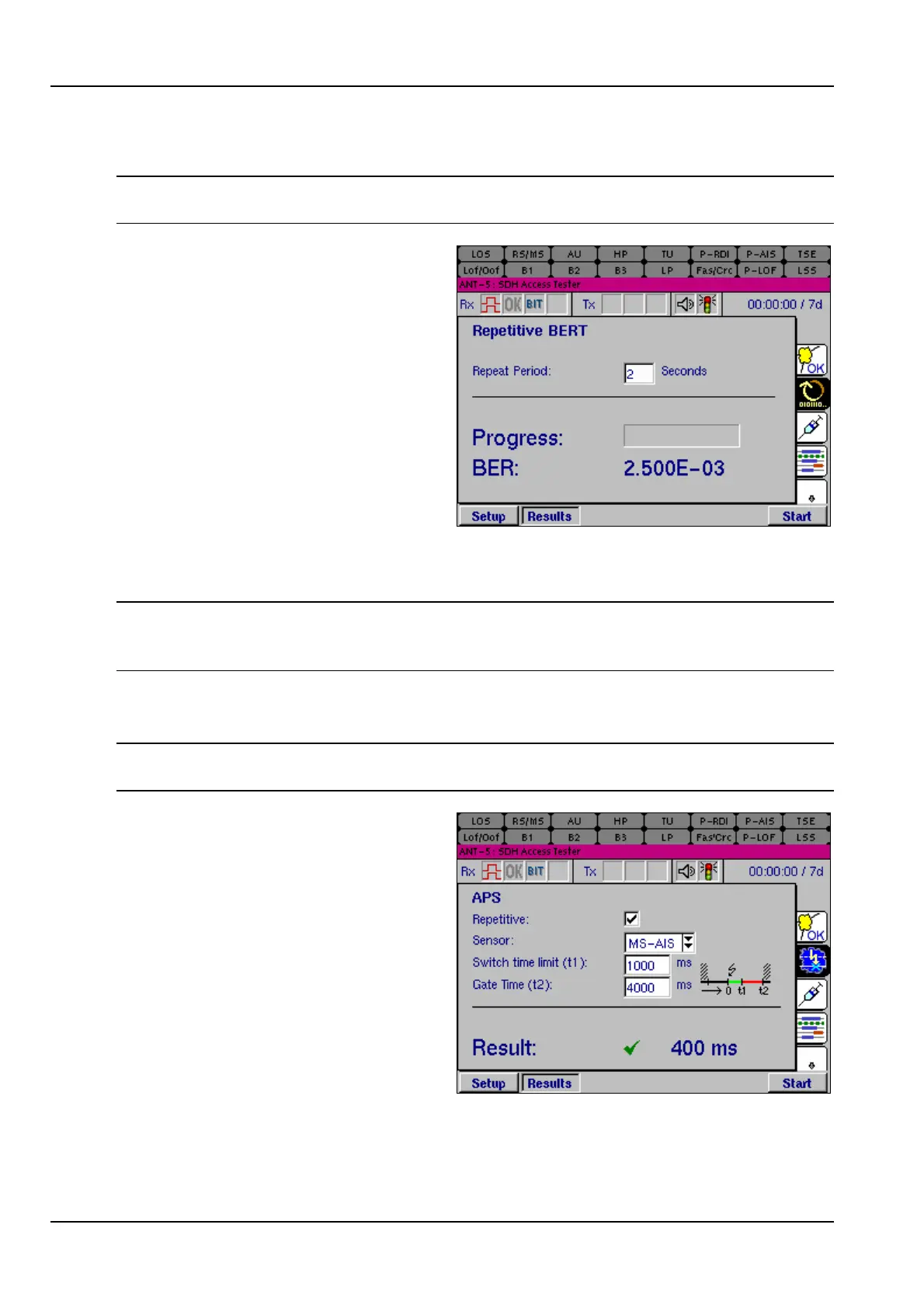
Repetitive BERT is useful when
commissioning a microwave link. The
commissioning operator may be
required to plot a graph BER against
C/N (carrier-to-noise ratio). This is
achieved by attenuating the signal
until a specific BER is reached, and
then noting the attenuation used. For
example, in an SDH network the
measurements could be made on a
single channel within an STM-1
signal, where the required BER will
probably be between 1E-6 and 1E-3.
A Repeat Period of I second is adequate for measuring high error rates, but this
period can be adjusted to a maximum of 99 seconds to test for lower rates.
Note: It is important not to confuse the results of the repetitive BERT test for a specific
interval with those on the results page which show the results for the duration of the
test. Further a repetitive BERT is not recommended from a delayed start.
4.18 Automatic Protection Switching
Note: The APS tab will become available if selected from the Measurement
Selection page. See Section 4.3 for further details.
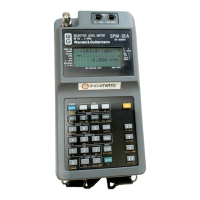
Automatic Protection Switching (APS)
allows network devices to switch
traffic onto a redundant line in the
event of network problems (e.g. high
error rates or heavy congestion).
However, the switch over has to occur
within a specified time, less than
50ms for most lines as specified by
ITU-T (G.841 7.2.2). This is generally
tested by breaking the working line at
a pre-determined point and monitoring
how long the disruption lasts.
Detection can be achieved by
monitoring the reduction in Quality of Service (QoS) or monitoring the resultant
alarms. Depending on the signalling structure the following sensors can be selected,
TSE, MS-AIS, AU-AIS and TU-AIS.


 To Next Page