EasyManua.ls Logo

Alcorn Mcbride V16Pro - User Manual

Alcorn Mcbride V16Pro
179 pages
Print Icon
To Next Page IconTo Next Page
Loading...
V Series
Network
Controllers
Alcorn McBride
January 3, 2018
User’s Guide

Table of Contents

Questions and Answers

Summary

Welcome

Product Comparison Chart

Compares V-Core, V4Pro, and V16Pro controllers' features.

Important Information

Quick Start Guide

1. Open Example Script

Instructions on launching WinScriptLive and opening sample scripts.

2. Connect

Steps for connecting the controller to the network or PC.

3. Watch and Run!

How to view events and start/stop sequences.

WinScriptLive Tutorial

WinScript Live Resources

Sequences

Defines sequences as groups of events that make up scripts.

Sequence Columns

Explains the meaning of columns like D, A, L, and Status in the sequence view.

Sequence Clock

Describes how sequences are timed using internal or external timecode sources.

Events

Event Grid View

Details the Grid View for displaying and editing events.

Event Timeline View

Explains the Timeline View for intuitive event editing.

Variables

User Variables

Explains user-created variables for custom purposes.

Device Variables

Describes variables automatically created after adding a device.

Devices

Ethernet Types

Device Configuration File

Inputs

IO64 Slave Inputs

How to use IO64 inputs as slave inputs in WinScript.

Modbus TCP Slave Inputs

Setup example for a Modbus TCP device (Beckhoff BK9100).

Outputs

IO64 Slave Outputs

Using IO64 outputs as slave outputs in WinScript.

Buttons

Triggers

Explains how triggers start or stop sequences.

Trigger Types

Details trigger actions like Start, Reset, Pause, and Stop Looping.

Trigger Cause

Lists the four reasons a trigger might activate (I/O, Variable, Date/Time, Message).

Media Files

Timeline

Display Timeline

How to view a sequence in Timeline mode.

Play, Pause, Stop, and Execute

Describes playback control buttons on the Timeline toolbar.

Current Time Marker

Explains the marker that indicates current playback time.

Timeline Specific Functions

Overview of Timeline-specific toolbar buttons.

View Time

How to view and adjust the current time displayed on the Timeline.

New Event, New Sequence, New Media, Delete

Describes creating new events, sequences, media events, and deleting.

Display Options

Options to customize the Timeline view for better usability.

Groups

How to organize events into groups (rows) in the Timeline.

Markers

Lock the Screen

Functionality to keep the Timeline view following the playback marker.

Event Buttons

Other Functionalities

Creating/dragging events and changing groups.

Properties Window

Window for configuring event properties and parameters.

Working with Media Files

Adding Media

Different methods to access the Media Files dialog.

Media Files Dialog

Details of the dialog for adding, editing, and removing media files.

New Media Event

How to create a media event by dragging a media file.

Media in a Timeline Sequence

How media files appear and are visualized in a Timeline sequence.

Synchronizing Media with other Events

Techniques for aligning media events with other sequence events.

Scrubbing (jump within) Media Files

How to start media playback at any offset.

WinScript Live Timecode (SMPTE;EBU)

Display the Timecode Configuration Dialog

How to open the dialog for timecode settings.

Internal Timecode Settings

Setting internal clock frame rates for sequences.

Lock to External Video Sync

How to sync the controller to an external video sync source.

External (SMPTE;EBU) Timecode Settings

General Settings

Options to enable/start/restart SMPTE/EBU timecode.

Read Settings

Configuring tolerance for timecode dropouts.

Generate Settings

Settings for generating SMPTE/EBU timecode (preroll, start/end times).

WinScript Live Live Mode

Connect to live mode

How to connect to Live Mode using the toolbar button.

Sequence Status

Displays current status (stopped, running, paused) of sequences in Live Mode.

Event Status

Information on highlighted events in Live Mode.

Current Time

Viewing the current running time of a sequence.

Watches

Using the Watch List for monitoring resources.

Adding Watches

How to add items to the Watch List.

Viewing;Changing Value

How to view and change resource values in Live Mode.

Forces

Using Forces to override sequence control of values.

Live Log

Explains the Live Log for viewing system messages and communication.

Live Display

Shows the front panel display of the show controller in Live Mode.

Live Config

Pinging devices and setting IP addresses.

Pinging Devices

Steps for pinging external devices to check connectivity.

Finding Devices

How to search for devices if pinging fails.

Setting Device Addresses

Options for changing device IP addresses and locations.

Resetting IP Addresses - AMI;O

How to reset IP addresses for AMI/O products.

Show Controller External Control

ShowTouch Software (For PC, iPhone, iPad)

Using ShowTouch software for remote control.

Ami-Terminal Control

Using Ami-Terminal for serial/USB/Ethernet control.

Webpage Control

Starting sequences via HTML form buttons.

TCP Client (Telnet) Control

Controlling the controller via TCP/Telnet clients.

1: Setup TCP Server on Show Controller

Steps to set up a TCP server on the show controller.

2: Add Incoming Message Triggers

Adding triggers to start sequences via incoming messages.

3: Control with Putty or TCP Client

Controlling sequences using Putty or other TCP clients.

Redundant Mode

Redundant Mode Setup

Steps to configure redundant mode using AMI-Terminal.

Redundant Mode in Touch Panels

How Touch Panels interact with redundant controllers.

WinScript Live Command Reference

Discrete Events

Details discrete events for controlling outputs and reading inputs.

Out Port

Sets a group of eight outputs to a binary value.

In Port

Reads a group of eight inputs into a variable.

Logical Events

Events for performing operations on variables.

Add

Adds a value to a variable.

Subtract

Subtracts a value from a variable.

Divide

Divides a variable by a value.

Multiply

Multiplies a variable by a value.

BitAnd

Performs a bitwise AND operation on a variable.

BitOr

Performs a bitwise OR operation on a variable.

Mod

Multiplies a variable by a value.

Concat

Concatenates string variables.

Format

Creates an ASCII string using variables.

Set Variable =

Sets a variable's value to a constant or another variable.

Save Variable

Stores a variable's value in non-volatile memory.

Restore Variable

Recovers a variable's value from non-volatile memory.

Program Control Events

Events to control the flow of the show script.

Start a Sequence

Starts a sequence.

Stop a Sequence

Stops a sequence.

Pause a Sequence

Pauses a sequence at its current event.

Stop Loop

Stops a looping sequence after the last event.

Goto

Unconditionally jumps over events.

If On, If Off

Conditionally performs events based on input/output/variable state.

If =, If not =, If >, If >=, If <, If <=

Conditionally executes events based on variable values.

End If

Marks the end of conditional "If" commands.

Else

Marks the false case of conditional "If" commands.

Empty (formerly Nop)

Used as a branch placeholder.

Display Events

Displays custom messages and variable states on the LCD.

Display

Displays a custom message on the screen.

Store Display

Stores currently displayed text from the LCD.

Recover Display

Re-displays stored text from the LCD.

Timecode (LTC, SMPTE, EBU) and Internal Time Events

Events related to timecode and internal timing.

Delay

Causes a sequence to delay for a specific amount of time.

Timecode Set

Sets the SMPTE/EBU Timecode to a specific value.

Timecode Pause

Pauses the SMPTE/EBU Timecode.

Timecode Start

Starts timecode running.

Timecode Stop

Stops and resets the SMPTE/EBU Timecode.

Timecode Stop Loop

Stops SMPTE/EBU Timecode at the next loop point.

Get Seq Time

Places current sequence time into a variable.

Arm

Allows SMPTE/EBU timecode to execute sequence events.

Disarm

Ignores current SMPTE/EBU timecode.

Network Events

Events related to network operations like sending email.

Send Mail

Sends an email using SMTP settings.

Number Generation

Functions for generating random numbers.

Get Random

Gets a random integer and saves it to a variable.

External Communication Events

Built-in events for custom messages to devices.

Message Out

Sends a custom serial message out one of the serial ports.

Log Message

Sends a message to the "Live Log".

V16 Pro

Specifications

Lists physical and operational specifications of the V16Pro.

Certifications

Details EMC and other compliance certifications.

LTC Ports

Describes the SMPTE/EBU timecode input/output ports.

Serial Ports

Information about serial ports for programming and control.

RS-232;422;485 Ports

Explains the differences and capabilities of RS-232C, RS422/485 ports.

Ethernet Ports

Information on the two Ethernet ports and their capabilities.

Ethernet Cables

Types of Ethernet cables used.

Programmer Ports

Ports used for programming, control, and monitoring.

RS-232 C

Details the V16Pro's RS-232C programmer port pinout.

USB

Use of the USB port for programming and Live Mode.

Ethernet Ports A and B

Using Ethernet ports for programming and status monitoring.

Show Control Ports

Ports used to control other show devices.

Ports 1-16: RS-232 or RS-422;485

Configuration and pinouts for show control serial ports.

MIDI Ports

Information on MIDI IN and OUT ports.

Display

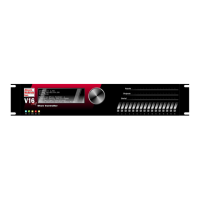
Description of the V16Pro's 8x40 VFD Display.

Menu Wheel

How to navigate V16Pro parameters using the menu wheel.

Menu Map

Overview of menu structure and navigation.

Function Description

Explains menu definitions and system operation.

System Sub-menu

Details the System menu options like firmware and hardware versions.

Real-Time Clock

Settings for time, date, and NTP synchronization.

LTC;SMPTE

Mode, frame rate, and configuration of the SMPTE processor.

Network

Network adapter settings (IP, Subnet, Gateway).

Password

Setting the controller password.

Script Configuration

Managing script files and loading them.

Digital Inputs

Input Connector

Details the parallel input connector pin assignments.

Voltage Inputs vs. Contact Closures

Pros and cons of using voltage inputs versus contact closures.

Input Configuration

Input Wiring

How to wire inputs to the controller.

Connecting a Voltage Input

Step-by-step guide for wiring voltage inputs.

Connecting a Contact Closure

Step-by-step guide for wiring contact closure inputs.

Using Front Panel Buttons

Digital Outputs

Configuring Outputs

How to configure output names, initial states, and comments.

Output Connector

Details the parallel output connector pin assignments.

Wiring Outputs

Non-inductive load

Wiring instructions for non-inductive loads (e.g., lamps).

Inductive loads

Wiring instructions for inductive loads (e.g., relays, motors) with protection.

Video Sync Input

SMPTE Reader;Generator

Power Supply

Rear DIP Switches

Reset

How to reset settings to factory defaults.

Backlight on; off

Enabling or disabling the backlight.

Firmware

Show Memory

V16+ or V4+ Compatibility

Hardware Compatibility

Specific changes for using ports 1-4 in RS422 mode.

Importing.amw files (WinScript scripts)

Steps to import WinScript scripts into WinScriptLive.

V4 Pro

Specifications

Lists physical and operational specifications of the V4Pro.

Serial, USB, Ethernet, Inputs and Outputs

Refers to V16Pro section for V4Pro hardware details.

VCore

Specifications

Lists physical and operational specifications of the VCore.

Setting VCore IP Address

Ways to set the IP address for the VCore.

DHCP (Automatic Assignment)

Setting the IP address via DHCP.

Manual IP Set

Manually setting the IP address for the VCore.

USB or Serial Set

Setting IP via USB or Serial connection.

Naming VCore

Renaming the VCore controller using AMI-Terminal.

Serial Port (RS-232)

Description of the VCore's RS-232 serial port.

Ethernet Ports

Information on the VCore's single Ethernet port and protocols.

USB

Use of the VCore's USB port.

Digital Inputs

Information on the VCore's 4 inputs.

Input Connector

Details the VCore's input connector.

Input Configuration

How to configure input names and comments in WinScriptLive.

Input Wiring

How to wire inputs to the VCore.

Connecting a Voltage Input

Step-by-step guide for wiring voltage inputs to the VCore.

Connecting a Contact Closure

Step-by-step guide for wiring contact closure inputs to the VCore.

Digital Outputs

Details the VCore's 4 Relay Outputs.

Configuring Outputs

How to configure output names, initial states, and comments for the VCore.

Output Connector

Details the VCore's parallel output connector pin assignments.

Wiring Outputs

How to wire outputs to loads for the VCore.

Non-inductive load

Wiring non-inductive loads to VCore outputs.

Inductive loads

Wiring inductive loads to VCore outputs with protection.

LED Indicators

Explains the meaning of the VCore's LED indicators.

Power Supply

Specifications for the VCore's power supply.

Power over Ethernet

Using PoE to power the VCore.

Rear DIP Switches

Explanation of the VCore's rear DIP switch functions.

Reset

How to reset VCore settings to factory defaults.

Backlight on; off

Enabling or disabling the backlight.

Show Memory

Information about SD card storage for scripts on the VCore.

Scheduler (Web-based)

Getting Started

How to access the scheduler via a web browser.

Creating a New Schedule File

Steps to create a new schedule file.

Editing Schedule Entries

How to add and configure schedule entries (sequence, time, date, repeat).

WEB Server Quick Start

Step 1: Connecting to the Web Server

How to access the web server using a browser.

Step 2: Configuration

Configuring web server settings and customer login.

Step 3: Customer Web Page

Setting up a customer-specific web page.

Step 4: Understanding home.php

Explains the home.php file for customizing the web interface.

Hypertext Transfer Protocol

File Names and Types

Allowed file names and types for the web server.

Show Controller Web-Script

Web-Script Blocks

Syntax for defining web-script blocks.

If Statements

Using conditional logic in web-script.

Variables

Functions

Serial and Ethernet Control

Command set

Overview of the serial command structure and usage.

ES

Command to enable the SMPTE module.

DS

Command to disable the SMPTE module.

PS

Command to pause SMPTE at the next loop point.

IS

Command to pause SMPTE immediately.

CT

Command to get/set SMPTE time.

ID

Command to get/set the unit ID number.

IP

Command to get/set the IP address.

SM

Command to get/set the subnet mask number.

GW

Command to get/set the gateway IP address.

DA

Command to get/set the calendar date.

TI

Command to get/set the time of day.

US

Command to get/set the user login name.

PW

Command to get/set the password.

SD

Command to get/set Daylight Saving Time status.

DT

Command to get/set the Daylight Saving Time Type.

TZ

Command to get/set the Time Zone.

DI

Command to display text on the screen.

LO

Command to get/set longitude coordinates.

LA

Command to get/set latitude coordinates.

VA

Command to get/set a variable.

VT

Command to toggle a Boolean variable.

RJ

Command to reset a sequence.

PA

Command to pause a sequence.

SL

Command to stop a looping sequence.

PL

Command to run a sequence.

SQ

Command to get sequence status.

OU

Command to control an output (off, on, toggle).

SS

Command to send a message to a selected port.

XX

Command to reboot the system.

NI

Command to get/set NTP IP Address.

NE

Command to enable/disable the NTP Function.

NJ

Command to get/set the Ethernet Port for NTP.

TS

Command to attach time to the active script.

SF

Command to get/set the active script file.

NM

Command to get/set the device name.

FT

Command to get the script edit date.

DH

Command to enable/disable the DHCP Function.

SJ

Command to get/set the Ethernet Port for SMTP.

SA

Command to get/set the SMTP Address.

SP

Command to get/set the SMTP Port.

SU

Command to get/set the SMTP User Login Name.

SW

Command to get/set the SMTP Password.

FR

Command to get/set the SMTP From Name.

MA

Command to send E-Mail.

HJ

Command to get/set the HTTP Ethernet Port.

HP

Command to get/set the HTTP WEB Page.

RI

Command to get/set Redundant IP Address.

RX

Command to get/set Redundant Ethernet Jack.

MS

Command to get/set Master Slave Message.

TMS

Command to get/set Master Slave Timeout Period.

JP

Command to jump to a Timecode Message.

LV

Command to initiate Live Mode.

EX

Command to execute a command.

Product File Creator

Live Mode Protocol

Timing Information

Information on timing accuracy and delays in Live Mode.

Connection Information

How to establish and maintain a Live Mode connection.

Sequence Status

Format for reporting sequence status in Live Mode.

Resource Requests

How to request the status of variables, inputs, outputs, or sequences.

Resource Type Lookup

Lookup table for resource item types used in requests.

Resource Status Examples

Examples of resource status responses.

Resource Status Frequency

When resource status is sent.

Error Reporting

How error status is returned and reported.

User Log Message

Format for user log messages and their types.

Name Lookup

Querying resource indexes using the "Name Lookup" command.

Troubleshooting Tips

WinScriptLive

Troubleshooting tips specific to the WinScriptLive software.

Alcorn Mcbride V16Pro Specifications

General IconGeneral
Audio Channels16
Control InterfaceEthernet
Power Supply100-240V AC
Audio Outputs16
Form FactorRackmount