SAFETY
MARINE PRODUCTS AND THE SAFETY OF PEOPLE
WHO
USE THEM
&
WARNING
&
This Safety section contains information relevant to the safety of boaters and people that ser-
vice boats.
Please read this section carefully and share it with all shop technicians. Always
follow
common shop safety practices. If you have not had training related to common shop
safety practices, you
should do so not only
to
protect yourself, but also to protect the people
around you.
It
is
impossible for this manual to cover every potentially hazardous situation you may
encounter. However, your understanding and adherence to the recommendations contained
in
this manual and use of good judgment when servicing outboards will help promote safety.
Always
be
alert and careful: a good foundation for safety.
Enjoyable boating
is
the goal of people who design and build marine products.
To
reach this goal, manu-
facturers are careful to make sure:
• Product user is informed; and
• Products are safe and reliable.
It
is up to you, the people who
...
• Rig boats;
• Fix machinery; and
• Maintain equipment
... to keep the products safe
and reliable.
This section talks about safe boating and how you can help make it safe. Some
of
these safety issues
you
will know, others you may not.
First!
A word about parts .
..
Plain parts; special parts; all parts!
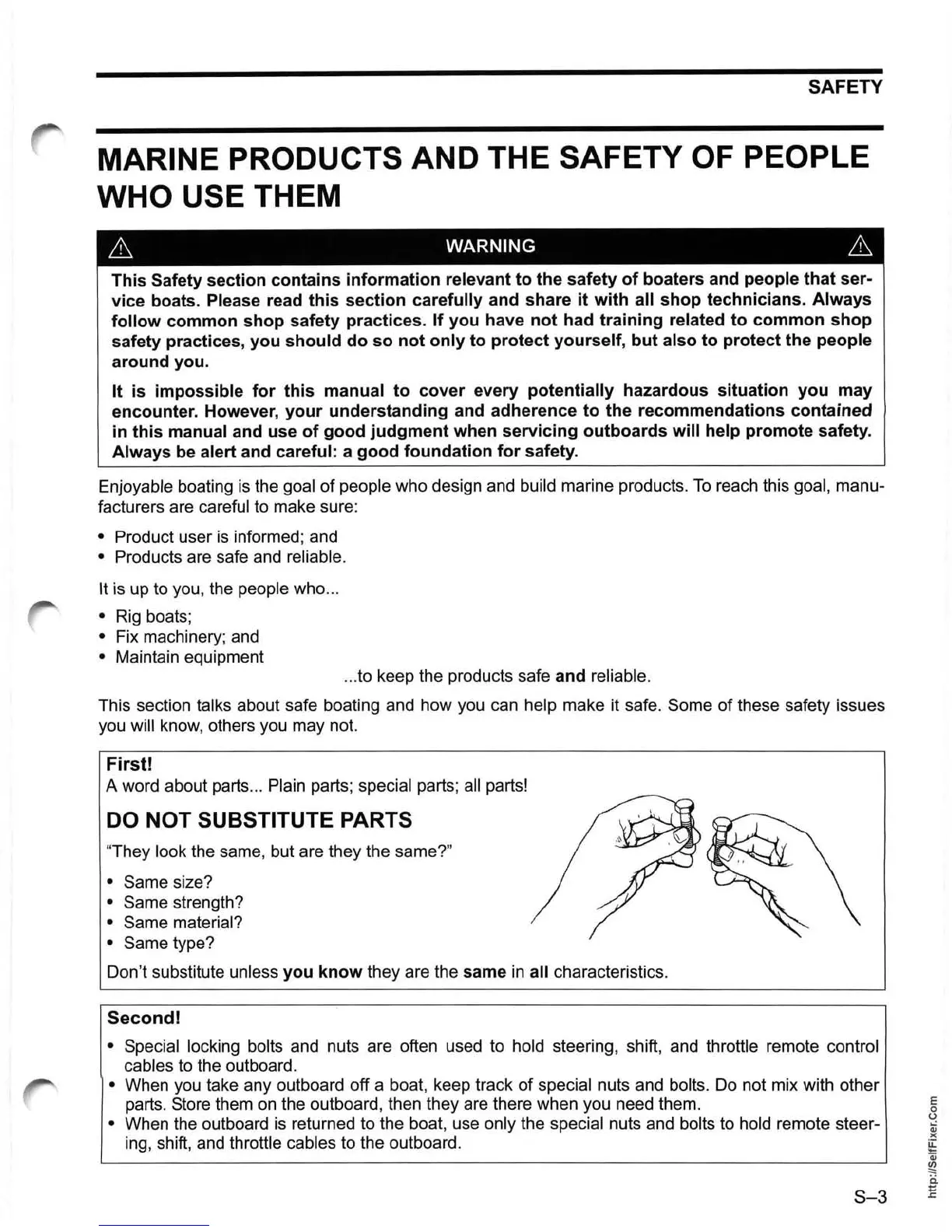
DO NOT SUBSTITUTE PARTS
"They look the same, but are they the same?"
• Same size?
• Same strength?
• Same material?
• Same type?
Don't substitute
unless you know they are the same
in
all characteristics.
Second!
• Special locking bolts and nuts are often used to hold steering, shift, and throttle remote control
cables
to the outboard.
• When
you
take any outboard off a boat, keep track
of
special nuts and bolts. Do not mix with other
parts.
Store them
on
the outboard, then they are there when you need them.
• When the outboard is returned to the boat, use only the special nuts and bolts to hold remote steer-
ing, shift, and
throttle cables to the outboard.
S-3
E
o
o
~
x
~
OJ
~
ii
t:
.s::




 To Next Page