Part II: Settings and Measurements
Chapter 6: Analog Non-Linear Distortion Measurement
In this chapter, we discuss technical background and instructions for using the Analog Non-Linear Distortion
function on the DS2831.
6-1 Carrier-to-Composite Noise Ratio
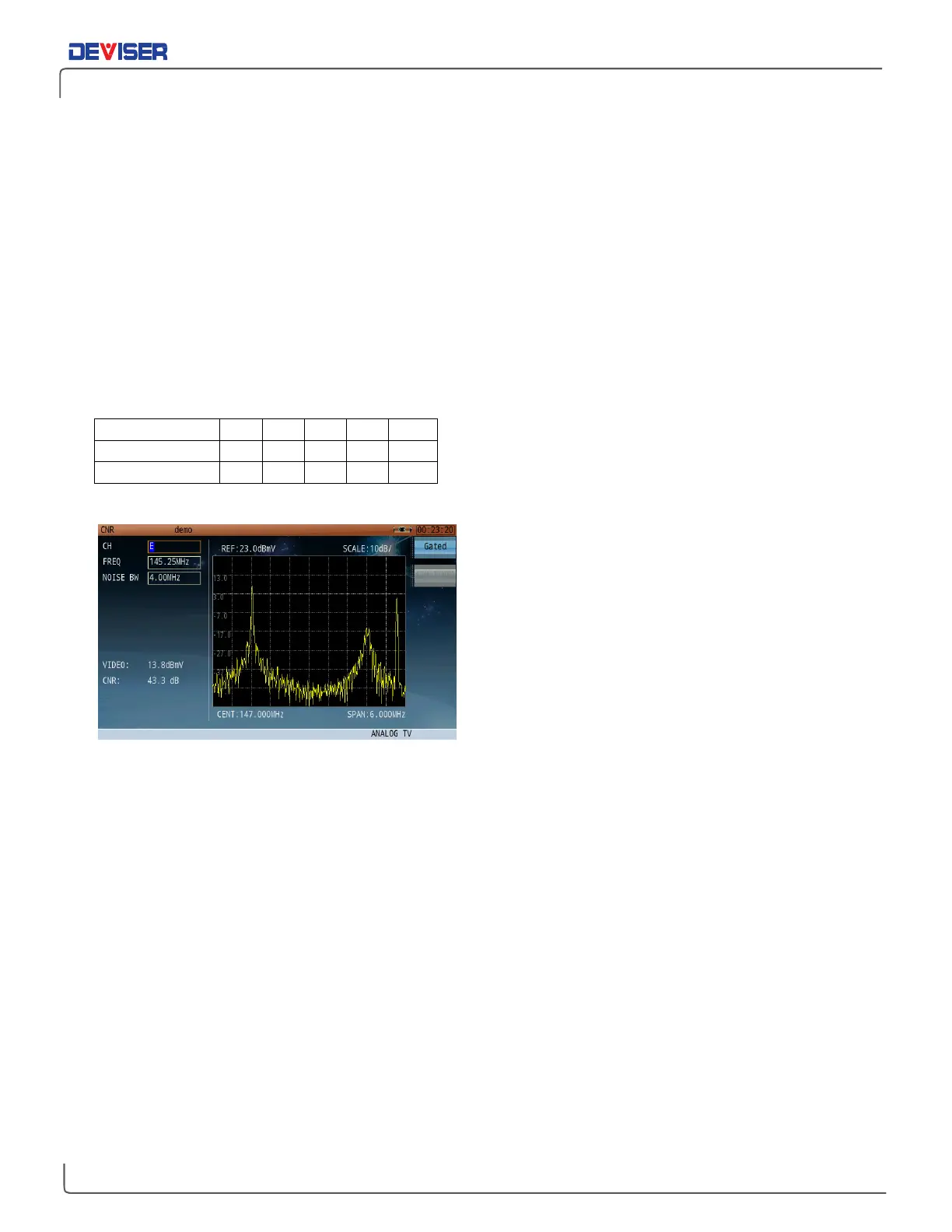
Before measuring CCN Ratio with your DS2831 analyzer, visit the channel plan editor (see Chapter 4:
Channel Plans) to set up the video carrier frequency and noise bandwidth correction as necessary for your
measurement. The noise bandwidth may differ depending on the channel bandwidth, which itself depends
on your location: NA, EU, or another region. The NTSC-M system, used in North America, as specified by the
FCC, employs a 4MHz noise bandwidth correction, while PAL-D systems use a 5.75MHz noise correction.
Noise measurement bandwidth for various TV standards
Standard I B, G
K1, L
D, K M, N
Video bandwidth
6.75 5.75 7.25 6.75 4.95
Noise bandwidth
5.08 4.75 5.58 5.75 4.00
Typically, CCN measurements require that system
engineers first measure the video carrier level (where
the sync tip of the modulation is the absolute peak
level); then remove the video modulation by shutting
down the modulator - or simply remove the
modulation from the carrier – to allow accurate noise
measurement. Unfortunately, removing the
modulation interrupts service.
A better way to measure CCN accurately is to perform
an in-service “gated” measurement, with the help of
gating technology and quiet line insertion in the
vertical blanking interval of video signals that are off the viewable screen (usually below line 12). If you
choose a higher VITS line, you may start encountering video modulation, and thus visible interference on
the television picture.
In a gated CCN test, the DS2831 will first measure peak carrier level, and then trigger on the appropriate
VITS line # (preset for each channel; can be set in the channel plan editor) to measure noise. Occasionally,
VITS lines are already quiet enough when video signals are delivered by the Broadcaster. It is highly
recommended to use your own VITS inserter to remove any measurement uncertainty.
Many other types of test signals may be inserted for gated mode testing, including in-channel frequency
response, differential gain, and differential phase. A quiet line is absolutely required for measuring CCN,
CSO, CTB, or cross-modulation. The DS2831 is equipped with triggering technology that accurately locks
onto a specific VITS line and provides precise measurement results.


 To Next Page