Chapter 7: Analog TV Video
Analog TV video measurements required by the FCC include: Depth of Modulation, In-Channel Frequency
Response, Differential Gain, Differential Phase, and Chrominance-Luminance Delay Inequality. To make
these measurements in the gated mode, you must use a VITS inserter to insert the various test signals
needed for specific measurements.
You may find that those test signals are already part of the video feed provided by the broadcaster. Still, it
is highly recommended to perform your own VITS signal insertion. The reasons for this are twofold: first, to
maximize accuracy; and second, to ensure that your results are not hindered by the possible lower-quality
feed from the broadcaster.
7-1 Depth of Modulation (DOM)
From the Channel Measurement application (
SLM
), press
DOM
(F2) to enter the Depth of Modulation menu.
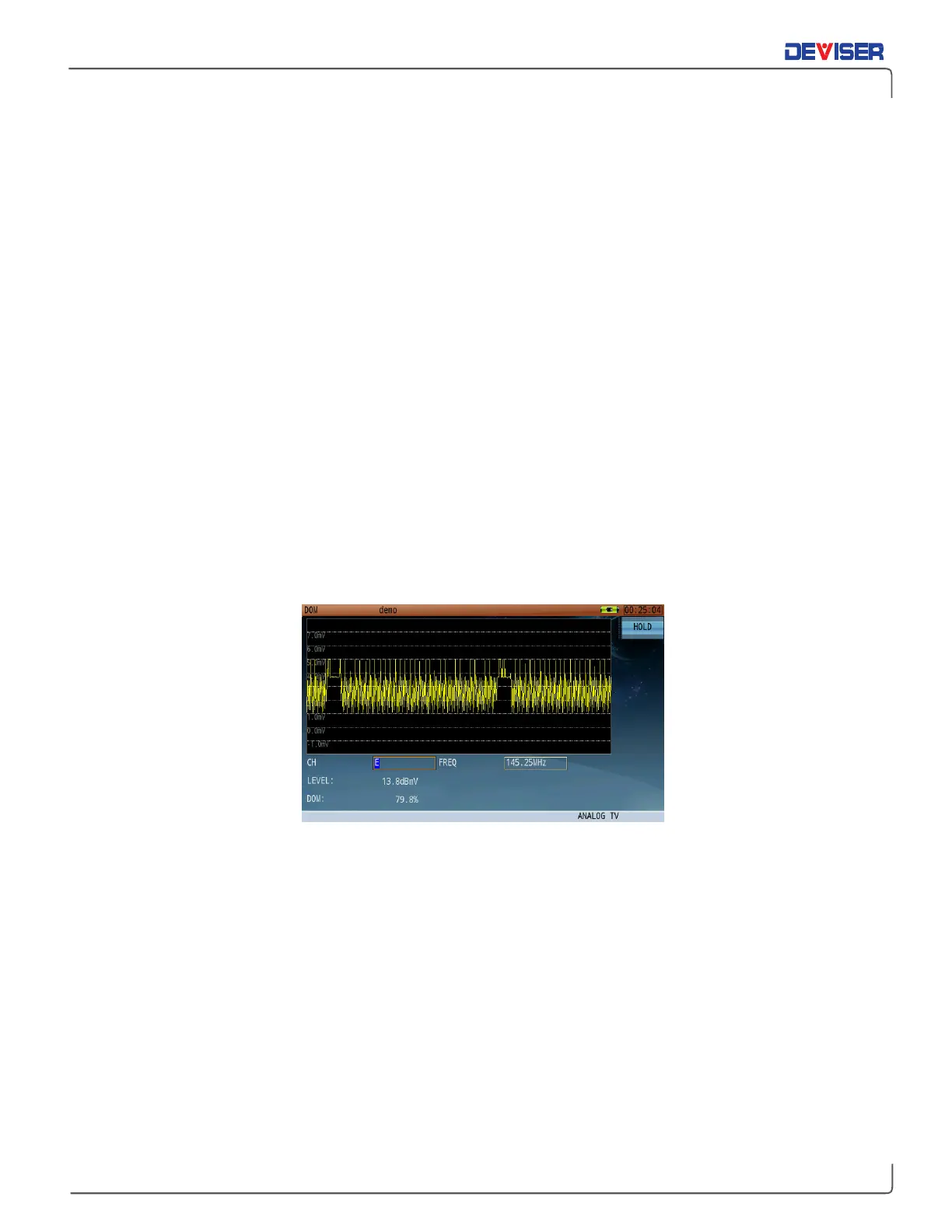
Depth of modulation is measured as the percentage of the total amplitude change of the carrier, as the
signal progresses from sync tip to peak white.
You can measure depth of modulation on a TV channel with a vertical interval test signal (VITS). A test
signal transmitted on the VITS of program video provides a reference to calibrate the video depth of
modulation. Transmission standards require that the DOM ratio be in the range of 87.5%. At horizontal sync
position, the carrier reaches maximum amplitude. At the peak white color position, the carrier amplitude is
12.5% less than the maximum amplitude.
Depth of Modulation Measurement


 To Next Page