(Continued)
• When driving on a slippery road,
push the shift lever forward into
the + (up) position. This causes the
transaxle to shift into the 2nd
gear which is better for appropri‐
ate driving on a slippery road.
Push the shift lever to the -
(down) side to shift back to the
1st gear.
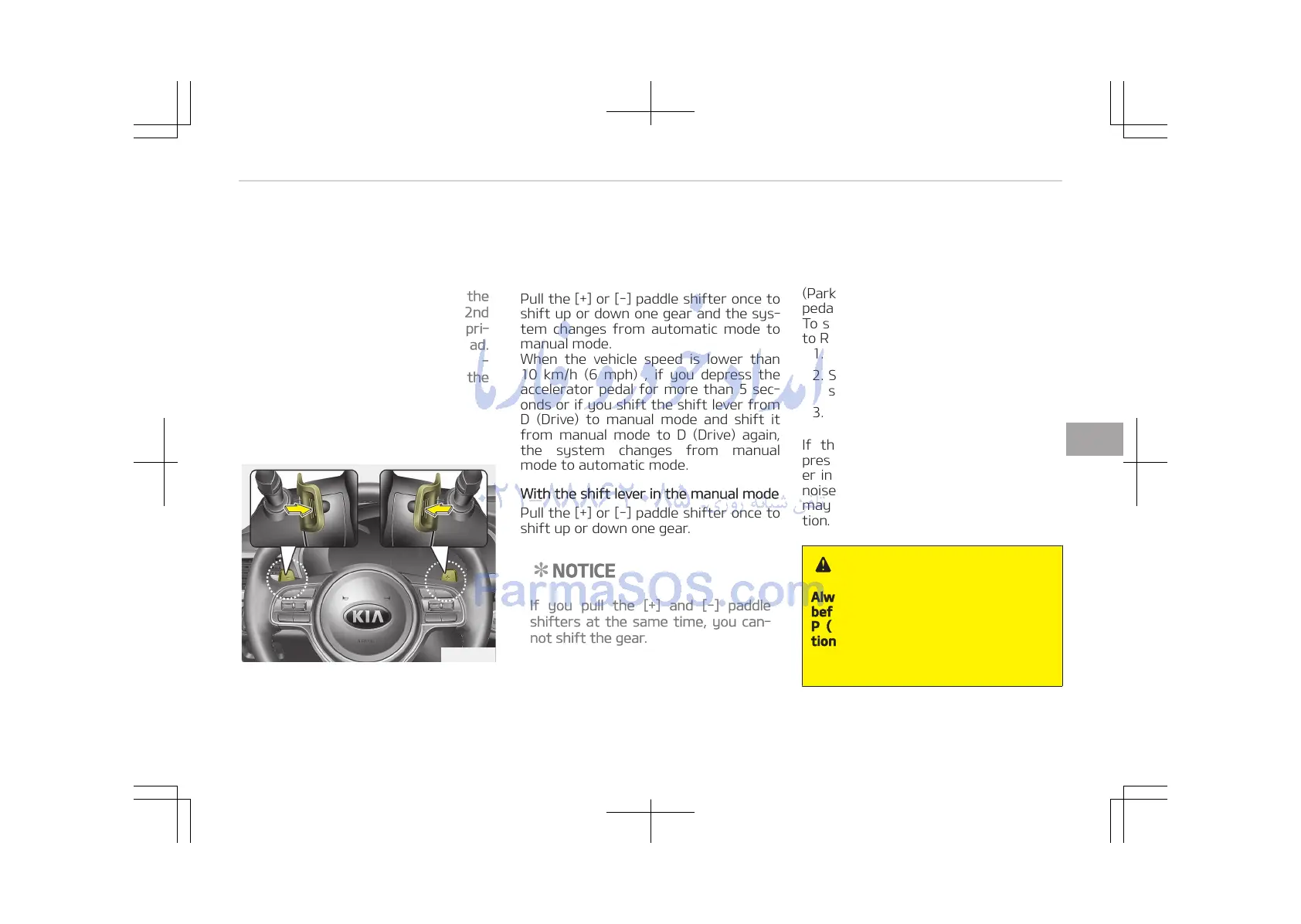
Paddle shifter (if equipped)
The paddle shift function is available
when the shift lever is in the D position
or the manual mode.
With the shift lever in the D position
The paddle shifter will operate when
the vehicle speed is more than 10 km/h
(6 mph) .
Pull the [+] or [-] paddle shifter once to
shift up or down one gear and the sys‐
tem changes from automatic mode to
manual mode.
When the vehicle speed is lower than
10 km/h (6 mph) , if you depress the
accelerator pedal for more than 5 sec‐
onds or if you shift the shift lever from
D (Drive) to manual mode and shift it
from manual mode to D (Drive) again,
the system changes from manual
mode to automatic mode.
With the shift lever in the manual mode
Pull the [+] or [-] paddle shifter once to
shift up or down one gear.
NOTICE
If you pull the [+] and [-] paddle
shifters at the same time, you can‐
not shift the gear.
Shift lock system
For your safety, the automatic trans‐
axle has a shift lock system which pre‐
vents shifting the transaxle from P
(Park) into R (Reverse) unless the brake
pedal is depressed.
To shift the transaxle from P (Park) in‐
to R (Reverse):
1. Depress and hold the brake pedal.
2. Start the engine or turn the ignition
switch to the ON position.
3. Move the shift lever.
If the brake pedal is repeatedly de‐
pressed and released with the shift lev‐
er in the P (Park) position, a chattering
noise & vibration near the shift lever
may be heard. This is a normal condi‐
tion.
WARNING
Always fully depress the brake pedal
before and while shifting out of the
P (Park) position into another posi‐
tion to avoid inadvertent motion of
the vehicle which could injure per‐
sons in or around the vehicle.
6-25
6
Driving your vehicle















 To Next Page