L-Gate User Manual 76 LOYTEC
Version 3.2 LOYTEC electronics GmbH
• Non-LNS 3.x network management tool with polling (see Section 6.4.3)
• Non-LNS 3.x network management tool with bindings (see Section 6.4.4)
6.4.1 Involved Configuration Files
In the configuration process, there are a number of files involved:
• XIF file: This is the standard file format to exchange the static interface of a device.
This file can be used to create a device in the database without having the L-Gate on-
line. There exists a standard XIF file for the FT port (L-Gate-900 FT-10.xif) and one
for the IP-852 port (L-Gate-900 10L.xif).
• L-Gate Configurator project file: This file contains all ports, data points, and
connections of a project. These files end with “.gtw”. It stores all relevant
configuration data and is intended to be saved on a PC to backup the L-Gate’s data
point configuration.
6.4.2 Configure with LNS
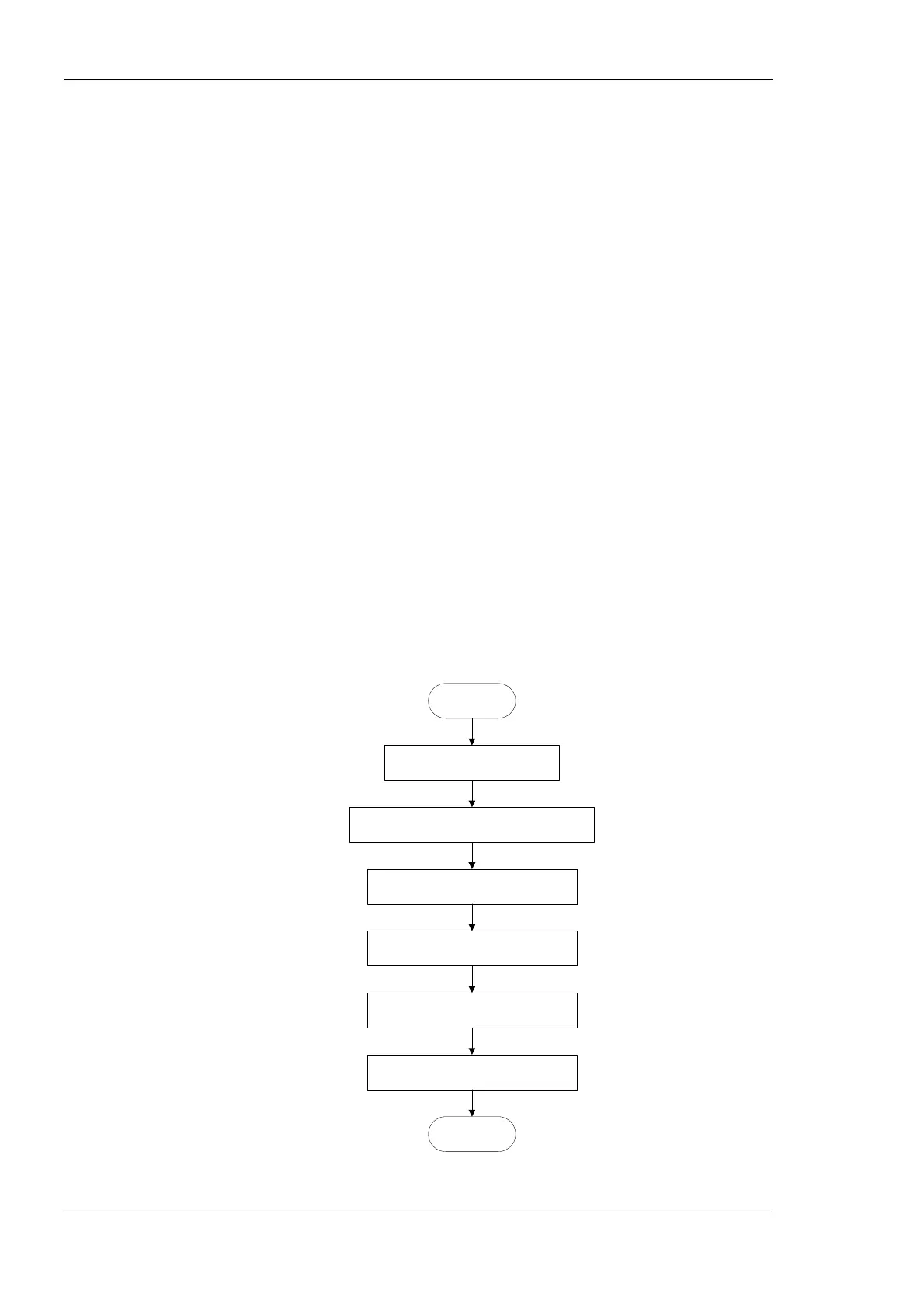
The flow diagram in Figure 55 shows the steps that need to be followed in order to
configure the L-Gate in a network with LNS 3.x. In this scenario the L-Gate will use
dynamic NVs and bindings.
First, the L-Gate device must be added to LNS (see Section 6.4.6). Then the L-Gate
Configurator must be started in plug-in mode to configure the L-Gate (see Section 6.7.1).
In the Configurator scan for the data points in the LNS database (see Section 6.7.4). Select
the NVs that the L-Gate shall expose to BACnet (see Section 6.7.7). Generate BACnet
objects and connections from the used NVs (see Section 6.7.11). Finally, the configuration
needs to be downloaded onto the L-Gate (see Section 6.7.13). It is recommended to save
the complete configuration to a disk file for being able to replace an L-Gate in the network.
Add L-Gate
Section 6.5
Start the Configurator as a plug-in
Section 6.7.1
Scan network variables
Section 6.7.4
START
DONE
Download configuration to L-Gate
Section 6.7.13
Select NVs and use on L-Gate
Section 6.7.7
Generate BACnet objects
Section 6.7.11
Figure 55: Basic design-flow with LNS.



 To Next Page