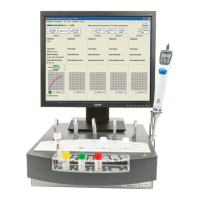
The Multiplate® analyzer is an in vitro diagnostic instrument designed for platelet function analysis in hospitals and other medical and scientific institutions. It utilizes innovative multiple electrode aggregometry (MEA) technology to assess platelet aggregation.
Function Description:
The analyzer operates by immersing two pairs of electrodes into a stirred blood sample. As platelets aggregate, they adhere to the electrodes, causing a change in electrical resistance (impedance) between them. This change is continuously recorded. The MEA technology, with two pairs of electrodes per test cell, allows for a double determination on each sample, ensuring high safety and reliability through disposable test cells.
The system includes an internal computer and proprietary software for data recording and processing. It features five measuring channels integrated into a measurement block, which is heated to 37.0 ± 1.0 °C. Four preheating positions are available for liquids (e.g., NaCl solution), though preheating blood samples in these positions is not recommended as platelet activity and function can be reduced when blood is stored at 37 °C. Blood is preheated directly in the measuring position during a 3-minute incubation phase.
An electronic pipette (Multiplate Transferpette) is used for software-controlled pipetting of fluids, simplifying and standardizing the measurement process, sample handling, assignment, and pipetting. The operator is guided through pipetting workflows with "next pipette step" instructions. The pipette operates on the air-displacement principle for aqueous solutions with average density and viscosity.
The software provides a main screen displaying data, graphics, patient and sample ID, and test identification for each channel. Three aggregation parameters are displayed: AUC (Area Under the Curve), Aggregation (increase of impedance), and Velocity (max. slope of aggregation). The AUC is the recommended parameter for evaluation and interpretation, representing the arithmetic mean of duplicate sensor measurements within one test cell. Results can be displayed as two overlapped curves or a single filled curve representing the mean value.
The system supports LIS connectivity for downloading orders, assigning them to channels, starting autopipette measurements, and uploading results. It also allows for manual measurement creation and management. Data alarms are displayed when internal checks fail, monitoring the correlation coefficient (CC) and deviation from the mean (DIF) of duplicate sensor measurements.
Important Technical Specifications:
- Measuring Principle: Impedance-aggregometry
- Number of Channels: 5
- Stirring Actuation: Induction
- Multiple Electrode Aggregometry: Double determination in a test cell
- Test Cell: Single use, disposable test cell with integrated sensor
- Measurement Block Temperature: 37.0 ± 1.0 °C
- Physical Dimensions: Width 45 cm, Depth 32 cm, Height 10 cm, Weight 9.5 kg
- Power Requirements: Line voltage 100–240 V, Line frequency 50 / 60 Hz, Power consumption 180 W
- Environmental Conditions (Running): Temperature +18 to +30 °C, Humidity 20–80%, Altitude 0–2000 m
- Electronic Pipette: Battery-operated piston-stroke pipette with cable and modular plugs (6 pin). Uses Nickel-metal hydride battery (AAA, 3.6 V, 700 mAh).
- Pipetting Volume: 10 μL to 300 μL (incremental steps for larger volumes, e.g., 1000 μL requires four steps).
- Supported Printers: Lexmark MS310d (default), HP LaserJet Professional P1102, HP LaserJet P1009, HP LaserJet P1006, HP LaserJet P1020.
- Supported Barcode Types: Codabar, Code 128, Code 39, Interleaved 2 of 5, EAN, Code 93, QR code, Data matrix.
- Operating System: Windows 7 (for new installations).
- Data Storage: Measurement data saved in graphic (PNG) and XML files in C:\Multiplate\Data, organized by date.
Usage Features:
- User Interface: Optimized main screen with quick access buttons and function keys (F1-F9) for essential commands.
- Language Support: Software available in at least 10 languages, with language-dependent test parameters requiring careful checking after changes.
- Passwords: Level 1 (operator) and Level 2 (administrator) passwords control access to configuration options.
- Test Parameters: Manufacturer-defined tests are read-only; user-defined tests are fully editable. Reference and target ranges can be set for AUC, Aggregation, and Velocity.
- Timer Function: Standard 3-minute incubation timer for manual pipetting, with acoustic signal and adjustable runtime (1 to 900 seconds).
- Graphic Scaling: Y-axis scale adjustable to 6 levels (50, 75, 100, 200, 400, 600 AU) for optimal visualization. Synchronized graphic scaling option available.
- Data Export: Measurement data and graphics can be exported as XML and PNG files, respectively, for further analysis or record-keeping.
- Screenshot Function: Save images of the current screen for analysis or documentation.
- Liquidtrans Function: Facilitates reagent reconstitution and aliquot preparation using the electronic pipette.
- Analyzer Status Display: Shows impedance raw data and internal/measurement block temperatures for troubleshooting.
- LIS Integration: Supports downloading orders, assigning channels, starting autopipette measurements, and uploading results.
- Rerun Functionality: Allows rerunning orders, with original results replaced by rerun results (original data retrievable from data folders).
Maintenance Features:
- Cleaning and Disinfection: Synthetic surfaces and measurement block should be cleaned and disinfected regularly using recommended detergents (Terralin® Liquid, Mikrozid® Liquid/AF, Sagrosept® tissues).
- Electronic Pipette Maintenance:
- Battery: Inserted and fully charged before first use (up to 3.5 hours). Replaced annually.
- Cleaning: Disassembly and cleaning of pipette parts (piston, O-ring, ejector, shaft) with water, isopropanol, and distilled water, followed by drying and oiling with manufacturer-supplied oil.
- Reference Run: Performed after battery replacement or pipette disassembly to ensure proper functioning.
- Tip Cone Filter: Inspected frequently and replaced when contaminated or soiled.
- Calibration Service: Recommended annually to check volumetric accuracy according to local standards.
- Sensor Cables: Replaced when soiled or when electronic control results indicate issues.
- Printer Function Check: Periodically check printing function and quality by printing a test page.
- Temperature Check: Verify measurement block and internal analyzer temperatures are within the specified range (37.0 ± 1.0 °C).
- Electronic Control Measurements: Performed daily or at the beginning of each shift, after repair, or software update to ensure validity of electronic parts. Criteria are configurable (level 2 password required).
- Data Alarms: Internal checks monitor correlation coefficient and deviation from mean for duplicate sensor measurements. Default values are 0.98 (CC) and 20% (DIF), with a minimum aggregation threshold of 30 AU. These parameters are adjustable for research use only (level 2 password required).
- Shutdown Procedure: Recommended weekly shutdown and power-off. Avoid shutting down during sample processing to prevent data loss.

 Need help?
 General


 To Next Page