Tyres
DANGER
Risk of explosion!
In potentially explosive areas, wheels
and tyres that do not meet explosion-
protection regulations may lead to explo-
sions in the surrounding atmosphere.
– Only use approved, electrically con-
ductive tyre types.
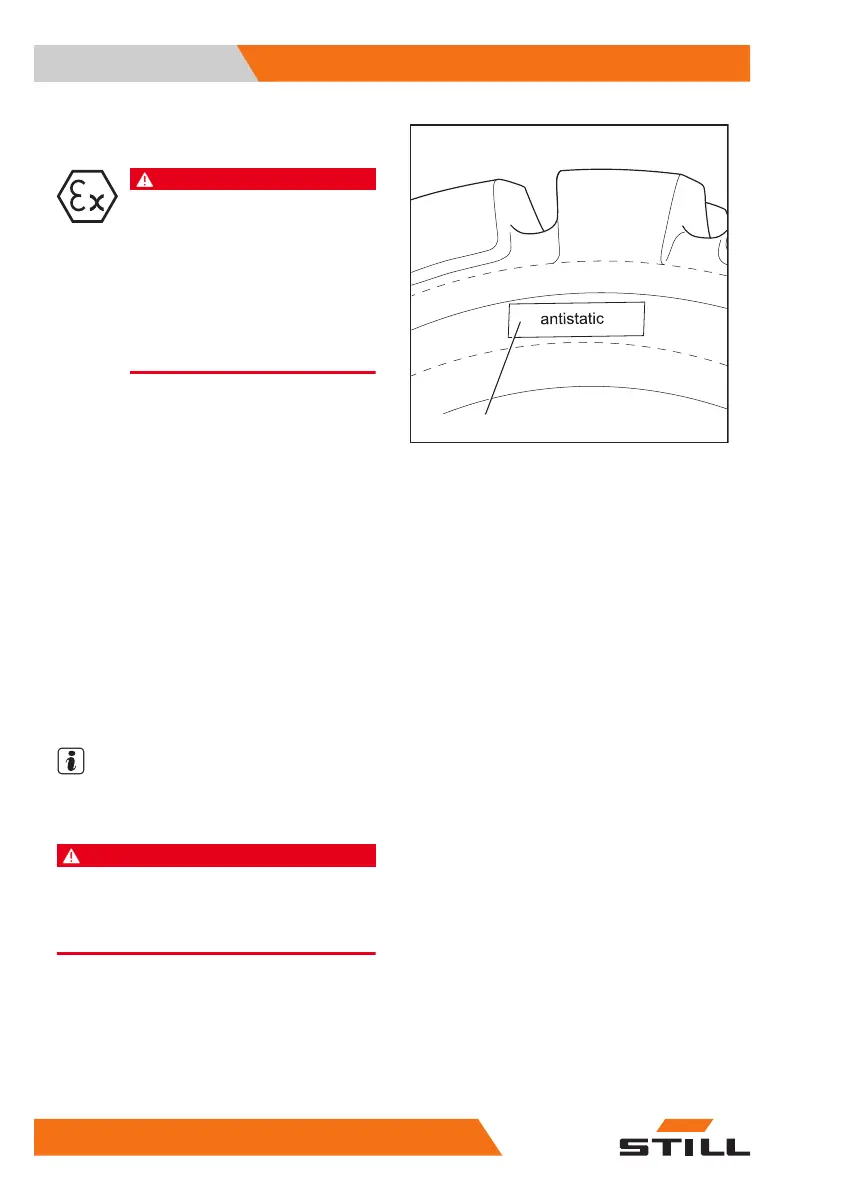
– Ensure that they are correctly labelled
(1).
If "non-marking" tyres (non-marking, light-col-
oured) are used, antistatic belts must be at-
tached beneath the truck. These antistatic
belts have an electrically conductive connec-
tion to the chassis and the other end drags
along the floor. In addition, a corona electrode
with leak resistance must be fitted.
Non-marking tyres are identified by the safety
information.
– Observe the explosion-protection regula-
tions.
– Ensure that permissible tyres are used.
– Check the presence and condition of the
antistatic belts/corona electrode.
– If in doubt, speak to the safety officer.
NOTE
Electrically conductive tyres are required on
both axles!
DANGER
Risk to stability!
Failure to observe the following information and in-
structions can lead to a loss of stability. The truck
may tip over. Risk of accident!
The following factors can lead to a loss of sta-
bility:
●
Different tyres on the same axle, e.g. pneu-
matic tyres and superelastic tyres
●
Tyres not approved by the manufacturer
●
Excessive tyre wear
●
Tyres of inferior quality
1
5063_901-033
Safety
2
Basic principles for safe operation
48 56368011531 EN - 01/2021 - 05


 To Next Page