
 Need help?
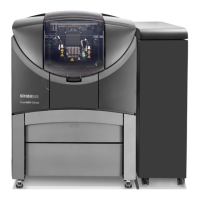
Do you have a question about the Stratasys Objet260 Connex and is the answer not in the manual?
Instructions for using the guide.
Information on how to get more details and support.
Definitions of terms used throughout the guide.
Details of the safety features integrated into the printer.
Explanation of warning symbols and labels on the printer.
General safety guidelines for printer installation and operation.
First aid instructions for contact with printing materials.
Guidelines for disposing of printer waste materials safely.
Introduction to Connex technology and its benefits for 3D printing.
Information on model and support materials used by the printer.
General safety precautions for handling printing materials before curing.
Steps for converting CAD files to supported formats.
Overview of the Objet Studio software and its functions.
Step-by-step guide for installing the Objet Studio software.
Instructions for uninstalling the Objet Studio software correctly.
Steps to launch the Objet Studio application.
Explanation of the User Account Control warning.
Overview of the main screens and components of the Objet Studio interface.
Details of commands available in the Tray Settings and Model Settings ribbons.
Description of the application's main command menu.
Explanation of the Model Tree pane and its functions.
Basic steps for preparing models for printing.
Explanation of the OBJDF file format and its uses.
How to open and place model files into Objet Studio.
Detailed steps for placing objects onto the build tray.
How to open and use previously saved tray files.
Using the Model Toolbar and context menus for quick access to commands.
Methods for duplicating objects within Objet Studio.
How to select objects on the build tray or in the model tree.
Converting complex objects into separate parts or shells.
Configuring material assignments for objects.
How to change the assigned material for an object.
Information on creating and using digital materials from combinations.
Process of assigning specific materials to objects.
Setting matte or glossy surface finishes for models.
Applying a surface layer of a different material.
Assigning properties to objects that are temporarily hidden.
Techniques for placing objects optimally on the build tray.
Using automatic orientation for efficient model building.
Arranging objects on the build tray for optimal printing.
Manually adjusting object positions on the build tray.
Factors affecting model orientation for efficient printing.
Tools and techniques for moving and transforming objects.
How to position objects directly on the build tray.
Ensuring models do not overlap or extend beyond the tray.
Utilizing a grid for precise object positioning.
Setting units (mm or inches) for object dimensions.
Adjusting object dimensions using the Dimensions group.
Manually moving and rotating objects on the build tray.
Methods for rotating and aligning object planes.
Manipulating multiple objects as a single unit.
Preventing automatic orientation changes for objects.
Changing how objects are displayed on the build tray.
Options for displaying objects in shaded, wireframe, or bounding box views.
Adjusting the layout of the build tray and model tree views.
Changing the viewing perspective of the build tray.
Customizing display colors for materials and coatings.
Optimizing the display of very large STL files.
Speeding up display and manipulation using polygon reduction.
Adjusting zoom levels for viewing objects.
Procedures after placing objects on the build tray.
Checking if the tray is valid for printing.
Calculating time and material resources for printing.
Understanding High Quality, High Speed, and Digital Material modes.
Sending OBJDF files via email.
Sending the prepared tray file to the printer.
Advanced features for model preparation.
Splitting large objects into smaller parts.
Adjusting the strength of the support material structure.
Printing objects with an outer shell and a hollow support center.
Viewing the interior of an object by slicing it.
Capturing the screen display as a graphic file.
Saving and loading tray configurations as compressed files.
Personalizing the Objet Studio interface and settings.
Adding frequently used commands to a custom toolbar.
Options for hiding or showing the ribbon interface.
Customizing screen colors and object display colors.
Selecting background color themes for the application.
Defining custom shortcut keys for commands.
Changing default settings affecting objects on the build tray.
Accessing advanced features available in Professional Mode.
Controlling default settings for Objet Studio features.
Modifying the default automatic orientation behavior.
Configuring automatic zooming for inspecting objects.
Checking and configuring OpenGL driver settings for 3D graphics.
Accessing help and support resources for Objet Studio.
Viewing details about the installed software and license.
Using the Job Manager screen to monitor and control print jobs.
Step-by-step guide to powering on and starting the printer.
Procedures for loading material containers into the printer.
Procedures for resuming interrupted print jobs.
Steps to replace printing material containers.
Proper procedures for shutting down the printer.
Recommended schedule for routine printer maintenance.
Procedure for cleaning critical printer components.
Checking and adjusting the alignment of the print heads.
Calibrating print heads for optimum performance.
Step-by-step guide for replacing print heads.
Testing and calibrating UV lamp intensity.
Step-by-step guide for replacing UV lamps.
Overview of the printer's built-in diagnostic tests.
Procedures for replacing waste containers.
Steps to safely remove printed models from the build tray.
Methods for removing excess support material.
Proper storage conditions to prevent model deformation.
 General
| Brand | Stratasys |
|---|---|
| Model | Objet260 Connex |
| Category | 3D Printers |
| Language | English |


 To Next Page