Chapter 5 - Working With Scan Modes Using Spectral Doppler Image Controls
Terason t3000 / Echo Ultrasound System User Guide 111
The increment value for each click depends on the current range, as defined in the
following table. For example, if the PRF setting is 4000, each time you click the right or
left arrow, the Terason software adds or subtracts 500 Hz from that value, until the
selected value falls into a lower or higher range
Increasing the PRF also increases the Thermal Index (TI) value (refer to General
Description of Indices on page 268 for more information about thermal indices).
Adjusting the Wall Filter
Doppler systems use a wall filter (high pass frequency filter) to eliminate unwanted low-
frequency high-intensity signals (known as clutter) from the display. Clutter can be caused
by tissue motion or by rapid movement of the transducer.
Increasing the wall filter setting reduces the display of low velocity tissue motion.
Decreasing the wall filter setting displays more information, but more wall tissue motion.
Use a wall filter setting that is high enough to remove clutter but low enough to display
information near the baseline.
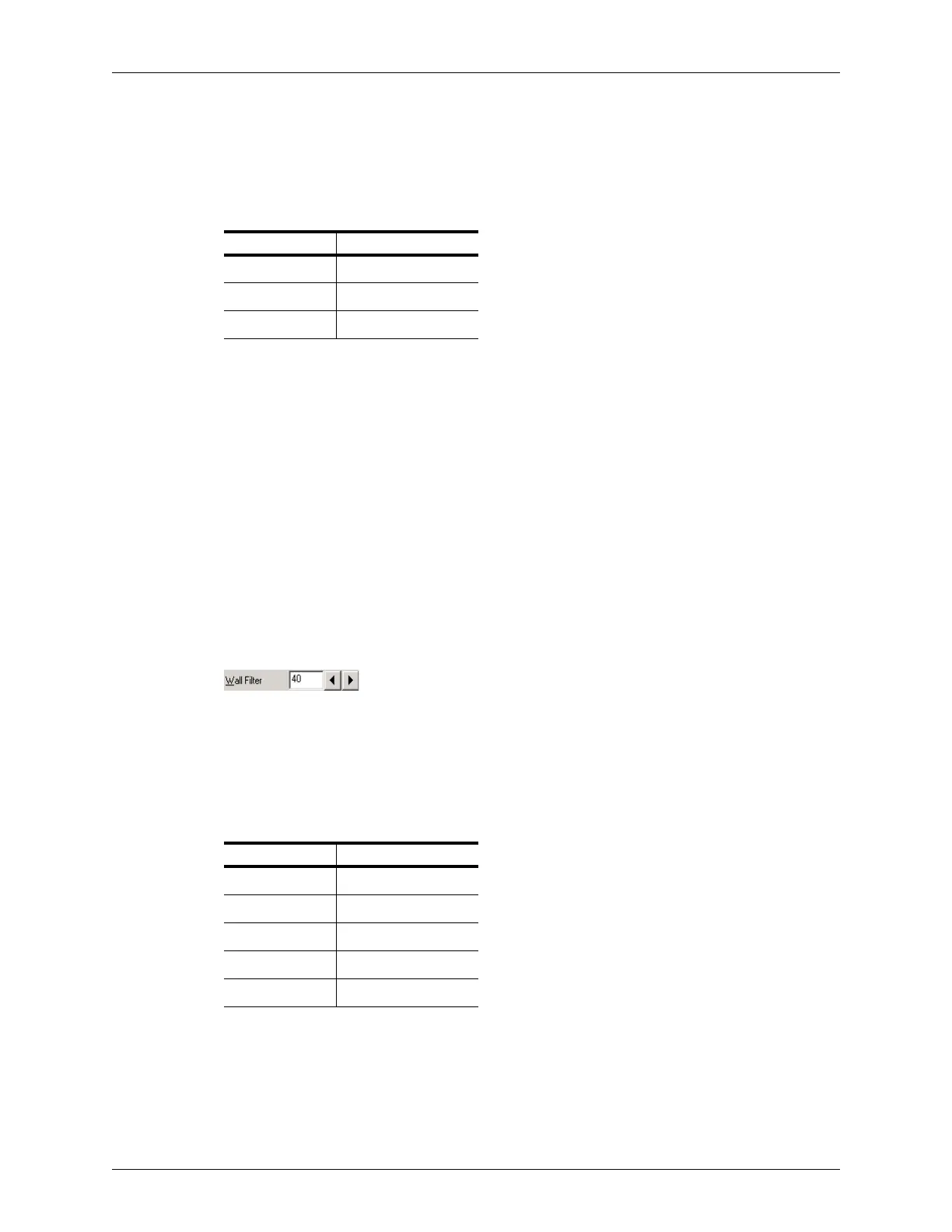
To adjust the wall filter value, click the right or left arrows next to the wall filter field.
Wall Filter Control
The wall filter range is from 1% to 25% of the PRF. The increment value for each click
depends on the current range, as defined in the table below. For example, if the wall filter
setting is 40, each time you click the right or left arrow, the Terason software adds or
subtracts 10 Hz from that value, until the selected value falls into a lower or higher range.
PRF Ranges
Range (Hz) Increment (Hz)
200-1000 100
1000-5000 500
5000-up 1000
Wall Filter Ranges
Range (Hz) Increment (Hz)
2-10 2
10-50 10
50-100 25
100-300 50
300-up 100


 To Next Page