3.5 Operation Procedure (Measurement/Measurement2)
50
3.5.2 Step 4. Measuring RF Characteristics of DUT
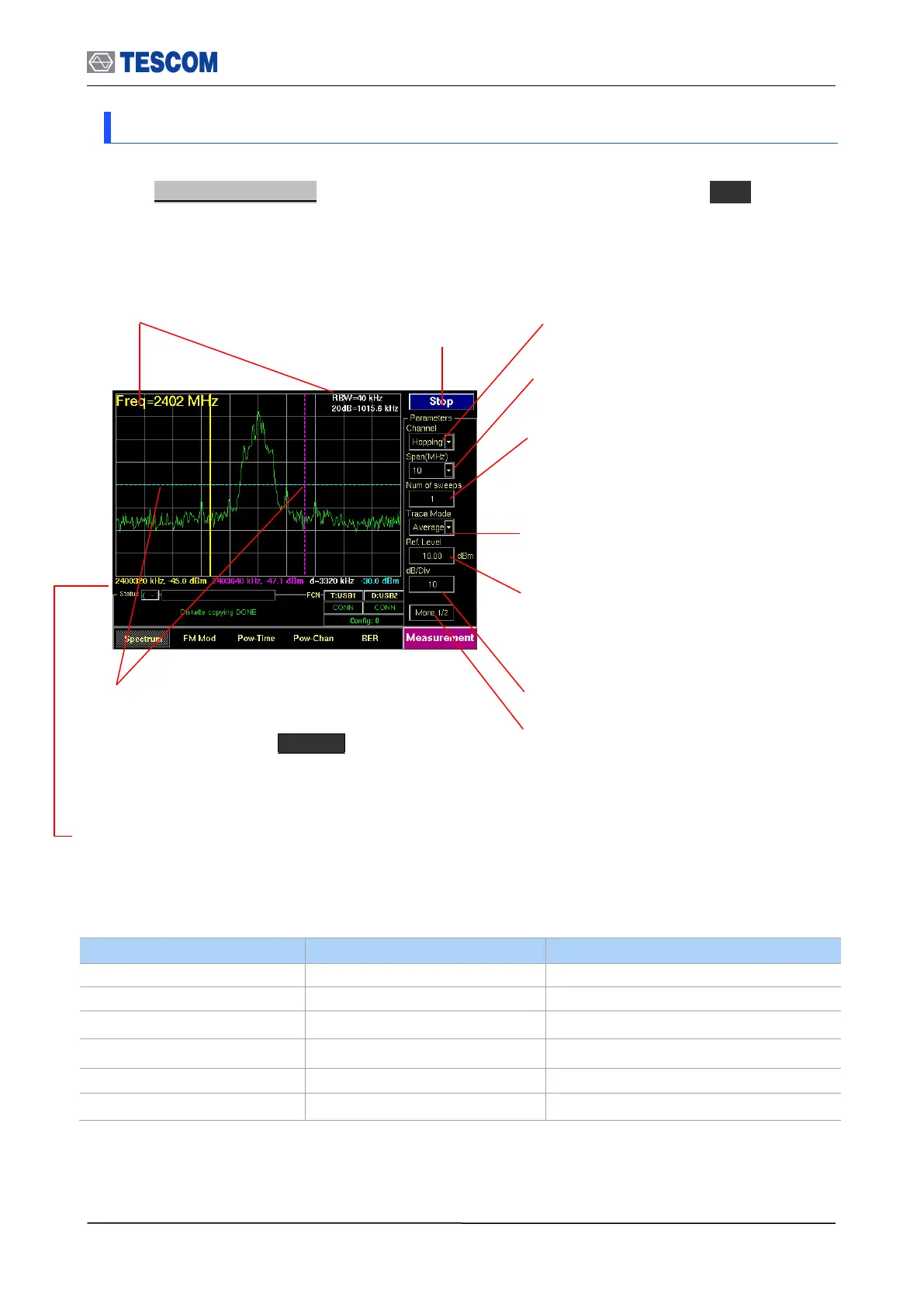
1. Spectrum Analyzer: To access the spectrum analyzer screen, press M1 soft key.
This screen shows the spectrum of a channel in single channel or hopping mode.
-80 + Path Loss ~ 40 + Path Loss
Center Frequency
Resolution Band Width
20dB Band Width
Start/Stop: When this menu is
pressed the tests will run once.
When the menu is pressed again
while the tests are running, the tests
will stop.
Channel: Selects the carrier frequency
channel, one of 79 channels or Hopping
mode. (Channel 0-78 : 2.402 – 2.480 GHz)
Span: Selects full screen frequency
span width.
Num of sweep: Specifies the number of times
that the analyzer sweeps the displayed
frequency span. This value directly affects
how long it takes to complete a measurement.
Trace Mode: Selects tracing mode, Average
or Maximum hold.
Line Markers: You can place line-shaped markers on the
screen to find the signal’s frequency and amplitude. To
activate a maker, press the Marker key in sequence.
An activated marker changes to a solid line. Turn the
knob to place the marker at the signal.
Readouts of markers amplitude and frequency: The
marker readouts have the same color as the marker
respectively. “d” displays a frequency difference between
yellow and red marker.
Ref. Level: Specifies the amplitude reference
level. The top line of the display is the
reference level. All signals displayed are
reference to this line.
dB/div: Sets the vertical amplitude per division
Test mode: Configures Bluetooth Test Mode
connection with the DUT



 To Next Page